填空题 公共英语四级
题号 #2750990

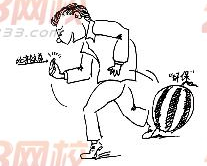
Study the following cartoon carefully and write an essay on it. In your essay, you should
(1) describe the cartoon briefly,
(2) analyze this situation, and
(3) give your comments.
You should write 160 - 200 words neatly on ANSWER SHEET 2.
进入在线模考

参考答案

暂无

答案解析

Penny-wise and Pound-foofish
From the cartoon we can see that the man is concentrating on the tiny sesame in his hand, which represents the economic benefits, while throwing away the watermelon symbolizing the environmental protection.
Just like the man in the cartoon, many decision makers tend to misplace the priorities by putting the pursuit of economic benefits to the first place and ignoring the environmental protection. This kind of behavior is short-sighted. As far as I am concerned, the economic benefits should be based on the environmental protection.
In the first place, we should understand that environmental pollution may cause some serious problems, such as contaminated drinking water, flood and biodiversity destruction, etc. These problems require large sums of money to deal with. Second, we should bear in mind that natural resources are limited. If we continue to consume the limited natural resources just to develop the economy without paying attention to the environmental protection, we will suffer the disasters caused by ourselves.
In a word, we should be visionary, obtaining maximum economic results at minimum costs by protecting the environment and maintaining the sustainable development of economy.
【写作点金】
本题属于结合提纲式和图画作文两种特点的写作题,此类文章的关键在于领悟图画的深层含义,并将其与社会现实结合起来,进行言之有物的分析和评述。近年来,这一级别的写作题一直偏爱反映社会问题的图画作文,考生一般可结合现实和自己对该问题的认识,提出切实可行的解决办法。
【高频词句】
1.economic benefits经济效益
2.environmental protection环境保护
3.short-sighted adj.没有远见的
4.visionary adj.有远见的
5.penny-wise and pound-foolish捡了芝麻丢了西瓜
6.We should bear in mind that…我们应该牢记…

你可能感兴趣的试题

1 根据材料,回答下列问题。
Ecological economics recognizes that humans and their economies are parts of larger natural ecosystems and co-evolve with those natural systems.61 ) There is a material and energy basis for the relations between human economies and their ecosystems, defining not only economic, but social, structures and processes.Economies possess general ecosystem properties, such as dynamism, evolution, integrity, stability and sustenance.Economies are embedded in larger natural ecosystems, and exchange flows of materials and energy with natural systems.
62) What makes humans and their economies unique as a sub-ecosystem is their ability,through willful effort, ignorance and human designed tools, to dramatically restructure and reform processes in ecosystems of which they are a part.The ability is to such a magnitude that human welfare can be diminished or enhanced by those original actions.Some types of economic activities, and the welfare that originates from them, would not be sustainable if they substantially adversely impact natural systems.
63)The willful effort to extract useful things from natural systems is motivated by the satisfaction of basic biological needs and the seemingly limitless search for pleasure through consumption of goods and through social associations.The magnitude of potential impact on their own welfare through effects on natural systems requires that human decisions be guided by some notion of the value of their actions and the value of their impacts on ecosystems, either in terms of benefits of use or costs of abuse.Some concept of value is required for rational activities of human economies within their natural systems.
Both the structures and processes of natural systems have identifiable instrumental value to the human economy.These narrow use values may be reflected by the summation of individual values, to the extent they are private.However, natural systems also have aesthetic, moral and cultural values.These values are more intrinsic and unmeasurable using traditional human preferences.
64) Valuation is made more complicated by the fact that our natural environment is highly likely to shape values through establishing social and economic relations, aesthetic standards and culture.If so, our decisions now about the natural environment will shape future value systems,
making values endogenous and, therefore, a poor guide to behavior.65) A way out of this dilemma is to make valuations of natural systems based on "What we would like to see society become," rather than to ask what current valuations are.The value of natural systems is then based on their ability to assist us in becoming what we wish to be.
________
找试题 · 找答案 · 找资料 在线模考