简答题 英语六级
题号 #2921581

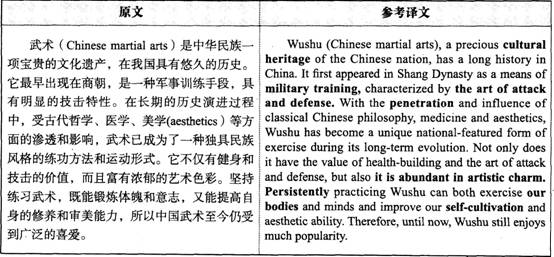
武术(Chinese martial arts) 是中华民族一项宝贵的文化遗产,在我国具有悠久的历史。它最早出现在商朝,是一种军事训练手段,具有明显的技击特性。在长期的历史演进过程中,受古代哲学、医学、美学(aesthetics) 等方面的渗透和影响,武术已成为了一种独具民族风格的练功方法和运动形式。它不仅有健身和技击的价值,而且富有浓郁的艺术色彩。坚持练习武术,既能锻炼体魄和意志,又能提高自身的修养和审美能力,所以中国武术至今仍受到广泛的喜爱。

进入在线模考

参考答案

暂无

答案解析


难点注释
1.第一句有两个小分句,翻译时把“是中华民族一项宝贵的文化遗产”处理为Wushu的同位语,把“在我国具有悠久的历史”放在译文主句谓语部分,使得与第二句更衔接;另外“武术”采用音译加注,即Wushu(Chinese martial arts)。
2.第二句中“具有明显的技击特性”这一小句,考生可翻译为主语补足语,放在译文句末,即characterized by the art of attack and defense。
3.第三句是一长句,把“在长期的历史演进过程中”和“受古代哲学、医学、美学等方面的渗透和影响”分别译为两个状语,放在译文句子主干两边;同时,翻译时考生应调整语序以符合英语的表达习惯,即With the penetration and influence of classical Chinese philosophy, medicine and aesthetics.Wushu has become a unique national—featured form of exercise during its lon9—term evolution。
4.第四句直译即可,采用not only…but also句型,考生应注意not only部分要部分倒装。
5.第五句是一长句,可拆译为两个句子,把“所以中国武术至今仍受到广泛的喜爱”单独译为一句;对于“坚持练习武术,既能锻炼体魄和意志,又能提高自身的修养和审美能力”,考生可用动名词短语做主语,将“既……又……”译为both…and;整句译文即为Persistently practicing Wushu can both exercise our bodies and minds and improve Our self-cultivation and aesthetic ability.Therefore,until now, Wushu still enjoys much popularity。

你可能感兴趣的试题

1 Questionsare based on the following passage
Knowing that you are paid less than your peers has two effects on happiness. The well-known one is negative: a thinner pay packet harms self-esteem. The lesser-known one is called the "tunnel" effect: high incomes for peers are seen as improving your own chances of similar riches, especially if growth, inequality and mobility are high.
A paper co-anthored by Felix FitzRoy of the University of St. Andrews and recently presented at the Royal Economic. Society in Cambridge separates the two effects using data from household surveys in Germany. Previous work showed that the income of others can have a small, or even positive, overall effect on people's satisfaction in individual firms in Denmark or in very dynamic economies in transition, such as eastern Europe. But Mr. FitzRoy's team theorized that older workers, who largely know their lifetime incomes already, will enjoy a much smaller tunnel effect.
The data confirm this hypothesis. The negative effect on reported levels of happiness of being paid less than your peers is not visible for people aged under 45. In western Germany, seeing peers' incomes rising actually makes young people happier (even more than a rise in their own incomes, remarkably) . It is only those people over 45, when careers have "reached a stable position", whose happiness is harmed by the success of others.
The prospect of 20-plus years of bitterness might make retirement seem more appealing. But the real gains in happiness from retirement go not to the outshone (被超越) , but to the out-of-work. Unemployment is known to damage happiness because not working falls short of social expectations. This loss of identity cannot be compensated for by unemployment benefits or increased leisure time. A paper presented at the same conference by a team represented by Clemens Hetschko of the Free University of Berlin uses the same German household data to show that the spirits of the long-term unemployed rise when they stop looking for work, go into retirement and no longer clash with social norms.
Those with jobs are no happier after they retire, however, perhaps because their lives already line up with social expectations. Indeed, retiring early from work can have nasty side-effects. Another paper, co-authored by Andreas Kuhn of the University of Zurich, investigates the effect of a change in Austrian employment-insurance roles that allowed blue-collar workers earlier retirement in some regions than others.    Men retiring a year early lower their chances of surviving to age 67 by 13%. Almost a third of this higher mortality rate,
which seemed to be concentrated among those who were forced into retirement by job loss, was caused by smoking and alcohol consumption. If you're in a job, even an underpaid one, hang on in there.

What did the study conducted by Mr. FitzRoy's team reveal?
A.The findings of previous work may be problematic.
B.The two effects of peers' incomes on happiness cannot be separated.
C.Older workers are not affected by the income of others.
D.Older workers have already known their lifetime incomes.
A.Their self-esteem is severely harmed. 
B.Their spirits will be lowered.
C.They enjoy a bigger tunnel effect than People over 45.
D.They prefer a rise in their own incomes.
A.High inequality and mobility. 
B.One's career stage.
C.Social expectations. 
D.One's age.
找试题 · 找答案 · 找资料 在线模考