根据材料,回答问题。
【教学材料】
Topic:Do You Like Bananas.9 Listen again.Fill in the blanks.再听一遍录音并填空。
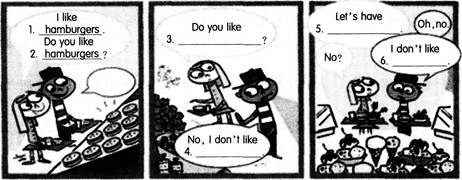
Answers (1. hamburgers, 2. hamburgers, 3. broccoli, 4. broccoli, 5. ice cream, 6. ice cream)
【微型教学实录简况】
(T: teacher, Ss: students, Bb: blackboard)
Step 1 (The teacher had a volleyball in hand. T asked Ss questions quickly and wrote down the names of Ss and sports things on the Bb.)( 12 mins.)
T: I don't have a basketball. I have a volleyball. Tom, do you have a tennis racket?
Tom: Yes, ! do.
T: Jim, what sports things do you have?
Jim: I have a ping-pong ball.
T: Li Lei, do you have a soccer ball?
Li Lei: No, I don't.
T: I have a TV. What other things do you have? (T drew a picture of TV.)
Ss: Ping-pong bat, computer, chair, book, CD, alarm clock, key, pencil case ...
T: Well done !
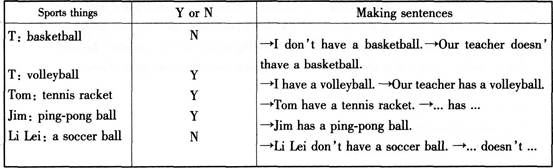
(T asked Ss to make sentences according to the information on the Bb.)
T: Now, let’s look at the blackboard and make sentences. I say "I don't have a basketball"and you say “Our teacher doesn't have a basketball". I say "I have a volleyball", and you say"Our teacher has a volleyball". Li Xing, making the third sentence ... (T wrote sentences on theSb.)
Li Xing: Tom have a tennis racket.
T: Is it correct? No, we should say it like this “Tom has a tennis racket”. We don't put“have” after "He, She, Tom, Lucy". We should say "He has She has Tom has Lucy has ...”. (T wrote the wrong sentence of Ss on the Bb and corrected it.)
T: Next one, Li Lei, please.
Li Lei: Jim has a ping-pong ball.
T: Yes.(T wrote it on the Bb.)Next one, Zhang Hong, please.
Zhang Hong: Li Lei don't have a soccer bail.
T: No, no, no. Wrong again. What is the correct answer? The whole class.
Ss: Li Lei doesn't have a soccer ball.
T: Yes.(T wrote the correct answer on the Bb.)
Step 2 T began to teach the new section : “Do you like bananas? 2b Listen again. Fill in the blanks.” ...
Step 3 ...
Step 4 ...
案例分析(满分15分)
(1)请分析学生课堂回答错误的主要原因。(2分)
(2)针对学生在该课堂中回答错误的情况,教师应如何进行课堂学习评价和引导?(7分)
(3)请依据新课程理念,对该教师教学过程的优缺点进行分析。(6分)
参考答案
答案解析
②与汉语不同,英语谓语动词需要随着时态、人称和数的变化而变化。
(2)①在课堂教学过程中,特别是在提问的过程中,很多学生都缺乏自信,羞于开口说英语。针对学生回答错误的情况,教师应当以鼓励性评价为主,采用多种方法适时地纠错。
通过表情、手势、语调等对学生的答案进行评价是教师课堂最常见的评价形式之一。学生回答问题时谓语动词使用错误,教师最好不要马上否认学生,试着多次重复,并放慢语速,或者摆摆手,摇摇头等,启发学生自己发现错误并改正,并且在此过程中不失时机地给予学生积极强化,这样学生会记得更牢,自信心也不会受打击。
②为了有效地纠正学生在英语课堂上出现的语言错误,就必须明确错误产生的原因,这样才能“对症下药”,进而进行有效的引导。
案例中回答错误的学生主要是由于受母语的干扰,对于新的语言规则掌握不完整。教师应该在纠正错误的基础上,指导学生进行有效地学习策略,例如归纳学习、演绎学习、情境学习、认知强化练习等,从而达到“药到病除”的效果。
(3)优点:①准确把握教材,教学步骤环环相扣,以旧引新。
②教学过程围绕话题体现交际,注重从知识学习到知识运用。
缺点:①学生参与面不广。活动形式单一。
②没有讲究纠错策略。
③教师缺乏课堂学习形成性评价。
④复习时间过长。