请根据以下教学内容设计一个课时的教案。
要求:设计要体现新课程标准的基本理念;遵循语言教学的规律,符合教学对象的认知特点和心理特征;结构完整,条理清晰。(中英文均可)
Students: Grade 2, senior high school
Material:人教版高中英语必修Unit 3 Reading
A Master of Nonverbal Humour
As Victor Hugo once said, "Laughter is the sun that drives winter from the human face", and up to now nobody has been able to do this better than Charlie Chaplin. He brightened the lives of Americans and British through two world wars and the hard years in between. He made people laugh at a time when they felt depressed, so they could feel more content with their lives.
Not that Charlie's own life was easy! He was born in a poor family in 1889. His parents were both poor music hall performers. You may find it astonishing that Charlie was taught to sing as soon as he could speak and dance as soon as he could walk. Such training was common in acting families at this time, especially when the family income was often uncertain. Unfortunately his lather died, leaving the family even worse off, so Charlie spent his childhood looking after his sick mother and his brother. By his teens, Charlie had, through his humour, become one of the most
popular child actors in England. He could mime and act the fool doing ordinary everyday tasks. No one was ever bored watching him--his subtle acting made everything entertaining.
As time went by, he began making films. He grew more and more popular as his charming character, the little tramp, became known throughout the world. The tramp, a poor, homeless man with a moustache, wore large trousers, worn-out shoes and a small round black hat. He walked around stiffly carrying a walking stick. This character was a social failure but was loved for his optimism and determination to overcome all difficulties. He was the underdog who was kind even when others were unkind to him.
How did the little tramp make a sad situation entertaining? Here is an example from one of his most famous films, The Gold Rush. It is the end of the nineteenth century and gold has just been discovered in Alaska. Like so many others, the little tramp has rushed there in search of gold, but without success. Instead he and another man are hiding in a small hut during a snowstorm with nothing to eat. They are so hungry, that the little tries boiling one of his leather shoes for dinner. Charlie cuts off the leather top of the shoe and shares the shoe with the other fellow. He tries cutting and chewing the bottom of the shoe as if it were the finest steak. Then he picks out the lace of the shoe and eats it as if it were spaghetti. He eats each mouthful with great enjoyment. The acting is so convincing that it makes you believe that it is one of the best meals he has ever tasted.
Charlie Chaplin wrote, directed and produced the films he starred in. In 1972 he was given a special Oscar for his outstanding work in films. He lived in England and the USA but spent his last years in Switzerland, where he was buried in 1977. He is loved and remembered as a great actor who could inspire people with great confidence.
1.确定这节课的具体教学目标。
2.确定这节课的教学重点和难点。
3.设计这节课的教学过程,并写出各教学步骤的具体做法和主要内容。
参考答案
答案解析
1. Teaching Objectives:
(1) Knowledge objectives :
Students can listen, read, and then imitate the jokes.
(2) Ability objectives:
a. Students can develop their reading ability.
b. Students can talk about some types of English humour and Chinese humour and then find their differences.
(3) Emotional objective:
Students can realize that humour is to let people be optimistic about everything around.
2. Teaching Important Points:
Help the students learn how to understand and enjoy English humors.
Teaching Difficult Points:
Help the students know the differences between English and Chinese in humours.
3. Teaching Procedures:
Step 1 Warming-up
Warm up by defining "Humour".
What is "Humour"? Does any one of you know anything about Humour? Look at the screen
and read the defi-nition of Humour from the lnternet.
Whose job?
This is the story about four people named Everybody, Somebody, Anybody and Nobody. There was an important job to be done, and Everybody was sure that Somebody would do it. Anybody could have done it, but Nobody did it.Somebody got angry about that because it was Everybody's job. Everybody thought Anybody could do it, but Nobody
realized that Everybody wouldn't do it. It ended up that Everybody blamed Somebody When Nobody did what Anybody could have done.
Step 2 Pro-reading
Telling the truth--what do you like to laugh at?
I like to laugh at cartoons, for they're lovely and fun.
I hke to laugh at fairy tales. They are amusing and interesting.
Many years ago there hved an Emperor who was so exceedingly fond of fine new clothes that he spent vast sums of money on dress. To him clothes meant more than anything else in the world. He took no interest in his army, nor did he care to go to the theatre, or to drive about in his state coach, unless it was to display his new clothes. He had different robes for every single hour of the day.
Step 3 Reading
(1) Reading aloud to the recording
Now please listen and read aloud to the recording of the text. Pay attention to the pronunciation of each word and the pauses. You shall read aloud twice.
I will play the NONVERBAL HUMOUR.
(2) Reading and underlining
Next you are to read and underline all the useful expressions or collocations in the passage.
Copy them to your notebook after class as homework.
(3) Reading to identify the topic sentence of each paragraph
Skimming the text and identify the topic sentence of each paragraph. You may find it either at the beginning, inthe middle or at the end of the paragraph.
(4) Reading and transferring information
Read the text again to complete the table.
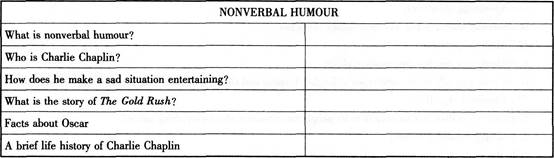
(5) Reading and understanding difficult sentences
As you have read the text times, you can surely tell which sentences are difficult to understand.
Now put your questions concerning the difficult points to the teacher.
Step 4 Closing down
(1) Closing down by doing exercises
To end the lesson you are to do the comprehending exercises No. 1 and 2.
Close down by watching a silent movie by Charlie Chaplin.
Do you like watching movies? Do you like humourous movies?Now let's watch a silent humourous movie by Charlie Chaplin. It's Charlie Chaphn's first film: Making a Living.
(2) Close down by reading about Charlie Chaplin
To end the period we shall read an article about Charlie Chaplin. Now look at the screen and read it aloud with me.