单选题
英语四级
题号 #3221422
Questions are based on the following passage.
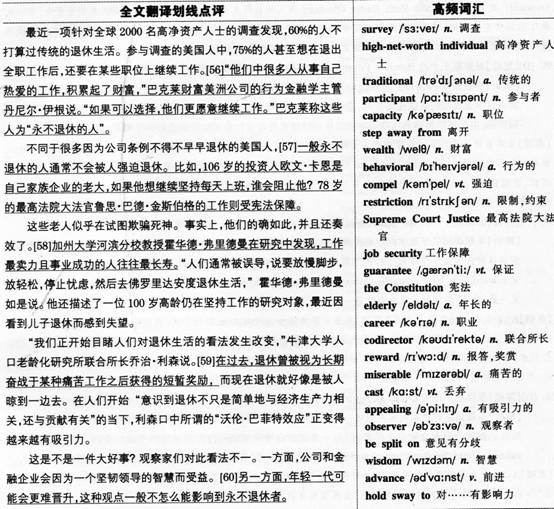
A recent global survey of 2,000 high-net-worth individuals found that 60% were not planning on a traditional retirement.Among U.S.participants, 75% expected to continue working in some capacity even after stepping away from full-time jobs."Many of these people made their wealth by doing something they're passionate (有激情的) about," says Daniel Egan, head of behavioral finance for Barclays Wealth
Americas."Given the choice, they prefer to continue working." Barclays calls these people "nevertirees."
Unlike many Americans compelled into early retirement by company restrictions, the averagenevertiree often has no one forcing his hand.If 106-year-old investor Irving Kahn, head of his own family firm, wants to keep coming to work every day, who's going to stop him? Seventy-eight-year-old Supreme Court Justice Ruth Bader Ginsburg's job security is guaranteed in the Constitution.
It may seem that these elderly people are trying to cheat death.In fact, they are.And it's working.Howard Friedman, a professor at UC Riverside, found in his research that those who work hardest and are successful in their careers often live the longest lives."People are generally being given bad advice to slow down, take it easy, stop worrying, and retire to Florida," he says.He described one study participant, Still working at the age of 100, who was recently disappointed to see his son retire.
"We're beginning to see a change in how people view retirement," says George Leeson, codirector of the Institute of Population Ageing at Oxford.Where once retirement was seen as a brief reward after a long straggle through some miserable job, it is now akin (近似) to being cast aside.What Leeson terms "the Warren Buffett effect" is becoming more broadly appealing as individuals come to "view retirement as not simply being linked to economic productivity but also about contribution:"
Observers are split on whether this is a wholly good thing.On the one hand, companies and financial firms can benefit from the wisdom of a resilient (坚韧的) chief.On the other, the new generation can find it more difficult to advance--an argument that typically holds little sway to a nevertiree.
What do we learn about the so-called "nevertirees"?
参考答案
C
答案解析
【定位】根据题干中的nevertirees定位至第l段最后l句。
【解析】本题询问对永不退休一族的理解。本段开头处一份全球调查结果表明60%的富人选择非传统的退休方式.且从Daniel Egan的话“他们很热爱自己的工作”以及“如果可以选择,他们宁愿继续工作”可得出,永不退休一族非常热爱自己的工作,并且选择继续工作而不退休。C中的love和choose not to retire分别对
应原文中的passionate about和prefer to continue workin9,故C为答案。
【点睛】A中虽然有文章原词are passionate about,但原文表达的是nevertirees对工作有激情,而非A所说的“他们热衷于赚钱”:首段提到的nevertirees都是资产丰厚一族,B“他们没有选择只能继续工作”与原文不符;原文第
2段Irving Kahn的例子说明没人可以强迫这些永不退休者退休,故D“除非被强制退休,否则他们选择不退休”也不对。
【解析】本题询问对永不退休一族的理解。本段开头处一份全球调查结果表明60%的富人选择非传统的退休方式.且从Daniel Egan的话“他们很热爱自己的工作”以及“如果可以选择,他们宁愿继续工作”可得出,永不退休一族非常热爱自己的工作,并且选择继续工作而不退休。C中的love和choose not to retire分别对
应原文中的passionate about和prefer to continue workin9,故C为答案。
【点睛】A中虽然有文章原词are passionate about,但原文表达的是nevertirees对工作有激情,而非A所说的“他们热衷于赚钱”:首段提到的nevertirees都是资产丰厚一族,B“他们没有选择只能继续工作”与原文不符;原文第
2段Irving Kahn的例子说明没人可以强迫这些永不退休者退休,故D“除非被强制退休,否则他们选择不退休”也不对。
你可能感兴趣的试题
A.Neither of them is subject to forced retirement.
B.Neither of them desires reward for their work.
C.Both cling to their positions despite opposition.
D.Both are capable of coping with heavy workloads.
A.The harder you work, the bigger your fortune will be.
B.The earlier you retire, the healthier you will be.
C.Elderly people have to slow down to live longer.
D.Working at an advanced age lengthens people's life.
A.It means a burden to the younger generation.
B.It is a symbol of a mature and civilized society.
C.It is a compensation for one's life-long hard work.
D.It helps increase a nation's economic productivity.