单选题
英语四级
题号 #3222872
Questions are based on the following passage.
The Gatais used to frown when they received power bills that routinely topped $200.Last Septemberthe couple moved into a 1,500-square-foot home in Premier Gardens, a subdivision of 95 "zero-energyhomes" (ZEH) just outside town.Now they're actually eager to see their electricity bills.The grand totalover the 10 months they've lived in the three-bedroom house: $75.For the past two months they haven'tpaid a cent.
ZEH communities are the leading edge of technologies that might someday create houses thatproduce as much energy as they consun~e.Premier Gardens is one of a haft-dozen subdivisions inCalifornia where every home cuts power consumption by 50%, mostly by using low-power appliances andsolar panels.
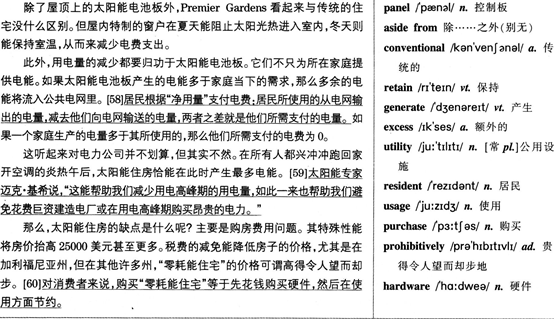
Aside from the panels on the roof, Premier Gardens looks like a community of conventional homes.But inside, special windows cut power bills by blocking solar heat in summer and retaining indoorwarmth in winter.
The rest of the energy savings comes from the solar units.They don't just feed the home theyserve.If they generate more power than the home is using, the excess flows into the utility's powergr/d (电网).The residents are billed by "net metering": they pay for the amount of power they tap offthe grid, less the kilowatts (千瓦) they feed into it.If a home generates more power than it uses, thebill is zero.,
That sounds like a bad deal for the power company, but it's not.Solar homes produce the mostpower on the hot sunny afternoous when everyone rushes home to turn up the air conditioner."It helpsus lower 'usage at peak power times," says solar expert Mike Keesee."That lets us avoid building costlyplants or buying expensive power at peak usage time."
What's not to like? Mostly the costs.The special features can add $25,000 or more to the purchaseprice of a house.Tax breaks bring the cost down, especially in California, but in many states ZEHs canbe prohibitively expensive.For the consumer, it's a matter of paying now for the hardware to save lateron the utilities.
he hardware to save lateron the utilities.
Why are the Gatais eager to see their electricity bills now?
参考答案
A
答案解析
【定位】根据题干中的the Gatais和eager to see…electricity bills定位到第l段。
【解析】本题问家泰夫妇为什么迫切地想看电费单。联系第l段前两句可知,家泰夫妇去年9月搬进了“零耗能住宅区”的Premier Gardens,而在此之前,他们电费单普遍高达200美元。而搬家后,l0个月加起来才70美元,据此判断,家泰夫妇是想确认,搬进“零耗能住宅”之后,能节省多少电费。A所述与此相符,故为答案。【点睛】B“他们想减少公共服务(如煤气、电力等)费用”,家泰夫妇搬进“零耗能住宅”无疑是想减少电费支出.但这应该是他们搬家的原因,而不是他们想看电费单的原因,且utility expenses范围太广,故排除;C“他们想知道付不付得起电费”,搬进“零耗能住宅”后l0个月加起来才要70美元,比之前大幅减少,因此不存在付不付得起的问题,C也排除;文中虽提到他们以前的电费高达200美元,但并不表示他们被多收了电费,D“他们想避免被多收电费”无原文支持。
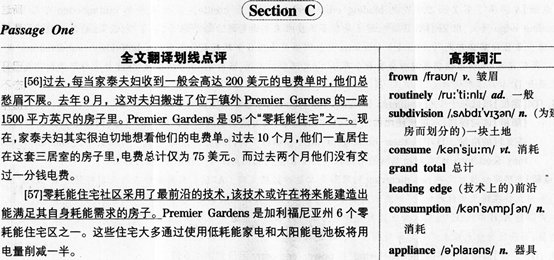
【解析】本题问家泰夫妇为什么迫切地想看电费单。联系第l段前两句可知,家泰夫妇去年9月搬进了“零耗能住宅区”的Premier Gardens,而在此之前,他们电费单普遍高达200美元。而搬家后,l0个月加起来才70美元,据此判断,家泰夫妇是想确认,搬进“零耗能住宅”之后,能节省多少电费。A所述与此相符,故为答案。【点睛】B“他们想减少公共服务(如煤气、电力等)费用”,家泰夫妇搬进“零耗能住宅”无疑是想减少电费支出.但这应该是他们搬家的原因,而不是他们想看电费单的原因,且utility expenses范围太广,故排除;C“他们想知道付不付得起电费”,搬进“零耗能住宅”后l0个月加起来才要70美元,比之前大幅减少,因此不存在付不付得起的问题,C也排除;文中虽提到他们以前的电费高达200美元,但并不表示他们被多收了电费,D“他们想避免被多收电费”无原文支持。
你可能感兴趣的试题
A.They have created cutting-edge technologies.
B.They aim to be self-sufficient in power supply.
C.They are subdivided into haft a dozen sections.
D.They are built in harmony with the environment.
A.They are only charged for the amount of power they consume on rainy days.
B.They needn't pay a single cent for their power consumption on sunny days.
C.They only pay for the excess power that flows into the utility's power grid.
D.They pay for the electricity from the grid less their home-generated power.
A.More pressure at peak time.
B.Less profits in the short term.
C.Increased electricity output.
D.Reduced operational costs.