单选题
英语四级
题号 #3223221
Questions are based on the following passage.
In 1950, a young man would have found it much easier than it is today to get and keep a job in the auto industry. And in that year the average autoworker could meet monthly mortgage (抵押贷款)payments on an average home with just 13.4 percent of his take-home pay. Today a similar mortgage would claim more than twice that share of his monthly earnings.
Other members of the autoworker's family, however, might be less inclined to trade the present for the past. His retired parents would certainly have had less economic security back then. Throughout much of the 1960s, more than a quarter of men and women age 65 and older lived below the poverty level, compared to less than 10 percent in 2010.
In most states, his wife could not have taken out a loan or a credit card in her own name. In 42 states, a homemaker had no legal claim on the earnings of her husband. And nowhere did a wife have legal protection against family violence.
Most black workers would not want to return to a time when, on average, they earned 40 percent less than their white counterparts (职位相对的人), while racially restrictive agreements largely prevented them from buying into the suburban neighborhoods being built for white working-class families.
Today, new problems have emerged in the process of resolving old ones, but the solution is not to go back to the past. Some people may long for an era when divorce was still hard to come by. The spread of no-fault divorce has reduced the bargaining power of whichever spouse is more interested in continuing the relationship. And the breakup of such marriages has caused pain for many families.
The growing diversity of family life comes with new possibilities as well as new challenges. Accord-ing to a recent poll, more than 80 percent of Americans believe that their current family is as close as the one in which they grew up, or closer. Finding ways to improve the lives of the remaining 20 percent seems more realistic than trying to restore an imaginary golden age.
What do we learn about American autoworkers in 1950?
参考答案
B
答案解析
[定位]根据题干中的autoworkers in 1950定位至第l段。
【解析】本题问1950年的美国汽车工人的情况。第l段第2句的in that year指代首句的1950年,该句提及“1950年普通的汽车工人只需要用税后工资的13.4%(just l3.4 percent)就可以应付每月的房贷”,而第3句讲到现在需用该比例的两倍多来支付房贷(more than twice that share)。这就暗示和现在相比,1950年的汽车工人买房子相对轻松,故B“他们买房子并不难”正确。
【点睛】A“他们的工作没有现在的工作稳定”与首句的much easier than it is today to…keepa job“比现在更容易……保住工作”相反。第1段最后一句提到了twice“两倍”,但该句说的是“现在他们的房贷占工资的比例是1950年的两倍”,对象是用于支付房贷的收入比例,而非earnings“总收入”,因此排除C“他们的工资是现在的两倍”。原文并未将汽车业工人与其他行业工人作对比,D“他们比其他行业的工人要富裕”属于无中生有。

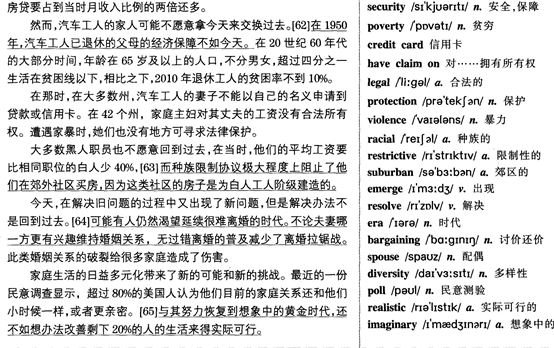
【解析】本题问1950年的美国汽车工人的情况。第l段第2句的in that year指代首句的1950年,该句提及“1950年普通的汽车工人只需要用税后工资的13.4%(just l3.4 percent)就可以应付每月的房贷”,而第3句讲到现在需用该比例的两倍多来支付房贷(more than twice that share)。这就暗示和现在相比,1950年的汽车工人买房子相对轻松,故B“他们买房子并不难”正确。
【点睛】A“他们的工作没有现在的工作稳定”与首句的much easier than it is today to…keepa job“比现在更容易……保住工作”相反。第1段最后一句提到了twice“两倍”,但该句说的是“现在他们的房贷占工资的比例是1950年的两倍”,对象是用于支付房贷的收入比例,而非earnings“总收入”,因此排除C“他们的工资是现在的两倍”。原文并未将汽车业工人与其他行业工人作对比,D“他们比其他行业的工人要富裕”属于无中生有。
你可能感兴趣的试题
A. They invariably long to return to the golden past.
B. They do not depend so much on social welfare.
C. They feel more secure economically than in the past.
D. They are usually unwilling to live with their children.
A. They lacked the means of transportation.
B. They were subjected to racial inequality.
C. They were afraid to break the law.
D. They were too poor to afford it.
A. Divorce is easier to obtain.
B. Domestic violence is lessened.
C. It causes little pain to either side.
D. It contributes to social unrest.