单选题
英语四级
题号 #3224201
Questionsare based on the following passage.
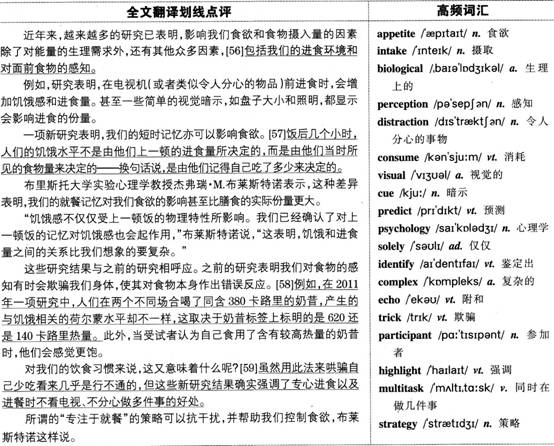
In recent years, a growing body of research has shown that our appetite and food intake areinfluenced by a large number of factors besides our biological need for energy, including our eatingenvironment and our perception of the food in front of us.
Studies have shown, for instance, that eating in front of the TV (or a similar distraction) canincrease both hunger and the amount of food consumed.Even simple visual cues, like plate size andlighting, have been shown to affect portion size and consumption.
A new study suggested that our short-term memory also may play a role in appetite.Several hoursafter a meal, people's hunger levels were predicted not by how much they'd eaten but rather by howmuch food they'd seen in front of them--in other words, how much they remembered eating.
This disparity (差异) suggests the memory of our previous meal may have a bigger influence on ourappetite than the actual size of the meal, says Jeffrey M.Brunstrom, a professor of experimentalpsychology at the University of Bristol.
"Hunger isn't controlled solely by the physical characteristics of a recent meal.We have identifiedan independent role for memory for that meal," Brunstrom says."This shows that the relationshipbetween hunger and food intake is more complex than we thought."
These findings echo earlier research that suggests our perception of food can sometimes trick ourbody's response to the food itself.In a 2011 study, for instance, people who drank the same 380-calorie(卡路里) milkshake on two separate occasions produced different levels of hunger-related hormones (荷尔蒙~,), depending on whether the shake's label said it contained 620 or 140 calories.Moreover, theparticipants reported feeling more full when they thought they'd consumed a higher-calorie Shake.
What does this mean for our eating habits? Although it hardly seems practical to trick ourselves intoeating less, the new findings do highlight the benefits of focusing on our food and avoiding TV andmultitasldng while eating.
The so-called mindful-eating strategies can fight distractions and help us control our appetite,Brunstrom says.
What is said to be a factor affecting our appetite and food intake?
参考答案
A
答案解析
【定位】根据题干中的factor及our appetite and food intake定位至第l段。
【解析】本题询问影响食欲和进食量的因素。第1段说我们的食欲和进食量除了受生理需求的影响外,还受其他众多因素影响,段末举例指出包括饮食环境和对食物的感知,A中的How we perceive the food“我们如何感知食物”与原文的perception of the food意思一致,故选A。
【点睛】本题是细节题,如果能准确定位到第一段,就可以很快排除其他干扰项。B“食物包含的原料”、C“进食的时间”及D“进食的速度”都是无关信息,在定位处并没有出现相关内容。
【解析】本题询问影响食欲和进食量的因素。第1段说我们的食欲和进食量除了受生理需求的影响外,还受其他众多因素影响,段末举例指出包括饮食环境和对食物的感知,A中的How we perceive the food“我们如何感知食物”与原文的perception of the food意思一致,故选A。
【点睛】本题是细节题,如果能准确定位到第一段,就可以很快排除其他干扰项。B“食物包含的原料”、C“进食的时间”及D“进食的速度”都是无关信息,在定位处并没有出现相关内容。
你可能感兴趣的试题
A.You would probably be more picky about food.
B.You would not feel like eating the same food.
C.You would have a good~ appetite.
D.You wpuld not feel so hungry.
A.Food labels may mislead consumers in their purchases.
B.Food labels may influence our body's response to food.
C.Hunger levels depend on one's consumption of calories.
D.People tend to take in a lot more calories than necessary.
A.Trick ourselves into eating less.
B.Choose food with fewer calories.
C.Concentrate on food while eating.
D.Pick dishes of the right size.