单选题
英语四级
题号 #3224268
Questionsare based on the following passage.
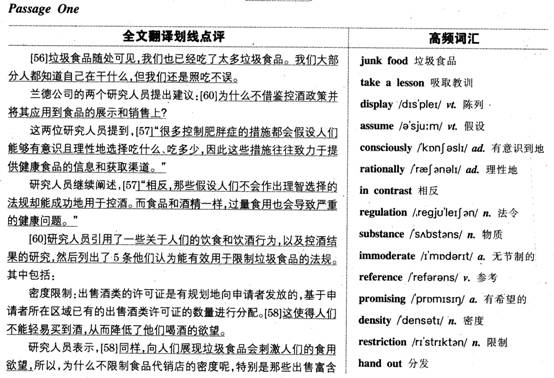
Junk food is everywhere.We're eating way too much .of it.Most of us know what we're doing and.yet we do it anyway.So here's a suggestion offered by two researchers at the Rand Corporation: Why not take a lesson from alcohol control policies and apply them to where food is sold and how it's displayed?
"Many policy measures to control obesity (肥胖症) assume .that people consciously and rationally choose what and how much they eat and .therefore focus on providing information and more access to healthier foods," note the two researchers."In contrast," the researchers continue, "many regulations that don't assume people make rational choices have been successfully applied to control alcohol, a substance like food--of which immoderate consumption leads to serious health problems."
The research references studies of people's behavior with food and alcohol and results of alcohol restrictions, and then lists five regulations that the researchers think might be promising if applied to junk foods.Among them: Density restrictions: licenses to sell alcohol aren't handed out unplanned to all comers but are allotted (分配) based on the number of places in an area that already .sell alcohol.These make alcohol less easy to get and reduce the number of psychological cues to drink.
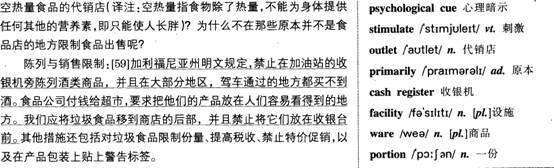
Similarly, the researchers say, being presented with junk food stimulates our desire to eat it.SO why not limit the density of food outlets, particularly ones that sell food rich in empty calories? And why not limit sale of food in places that aren't primarily food stores?
Display and sales restrictions: California has a rule prohibiting alcohol displays near the cash registers in gas stations, and in most places you can't buy alcohol at drive-through facilities.At supermarkets, food companies pay to have their wares in places where they're easily seen.One could remove junk food to the back of the store and ban them from the shelves at checkout lines.The other measures include restricting portion sizes, taxing and prohibiting special price deals for junk foods, and placing warning labels on the products.
What does the author say about junk food?
参考答案
B
答案解析
【定位】根据题干中的junk food定位到第l段。
【解析】首段提到,“垃圾无处不在,我们已吃得太多了(eatin9…too much of it)”;而最后一句“我们大部分人都知道自己在干什么,但我们还是照吃不误”则暗示了,人们明知垃圾食品有害,但仍会去吃。B中的widely consumed“被广泛食用”对应首段的前两句.despite its ill reputation“不顾其坏名声”则对应首段最后一句,故B为答案。
【点睛】由首段最后一句可知,人们都清楚垃圾食品的危害,故无需再对人们进行此类教育,排除A;人们对垃圾食品照吃不误(do it anyway),其中的原因有多种,并不只是受诱惑而购买,C“垃圾食品的诱惑太大,令人无法抗拒”属于过度推断。人们不能拒绝垃圾食品的说法也过于绝对;D“垃圾食品的危害性比普遍所知的要大”,全文都在讨论如何减少食用垃圾食品.并未谈及垃圾食品对健康具体存在哪些危害,D严重偏离主题。
【解析】首段提到,“垃圾无处不在,我们已吃得太多了(eatin9…too much of it)”;而最后一句“我们大部分人都知道自己在干什么,但我们还是照吃不误”则暗示了,人们明知垃圾食品有害,但仍会去吃。B中的widely consumed“被广泛食用”对应首段的前两句.despite its ill reputation“不顾其坏名声”则对应首段最后一句,故B为答案。
【点睛】由首段最后一句可知,人们都清楚垃圾食品的危害,故无需再对人们进行此类教育,排除A;人们对垃圾食品照吃不误(do it anyway),其中的原因有多种,并不只是受诱惑而购买,C“垃圾食品的诱惑太大,令人无法抗拒”属于过度推断。人们不能拒绝垃圾食品的说法也过于绝对;D“垃圾食品的危害性比普遍所知的要大”,全文都在讨论如何减少食用垃圾食品.并未谈及垃圾食品对健康具体存在哪些危害,D严重偏离主题。
你可能感兴趣的试题
A.They should be implemented effectively.
B.They provide misleading information.
C.They are based on wrong assumptions.
D.They help people make rational choices.
A.Few people are able to resist alcohol's temptations.
B.There are already too many stores selling alcohol.
C.Drinking strong alcohol can cause social problems.
D.Easy access leads to customers' over-consumption.
A.To effectively limit the density of alcohol outlets.
B.To help drivers to give up the habit of drinking.
C.To prevent possible traffic jams in nearby areas.
D.To get alcohol out of drivers' immediate sight.