简答题
高中英语
题号 #3476991
设计任务:请阅读下面学生信息和语言素材,设计一节课的教学方案。
教案没有固定格式,但须包含下列要点:
● teaching objectives
● teaching contents
● key and difficult points
● major steps and time allocation
● activities and justifications
教学时间:45分钟
学生概况:某城镇普通中学高中一年级第二学期学生,班级人数40人,多数学生已经达到《普通高中英语课程标准(实验)》五级水平。学生课堂参与积极性一般。
语言素材:
An Interview Pausanias, who was a Greek writer about 2,000 years ago, has come on a magical journey on March 18th,2007 to find out about the present-day Olympic Games. He is now interviewing Li Yan, a volunteer for the 2008 Olympic Games.
P: My name is Pausanias. I lived in what you call "Ancient Greece" and I used to write about the Olympic Games a long time ago. I've come to your time to find out about the present-day Olympic Games because I know that in 2004 they were held in my homeland. May ! ask you some questions about the modern Olympics?
L: Good heavens! Have you really come from so long ago? But of course you can ask any questions you like. What would you like to know?
P: How often do you hold your Games?
L: Every four years. There are two main sets of Games--the Winter and the Summer
Olympics, and both are held every four years on a regular basis. The Winter Olympics are usually held two years before the Summer Games. Only athletes who have reached the agreed standard for their event will be admitted as competitors. They may come from anywhere in the world.
P: Winter Games? How can the runners enjoy competing in winter? And what about the
horses?
L: Oh no! There are no running races or horse riding events. Instead there are competitions like skiing and ice skating which need snow and ice. That's why they're called the Winter Olympics. It's in the Summer Olympics that you have the running races, together with swimming, sailing and all the team sports.
P: I see. Earlier you said that athletes are invited from all over the world. Do you mean the Greek world? Our Greek cities used to compete against each other just for the honour of winning. No other countries could join in, nor could slaves or women!
L: Nowadays any country can take part if their athletes are good enough. There are over 250 sports and each one has its own standard. Women are not only allowed, but play a very important role in gymnastics, athletics, team sports and ...
P: Please wait a minute! All those events, all those countries and even women taking part!
Where are all the athletes housed?'
L: For each Olympics, a special village is built for them to live in, a main reception
building, several stadiums for competitions, and a gymnasium as well.
P: That sounds very expensive. Does anyone want to host the Olympic Games?
L: As a matter of fact, every country wants the opportunity. It's a great responsibility but also a great honor to be chosen. There's as much competition among countries to host the Olympics as to win Olympic medals. The 2008 Olympics will be held in Beijing, China. Did you know that?
P: Oh yes! You must be very proud.
L: Certainly. And after that the 2012 Olympics will be held in London. They have already started planning for it. A new village for the athletes and all the stadiums will be built to the east of London. New medals will be designed of course and ...
P: Did you say medals? So even the olive wreath has been replaced! Oh dear! Do you compete for prize money too?
L: No, we don't. It's still all about being able to run faster, jump higher and throw further. That's the motto of the Olympics, you know--"Swifter, Higher and Stronger."
P: Well, that's good news! How interesting! Thank you so much for your time.
参考答案
暂无
答案解析
Teaching Contents: This passage is about the differences between the ancient Olympic Games and modern Olympic Games.
Teaching Objectives:
Language objective The students can learn and master the new words and expressions in this period. Ability objective The students can develop their reading and speaking ability. Emotional objective The students can increase their awareness of cooperating with others.
Teaching Key Points:
Train the students' reading ability--skimming and scanning.
Teaching Difficult Points:
Describe the differences between the ancient Olympics and the modern Olympics.
Teaching Procedures..
Step 1 Warming up and Lead-in (5 min)
1. Let students enjoy a clip of video about the Beijing Olympic Games in order to introduce the topic: the Olympic Games.
2. Guessing game: Which number is concerned with the Olympic Games? (Five)
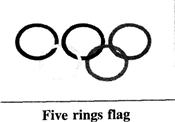
The five interlocking rings stand for friendship of five continents.
Blue =Europe
Black =Africa
Red =America
Yellow =Asia
Green =Oceania
3. Welcome to Beijing
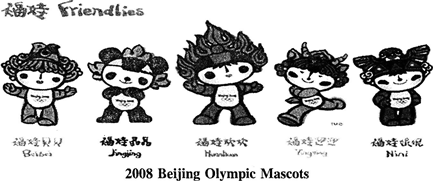
After that the teacher asks the students about the Olympic motto: Swifter, Higher, Stronger .And then the teacher asks the students to brainstorm some summer Olympic events and winter Olympic events. Summer Olympic events: swimming, relay, gymnastics, weightlifting, tennis, table tennis, running, softball, diving, wrestling, volleyball, football, basketball, judo, pentathlon, javelin, high jump , long jump, marathon ...
Winter Olympic events: skating, skiing, ski jumping, sledding, snowboarding, ice hockey ...
Step 2 Pre-reading (6 rain)
The teacher asks the students to read the passage quickly and then do the following exercise.
True or False
(1) Men and women were allowed to take part in the ancient Olympic Games. ()
(2) The Winter Olympic Games are held every three years. ()
(3) The 28th Olympic Games will be held in Beijing. ()
(4) A special village is built for competitors to live in. ()
5) To hold the Olympic is a rich prize and a big honor for a country. ()
Step 3 While-reading (20 rain)
The teacher asks the students to read the passage carefully in groups and then tell the differences between the ancient Olympics and the modern Olympics according to the reading
passage.
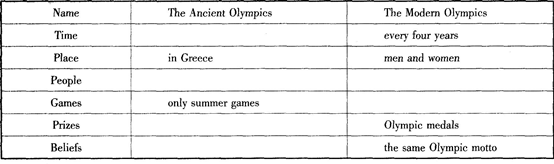
After the students fill the form, the teacher asks them to answer the following questions.
(1) Pausanias was
A. a writer who lived in "Ancient Greece"
B. an English writer 2,000 years ago
C. a writer who wrote about the modern Olympic Games
D. an athlete
(2) Who could take part in the ancient Olympics in Greece?
A. Greek nobles.
B. Greek slaves.
C. Greek women.
D. English nobles.
(3) Who can be admitted to the present Olympic Games?
A. All the athletes from all over the world.
B. Athlete from the developed countries.
C. Athletes who can reach the required standard.
D. Athletes from the Greek cities.
(4) When will the next Winter Olympics be held?
A.2006
B.2007
C.2008
D.2009
(5) Which of the following statements is TRUE?
A. Pausanias wasn't interested in the Olympics.
B. It is easy to win the right to host the Olympics.
C. Almost every country wants to host the Olympics.
D. It costs little to host the Olympics.
Step 4 Post-reading (9 rain)
The teacher asks the students to discuss the following questions.
(1) What upsets Pausanias about modern Winter Olympic Games7
(2) What amazes Pausanias about the modern Summer Olympic Games?
(3) When does Pausanias think Athens, Greece and Beijing, China should feel proud? (4) Why does Pausanias think people may be competing for money in the modern Olympic
Games?
(5) What makes Pausanias happy about the modern Olympic Games?
Step 5 Summary and Homework (5 rain)
Summary: The teacher asks one student to act as an assistant teacher to guide others to summarize what they have learned in this class. And then give a conclusion about this lesson. Homework: The teacher asks students to find out more useful information about the Olympics after class.
(Justification: Summary and homework are so important and necessary for the students to master the knowledge they have acquired in class.)
Teaching Objectives:
Language objective The students can learn and master the new words and expressions in this period. Ability objective The students can develop their reading and speaking ability. Emotional objective The students can increase their awareness of cooperating with others.
Teaching Key Points:
Train the students' reading ability--skimming and scanning.
Teaching Difficult Points:
Describe the differences between the ancient Olympics and the modern Olympics.
Teaching Procedures..
Step 1 Warming up and Lead-in (5 min)
1. Let students enjoy a clip of video about the Beijing Olympic Games in order to introduce the topic: the Olympic Games.
2. Guessing game: Which number is concerned with the Olympic Games? (Five)
The five interlocking rings stand for friendship of five continents.
Blue =Europe
Black =Africa
Red =America
Yellow =Asia
Green =Oceania
3. Welcome to Beijing
After that the teacher asks the students about the Olympic motto: Swifter, Higher, Stronger .And then the teacher asks the students to brainstorm some summer Olympic events and winter Olympic events. Summer Olympic events: swimming, relay, gymnastics, weightlifting, tennis, table tennis, running, softball, diving, wrestling, volleyball, football, basketball, judo, pentathlon, javelin, high jump , long jump, marathon ...
Winter Olympic events: skating, skiing, ski jumping, sledding, snowboarding, ice hockey ...
Step 2 Pre-reading (6 rain)
The teacher asks the students to read the passage quickly and then do the following exercise.
True or False
(1) Men and women were allowed to take part in the ancient Olympic Games. ()
(2) The Winter Olympic Games are held every three years. ()
(3) The 28th Olympic Games will be held in Beijing. ()
(4) A special village is built for competitors to live in. ()
5) To hold the Olympic is a rich prize and a big honor for a country. ()
Step 3 While-reading (20 rain)
The teacher asks the students to read the passage carefully in groups and then tell the differences between the ancient Olympics and the modern Olympics according to the reading
passage.
After the students fill the form, the teacher asks them to answer the following questions.
(1) Pausanias was
A. a writer who lived in "Ancient Greece"
B. an English writer 2,000 years ago
C. a writer who wrote about the modern Olympic Games
D. an athlete
(2) Who could take part in the ancient Olympics in Greece?
A. Greek nobles.
B. Greek slaves.
C. Greek women.
D. English nobles.
(3) Who can be admitted to the present Olympic Games?
A. All the athletes from all over the world.
B. Athlete from the developed countries.
C. Athletes who can reach the required standard.
D. Athletes from the Greek cities.
(4) When will the next Winter Olympics be held?
A.2006
B.2007
C.2008
D.2009
(5) Which of the following statements is TRUE?
A. Pausanias wasn't interested in the Olympics.
B. It is easy to win the right to host the Olympics.
C. Almost every country wants to host the Olympics.
D. It costs little to host the Olympics.
Step 4 Post-reading (9 rain)
The teacher asks the students to discuss the following questions.
(1) What upsets Pausanias about modern Winter Olympic Games7
(2) What amazes Pausanias about the modern Summer Olympic Games?
(3) When does Pausanias think Athens, Greece and Beijing, China should feel proud? (4) Why does Pausanias think people may be competing for money in the modern Olympic
Games?
(5) What makes Pausanias happy about the modern Olympic Games?
Step 5 Summary and Homework (5 rain)
Summary: The teacher asks one student to act as an assistant teacher to guide others to summarize what they have learned in this class. And then give a conclusion about this lesson. Homework: The teacher asks students to find out more useful information about the Olympics after class.
(Justification: Summary and homework are so important and necessary for the students to master the knowledge they have acquired in class.)
你可能感兴趣的试题
A. car
B. war
C. star
D. large
A. essence
B. texture
C. content
D. threshold