单选题
英语六级
题号 #3493046
阅读下面材料,回答题:
Inequality Is Not Inevitable
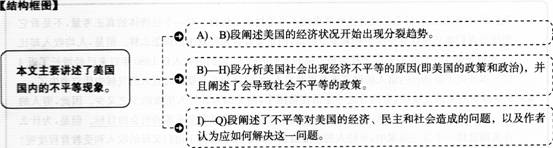
A) A dangerous trend has developed over this past third of a century. A country that experienced shared growth after World War Ⅱ began to tear apart, so much so that when the Great Recession hit in late 2007, one could no longer ignore the division that had come to define the American economic landscape. How did this "shining city on a hill" become the advanced country with the greatest level of inequality?
B) Over the past year and a half, The Great Divide, a series in The New York Times, has presented a wide range of examples that undermine the notion that there are any truly fundamental laws of capitalism. The dynamics of the imperial capitalism of the 19th century needn't apply in the democracies of the 21st. We don't need to have this much inequality in America.
C) Our current brand of capitalism is a fake capitalism. For proof of this go back to our response to the Great Recession, where we socialized losses, even as we privatized gains. Perfect competition should drive profits to zero, at least theoretically, but we have monopolies making persistently high profits. C. E. O. s enjoy incomes that are on average 295 times that of the typical worker, a much higher ratio have in the past, without any evidence of a proportionate increase in productivity.
D)If it is not the cruel laws of economics that have led to America's great divide, what is it? The straightforward answer., our policies and our politics. People get tired of hearing about Scandinavian success stories, but the fact of the matter is that Sweden, Finland and Norway have all succeeded in having about as much or faster growth in per capita (人均的 ) incomes than the United States and with far greater equality.
E) So why has America chosen these inequality-enhancing policies? Part of the answer is that as World War Ⅱ faded into memory, so too did the solidarity it had created. As America triumphed in the Cold War, there didn't seem to be a real competitor to our economic model. Without this internat~ competition, we no longer had to show that our system could deliver for most of our citizens.
F) Ideology and interests combined viciously. Some drew the wrong lesson from the collapse of the Soviet system in 1991. The pendulum swung from much too much government there to much too little here. Corporate interests argued for getting rid of regulations, even when those regulations had done so much to protect and improve our environment, our safety, our health and the economy itself.
G) But this ideology was hypocritical (虚伪的). The bankers, among the strongest advocates of laissez- faire (自由放任的 ) economics, were only too willing to accept hundreds of billions of dollars from the government in the aid programs that have been a recurring feature of the global economy since the beginning of the Thatcher-Reagan era of "free" markets and deregulation.
H) The American political system is overrun by money. Economic inequality translates into political inequality, and political inequality yields increasing economic inequality. So corporate welfare increases as we reduce welfare for the poor. Congress maintains subsidies for rich farmers as we cut back on nutritional support for the needy. Drug companies have been given hundreds of billions of dollars as we limit Medicaid benefits. The banks that brought on the global financial crisis got billions while a tiny bit went to the homeowners and victims of the same banks' predatory (掠夺性的) lending practices. This last decision was particularly foolish. There were alternatives to throwing money at the banks and hoping it would circulate through increased lending.
I) Our divisions are deep. Economic and geographic segregation has immunized those at the top from the problems of those down below. Like the kings of ancient times, they have come to perceive their privileged positions essentially as a natural right.
J) Our economy, our democracy and our society have paid for these gross inequalities. The true test of an economy is not how much wealth its princes can accumulate in tax havens (庇护所), but how well off the typical citizen is. But average incomes are lower than they were a quarter-century ago. Growth has gone to the very, very top, whose share has almost increased four times since 1980. Money that was meant to have trickled (流淌) down has instead evaporated in the agreeable climate of the Cayman Islands.
K) With almost a quarter of American children younger than 5 living in poverty, and with America doing so little for its poor, the deprivations of one generation are being visited upon the next. Of course, no country has ever come close to providing complete equality of opportunity. But why is America one of the advanced countries where the life prospects of the young are most sharply determined by the income and education of their parents?
L) Among the most bitter stories in The Great Divide were those that portrayed the frustrations of the young, who long to enter our shrinking middle class. Soaring tuitions and declining incomes have resulted in larger debt burdens. Those with only a high school diploma have seen their incomes decline by 13 percent over the past 35 years.
M) Where justice is concerned, there is also a huge divide. In the eyes of the rest of the world and a significant part of its own population, mass imprisonment has come to define America--a country, it bears repeating, with about 5 percent of the world's population but around a fourth of the world's prisoners.
N) Justice has becom~ a commodity, affordable to only a few. While Wall Street executives used their expensive lawyers to ensure that their ranks were not held accountable for the misdeeds that the crisis in 2008 so graphically revealed, the banks abused our legal system to foreclose (取消赎回权) on mortgages and eject tenants, some of whom did not even owe money.
O) More than a half-century ago, America led the way in advocating for the Universal Declaration of Human Rights, adopted by the United Nations in 1948. Today, access to health care is among the most universally accepted rights, at least in the advanced countries. America, despite the implementation of the Affordable Care Act, is the exception. In the relief that many felt when the Supreme Court did not overturn the Affordable Care Act, the implications of the decision for Medicaid were not fully appreciated. Obamacare's objective--to ensure that all Americans have access to health care--has been blocked: 24 states have not implemented the expanded Medicaid program, which was the means by which Obamacare was supposed to deliver on its promise to some of the poorest.
P) We need not just a new war on poverty but a war to protect the middle class. Solutions to these problems do not have to be novel. Far from it. Making markets act like markets would be a good place to start. We must end the rent-seeking society we have gravitated toward, in which the wealthy obtain profits by manipulating the system.
Q) The problem of inequality is not so much a matter of technical economics. It's really a problem of practical politics. Inequality is not just about the top marginal tax rate but also about our children's access to food and the right to justice for all. If we spent more on education, health and infrastructure (基础设施), we would strengthen our economy, now and in the future.
In theory, free competition is supposed to reduce the margin of profits to the minimum.
参考答案
C
答案解析
【文章来源】本文选自2014年6月27日The New York Times(《纽约时报》)上的一篇文章,标题为“Inequality Is Not Inevitable”(《不平等并非不可避免》)。
【参考译文】
B) (50)在过去一年半的时间里,《纽约时报》中的“大鸿沟”系列报道为我们提供了很多削弱一个观点的事例.这一观点是:美国有真正意义上的资本主义的基本法律。l9世纪帝国资本主义的动态不再适用于21世纪的民主国家。美国不需要如此巨大的不平等。
C) 我们现在的这种资本主义并非真正的资本主义。想要证明这一点,可以回顾我们在经济大萧条时期的反应:我们将损失社会化,尽管收益还是私有化的。(46)最好的竞争应该是使利润趋于零,至少理论上是这样,但是我们的垄断行业还在持续赚取高额利润。公司总裁享受着平均是普通工人的295倍的收入,这个比例远远高于过去,而没有任何证据表明他们的生产力在成比例地增长。
D)如果导致美国巨大分化的不是残酷的经济法律,那又是什么呢?最简单的答案就是:我们的政策和政治。人们已经厌倦听到斯堪的纳维亚的成功案例,但事实上,瑞典、芬兰和挪威这些国家都成功地使人均收入增长与美国一样快或者更快,而这些国家国内比美国更平等。
E) 那么,为什么美国要选择这些促使社会更加不平等的政策呢?部分原因在于随着二战逐渐淡出人们的记忆,二战带来的团结也不复存在了。(48)由于美国在冷战中大胜,似乎我们的经济体制已没有真正的竞争对手。没有了这种国际竞争,我们就没有必要证明我们的体制能够为大多数公民带来利益 F) 意识形态和利益发生了恶意结合。有些人从1991年苏联解体事件中吸取了错误的教训。(53)政府干预经济的力度从太大转变为太小。企业利益要求摆脱经济干预,即便这些干预对保护和提高我们的环境、安全、健康以及经济本身起到了很大的作用。
G)但是,这种意识形态是虚伪的。银行家是最支持自由放任的经济体制的群体之一,他们也只是非常愿意接受来自政府援助项目的几千亿美元的资金。从撒切尔一里根时代的“自由”市场和放松管制开始,这些援助项目就已经成为全球经济中一个反复出现的特点。
H)金钱肆意控制着美国的政治体系。经济的不平等造成政治的不平等,而政治的不平等进而又加剧了经济的不平等。所以,当我们减少穷人的福利时,企业的福利增加了。在我们削减对穷人的营养支持的同时,国会保持对富农的补助。在我们限制医疗补助的同时,政府却给医药公司几千亿美元的资助。引起全球金融危机的银行得到了几十亿美元的援助,而只有微不足道的一部分资金进入房主和这些银行掠夺性贷款行为的受害者的口袋里。最后这一决定尤为愚蠢。把钱扔给银行并期待银行通过增加贷款使自己得以周转,除了这样,本可以有其他的选择。
1) 我们的分化程度很深:(49)经济和地理分隔使得上层人群免受底层人群问题的困扰。正如古代的国王.她们认为自己的优越地位本质上是一种与生俱来的权利。
J)我们的经济、民主和社会已经为这些严重的不平等付出了代价。对一个经济体的真正考量,不是看它的统治者们能从税收庇护所中积累多少财富,而是要看普通民众生活得怎么样。但是,人均收入却比25年前更低了。增长的是位于社会最上层的人们的收入,他们的收入自1980年以来已经增长了近4倍。本该向下渗透(注:富人的财富逐渐惠及穷人)的财富却在开曼群岛宜人的气候中凭空消失了。 K)5岁以下的美国儿童中,有四分之一生活在贫困中,而美国为其穷人所做的少之又少。因此,穷人的下一代依旧贫困。(55)当然,没有任何一个国家能够达到提供完全平等的机会的目标。但是,为什么在美国这样一个发达国家中,年轻人的生活前景却几乎完全取决于他们父母的收入和受教育程度呢? L)在“大鸿沟”系列报道中,最悲伤的故事莫过于那些描述年轻人的沮丧的故事。这些年轻人渴望跻身 于不断缩水的中产阶级行列。骤增的学费和不断降低的收入使人们背负着更加沉重的债务负担。那 些只有高中文凭的人们的收入在过去的35年中降低了13%。
M)虽然人们关注公平,但差距还是很大。在世界上其他国家的公民和美国本国很多公民的眼中,美国是一个入狱率极高的国家。(52)如果算上重复入狱的人数,那么这个人口仅为世界人口5%的国家的入狱人数达到了全世界入狱人数的四分之一。
N)(54)公平已经变成了一种商品,但只有少数人才买得起。华尔街的主管利用他们要价高昂的律师来保证他们这一阶层不为自己的恶行承担责任时(2008年的金融危机非常清晰地揭示出他们的恶行),而银行则滥用了我们的法律体系来取消抵押贷款的赎回权,并把房客驱逐出去,而有些房客甚至没有欠款。
O)半个多世纪以前,美国率先支持联合国在1948年通过的《世界人权宣言》。如今,医疗保健权是最被普遍接受的权利之一,至少在发达国家是这样。而美国,虽然也实施了《平价医疗法案》,却是个例外。很多人在最高法院没有推翻《平价医疗法案》的时候感到一丝欣慰,但有关医疗补助制度的决议的暗示并未得到充分重视。奥巴马医改的目标——确保所有的美国人都能获得医疗保健服务——受到了阻碍:24个州没有实施扩大医疗补助项目,奥巴马医改本想通过这种方式来兑现其对一些最贫穷的 人们的承诺。
P)我们不仅需要对贫穷宣战,还需要为保护中产阶级而战。(51)这些问题的解决方法并不需要多么新颖除恰相反。让市场像正常市场那样运作就是个好起点。我们必须结束我们一直向往的寻租社会,在这样的社会中,富人通过操控体系来获得利益。
Q)不平等问题并非一个技术经济学问题。它实际上是一个实用政治学的问题。不平等不仅关乎最高边 际税率,而且关乎我们的孩子能否获得食物及所有人的公平权。如果我们能在教育、卫生和基础设施方面花费更多,那么我们现在和将来就能更好地加强我们的经济。
【答案详解】
【定位】由题干中的competition和profits定位到 C)段第三句。
C)【精析】同义转述题。定位句指出,最好的竞争应 该是使利润趋于零,至少理论上是这样。题干中的to the minimum是对定位句中的zero的同义 转述,In theory是对定位旬中的theoretically的 同义转述,故答案为C)。
【参考译文】
不平等并非不司避免
A)在过去的三分之一个世纪里,出现了一个危险的趋势。(47)二战后,经历共同发展的美国开始出现分裂.这一势头是如此强烈,以至于2007年底,当美国出现经济大萧条时,人们再也无法忽视司以用来说明美国经济状况的分化。那么,这个“山巅上的光辉之城”是如何成为不平等程度最高的发达国家的呢?B) (50)在过去一年半的时间里,《纽约时报》中的“大鸿沟”系列报道为我们提供了很多削弱一个观点的事例.这一观点是:美国有真正意义上的资本主义的基本法律。l9世纪帝国资本主义的动态不再适用于21世纪的民主国家。美国不需要如此巨大的不平等。
C) 我们现在的这种资本主义并非真正的资本主义。想要证明这一点,可以回顾我们在经济大萧条时期的反应:我们将损失社会化,尽管收益还是私有化的。(46)最好的竞争应该是使利润趋于零,至少理论上是这样,但是我们的垄断行业还在持续赚取高额利润。公司总裁享受着平均是普通工人的295倍的收入,这个比例远远高于过去,而没有任何证据表明他们的生产力在成比例地增长。
D)如果导致美国巨大分化的不是残酷的经济法律,那又是什么呢?最简单的答案就是:我们的政策和政治。人们已经厌倦听到斯堪的纳维亚的成功案例,但事实上,瑞典、芬兰和挪威这些国家都成功地使人均收入增长与美国一样快或者更快,而这些国家国内比美国更平等。
E) 那么,为什么美国要选择这些促使社会更加不平等的政策呢?部分原因在于随着二战逐渐淡出人们的记忆,二战带来的团结也不复存在了。(48)由于美国在冷战中大胜,似乎我们的经济体制已没有真正的竞争对手。没有了这种国际竞争,我们就没有必要证明我们的体制能够为大多数公民带来利益 F) 意识形态和利益发生了恶意结合。有些人从1991年苏联解体事件中吸取了错误的教训。(53)政府干预经济的力度从太大转变为太小。企业利益要求摆脱经济干预,即便这些干预对保护和提高我们的环境、安全、健康以及经济本身起到了很大的作用。
G)但是,这种意识形态是虚伪的。银行家是最支持自由放任的经济体制的群体之一,他们也只是非常愿意接受来自政府援助项目的几千亿美元的资金。从撒切尔一里根时代的“自由”市场和放松管制开始,这些援助项目就已经成为全球经济中一个反复出现的特点。
H)金钱肆意控制着美国的政治体系。经济的不平等造成政治的不平等,而政治的不平等进而又加剧了经济的不平等。所以,当我们减少穷人的福利时,企业的福利增加了。在我们削减对穷人的营养支持的同时,国会保持对富农的补助。在我们限制医疗补助的同时,政府却给医药公司几千亿美元的资助。引起全球金融危机的银行得到了几十亿美元的援助,而只有微不足道的一部分资金进入房主和这些银行掠夺性贷款行为的受害者的口袋里。最后这一决定尤为愚蠢。把钱扔给银行并期待银行通过增加贷款使自己得以周转,除了这样,本可以有其他的选择。
1) 我们的分化程度很深:(49)经济和地理分隔使得上层人群免受底层人群问题的困扰。正如古代的国王.她们认为自己的优越地位本质上是一种与生俱来的权利。
J)我们的经济、民主和社会已经为这些严重的不平等付出了代价。对一个经济体的真正考量,不是看它的统治者们能从税收庇护所中积累多少财富,而是要看普通民众生活得怎么样。但是,人均收入却比25年前更低了。增长的是位于社会最上层的人们的收入,他们的收入自1980年以来已经增长了近4倍。本该向下渗透(注:富人的财富逐渐惠及穷人)的财富却在开曼群岛宜人的气候中凭空消失了。 K)5岁以下的美国儿童中,有四分之一生活在贫困中,而美国为其穷人所做的少之又少。因此,穷人的下一代依旧贫困。(55)当然,没有任何一个国家能够达到提供完全平等的机会的目标。但是,为什么在美国这样一个发达国家中,年轻人的生活前景却几乎完全取决于他们父母的收入和受教育程度呢? L)在“大鸿沟”系列报道中,最悲伤的故事莫过于那些描述年轻人的沮丧的故事。这些年轻人渴望跻身 于不断缩水的中产阶级行列。骤增的学费和不断降低的收入使人们背负着更加沉重的债务负担。那 些只有高中文凭的人们的收入在过去的35年中降低了13%。
M)虽然人们关注公平,但差距还是很大。在世界上其他国家的公民和美国本国很多公民的眼中,美国是一个入狱率极高的国家。(52)如果算上重复入狱的人数,那么这个人口仅为世界人口5%的国家的入狱人数达到了全世界入狱人数的四分之一。
N)(54)公平已经变成了一种商品,但只有少数人才买得起。华尔街的主管利用他们要价高昂的律师来保证他们这一阶层不为自己的恶行承担责任时(2008年的金融危机非常清晰地揭示出他们的恶行),而银行则滥用了我们的法律体系来取消抵押贷款的赎回权,并把房客驱逐出去,而有些房客甚至没有欠款。
O)半个多世纪以前,美国率先支持联合国在1948年通过的《世界人权宣言》。如今,医疗保健权是最被普遍接受的权利之一,至少在发达国家是这样。而美国,虽然也实施了《平价医疗法案》,却是个例外。很多人在最高法院没有推翻《平价医疗法案》的时候感到一丝欣慰,但有关医疗补助制度的决议的暗示并未得到充分重视。奥巴马医改的目标——确保所有的美国人都能获得医疗保健服务——受到了阻碍:24个州没有实施扩大医疗补助项目,奥巴马医改本想通过这种方式来兑现其对一些最贫穷的 人们的承诺。
P)我们不仅需要对贫穷宣战,还需要为保护中产阶级而战。(51)这些问题的解决方法并不需要多么新颖除恰相反。让市场像正常市场那样运作就是个好起点。我们必须结束我们一直向往的寻租社会,在这样的社会中,富人通过操控体系来获得利益。
Q)不平等问题并非一个技术经济学问题。它实际上是一个实用政治学的问题。不平等不仅关乎最高边 际税率,而且关乎我们的孩子能否获得食物及所有人的公平权。如果我们能在教育、卫生和基础设施方面花费更多,那么我们现在和将来就能更好地加强我们的经济。
【答案详解】
【定位】由题干中的competition和profits定位到 C)段第三句。
C)【精析】同义转述题。定位句指出,最好的竞争应 该是使利润趋于零,至少理论上是这样。题干中的to the minimum是对定位句中的zero的同义 转述,In theory是对定位旬中的theoretically的 同义转述,故答案为C)。