单选题
英语六级
题号 #3493056
Questionsare based on the following passage.
I'll admit I've never quite understood the obsession (难以破除的成见 ) surrounding genetically modified (GM) crops. To environmentalist opponents, GM foods are simply evil, an understudied. possibly harmful tool used by big agricultural businesses to control global seed markets and crush local farmers. They argue that GM foods have never delivered on their supposed promise, that money spent on GM crops would be better channeled to organic farming and that consumers should be protected with warning labels on any products that contain genetically modified ingredients. To supporters, GM crops are a key part of the effort to sustainably provide food to meet a growing global population. But more than that, supporters see the GM opposition of many environmentalists as fundamentally anti-science, no different than those who question the basics of man-made climate change.
For both sides, GM foods seem to act as a symbol: you're pro-agricultural business or anti-science. But science is exactly what we need more of when it comes to GM foods, which is why I was happy to see Nature devote a special series of articles to the GM food controversy. The conclusion: while GM crops haven't yet realized their initial promise and have been dominated by agricultural businesses, there is reason to continue to use and develop them to help meet the enormous challenge of Sustainably feeding a growing planet.
That doesn't mean GM crops are perfect, or a one-size-fits-all solution to global agriculture problems. But anything that can increase farming efficiency--the amount of crops we can produce per acre of land-- will be extremely useful. GM crops can and almost certainly will be part of that suite of tools, but so will traditional plant breeding, improved soil and crop management--and perhaps most important of all, better storage and transport infrastructure (基础设施), especially in the developing world. (It doesn't do much good for farmers in places like sub-Saharan Africa to produce more food if they can't get it to hungry consumers. ) I'd like to see more non-industry research done on GM crops--not just because we'd worry
less about bias, but also because seed companies like Monsanto and Pioneer shouldn't be the only entities working to harness genetic modification. I'd like to see GM research on less commercial crops, like corn. I don't think it's vital to label GM ingredients in food, but I also wouldn't be against it--and industry would be smart to go along with labeling, just as a way of removing fears about the technology.
Most of all, though, I wish a tenth of the energy that's spent endlessly debating GM crops was focused
on those more pressing challenges for global agriculture. There are much bigger battles to fight.注意:此部分试题请在答题卡2上作答。
How do environmentalist opponents view GM foods according to the passage?
参考答案
B
答案解析
【文章来源】本文选自2013年5月14日TIME(《时代》)上的一篇文章,标题为“Modifying the Endless Debate Over Genetically Modified Crops”(《更改有关转基因农作物的无休止的争论》)。
【参考译文】
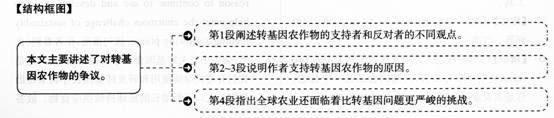
我得承认我一直不太能理解人们对转基因农作物的成见。(56)对奉行环境保护主义的反对者们来说,转基因食品就是很邪恶,还是大型农业公司用来控制全球种子市场和压迫当地农民的未经充分研究且司能有害的工具。他们认为转基因食品从来没有兑现它们所谓的承诺。这些承诺是,用在转基因农作物上的钱最好转用到有机耕作上,并且任何含有转基因成分的产品都应该贴上警告标签,以此来保护消费者。对支持者们来说,为了持续提供食品以满足全球人口不断增长的需求,转基因农作物是所作出的努力的关键部分。但是不仅这样,支持者们认为,很多环境保护主义者对转基因的反对基本上是反科学的,和那些质疑人工改变气候的基础原理的人没有什么不同。
对双方而言,转基因食品是一个标志:你是亲农业还是反科学。(57)(58)但是谈到转基因食品,我们确实更需要科学,基于这个原因,我很高兴看到《自然》杂志的一系列致力于转基因食品争议的特别报道。
(58)结论就是:尽管转基因农作物还没有实现它们预期的承诺,并且被一些农业公司控制,我们仍有理由继续使用和研发转基因农作物来帮助我们应对这个巨大的挑战,即为人口不断增长的星球持续供应食物。
(59)这并不意味着转基因农作物很完美,或者这是解决全球农业问题“一劳永逸”的办法。但是任何能提高耕作效率(每英亩土地我们能产出的粮食量)的方法都是极为有用的。转基因农作物可以并且几乎肯定能成为这套工具之一,此外还有传统作物培育、土壤改良和农作物管理——可能最重要的,尤其是对发展中国家来说,更好的存储和运输基础设施。(对于像在撒哈拉沙漠以南地区的农民来说,如果粮食不能送到饥饿的消费者手里,高产是没有什么用处的。)我希望看到在转基因农作物方面有更多非产业化的研究——不仅是因为我们会少些对偏见的担心,还因为像孟山都和先锋这样的种子公司不应该是仅有的掌控基因修改工作的实体。我希望看到在商业化较少的农作物上的转基因研究,如玉米。我认为是否在食品上标明转基因成分并不重要,但是我也不反对这样傲——企业会以一种可以消除科技恐惧的方式对标注进行巧妙处理。
(60)但是最重要的是·我希望人们能拿出花在无休止讨论转基因农作物上时间的十分之一来关注一下全球农业面f临的更紧迫的挑战。我们还有更大的仗要打。
【答案详解】
【定位】由题干中的environmentalist opponents 定位到首段第二句。
B)【精析】推理判断题。定位句指出,奉行环境保护主义的反对者们反对转基因食品是因为转基 因食品邪恶、没有经过充分研究并可能成为大型农业公司控制全球种子市场和压榨当地农民 的工具。由此可见,B)的意思符合文意,即转基因食品是一种被大型农业公司用以垄断的 工具。
你可能感兴趣的试题
A.Breaking the GM food monopoly.
B.More friendly exchange of ideas.
C.Regulating GM food production.
D.More scientific research on GM crops.
A.Feeding the growing population makes it imperative to develop GM crops.
B.Popularizing GM technology will help it to live up to its initial promises.
C.Measures should be taken to ensure the safety of GM foods.
D.Both supporters and opponents should make compromises.
A.It has to depend more and more on GM technology.
B.It is vital to the sustainable development of human society.
C.GM crops should be allowed until better alternatives are found.
D.Whatever is useful to boost farming efficiency should be encouraged.