阅读下面材料,回答题:
Plastic Surgery
A better credit card is the solution to ever larger hack attacks
A) A thin magnetic strip (magstripe) is all that stands between your credit-card information and the bad guys. And they've been working hard to break in. That's why 2014 is shaping up as a major showdown: banks, law enforcement and technology companies are all trying to stop a network of hackers who are succeeding in stealing account numbers, names, email addresses and other crucial data used in identity theft. More than 100 million accounts at Target, Neiman Marcus and Michaels stores were affected in some way during the most recent attacks, starting last November.
B) Swipe (刷卡 ) is the operative word: cards are increasingly vulnerable to attacks when you make purchases in a store. In several recent incidents, hackers have been able to obtain massive information of credit-, debit- (借记) or prepaid-card numbers using malware, i.e. malicious software, inserted secretly into the retailers' point-of-sale system--the checkout registers. Hackers then sold the data to a second group of criminals operating in shadowy corners of the web. Not long after, the stolen data was showing up on fake cards and being used for online purchases.
C) The solution could cost as little as $2 extra for every piece of plastic issued. The fix is a security technology used heavily outside the US. While American credit cards use the 40-year-old magstripe technology to process transactions, much of the rest of the world uses smarter cards with a technology called EMV (short for Europay, MasterCard, VisA. that employs a chip embedded in the card plus a customer PIN (personal identification number~ to authenticate (验证) every transaction on the spot. If a purchaser fails to punch in the correct PIN at the checkout, the transaction gets rejected. (Online purchases can be made by setting up a separate transaction code. )
D) Why haven't big banks adopted the more secure technology? When it comes to mailing out new credit cards, it's all about relative costs, says David Robertson, who runs the Nilson Report, an industry newsletter. "The cost of the card, putting the sticker on it, coding the account number and expiration date, embossing (凸印) it, the small envelope--all put together, you're in the dollar range." A chip- and.PrN card currently costs closer to$3,says Robertson,because of the price of chips.(Once large issuers convert together,the chip costs should drop.)
E) Multiply S3 by the more than 5 billion magstripe credit and prepaid cards in circulation in the US. Then consider that there’s an estimated$12.4 billion in card fraud on a global basis,says Robertson. With 44eo of that in the US,American credit.card fraud amounts to about$5.5 billion annually.Card issuers have so far calculated that absorbing the liability for even big hacks like the Target one is still cheaper than replacing all that plastic.
F) That leaves American retailers pretty much alone the world over in relying on magstripe technology to charge purchases--and leaves consumers vulnerable.Each magstripe has three tracks of information, explains payments security expert Jeremy Gumbley,the chief technology officer of CreditCall,an electronic.payments company.The first and third are used by the bank or card issuer.Your vital account information lives on the second track,which hackers try to capture.“Malware is scanning through the memory in real time and looking for data.”he says.“It creates a text file that gets stolen.’’
G) Chip-and—PIN cards,by contrast,make fake cards or skimming impossible because the information that gets scanned is encrypted(加密).The historical reason the US has stuck with magstripe, ironically enough.is once superior technology.Our cheap,ultra·reliable wired networks made credit- card authentication over the phone frictionless.In France,card companies created EMV in part because the telephone monopoly was so maddeningly inefficient and expensive.The EMV solution allowed transactions to be verified locally and securely.
H) Some big banks,like Wells Far90,are now offering to convert your magstripe card to a chip—and-PIN model.(It’s actually a hybrid(混合体)that will still have a magstripe,since most US merchants don’t have EMV terminals.)Should you take them up on it?If you travel internationally,the answer is yes.
I)Keep in mind,too,that credit cards typically have better liability protection than debit cards.If someone uses your credit card fraudulently(欺诈性地),it's the issuer or merchant,not you,that takes the hit.Debit cards have different liability limits depending on the bank and the events surrounding any fraud.“If it’s available。the logical thing is to get a chip·and-PIN card from your bank.”says Eric Adamowsky a co.founder of CreditCardlnsider.com.“l would use credit cards over debit cards because of liability issues.”Cash still works pretty well too.
J) Retailers and banks stand to benefit from the lower fraud levels of chip-and-PIN cards but have been reluctant for years to invest in the new infrastructure(基础设施)needed for the technology, especially if consumers don’t have access to it.It’s a chicken-and-egg problem..no one wants to spend the money on upgraded point.of.sale systems that can read the chip cards if shoppers aren 7t carrying them——vet there’s little point in consumers’carrying the fancy plastic if stores aren’t equipped to use them.(An earlier effort by Target to move to chip and PIN never gained progress.)According to Gumbley.there’s a“you.first mentality.The logjam(僵局)has to be broken.”
K) JPMorgan Chase CEO Jamie Dimon recently expressed his willingness to do s0,noting that banks and merchants have spent the past decade suing each other over interchange fees--the percentage of the transaction price they keep—rather than deal with the growing hacking problem.Chase offers a chip- enabled card under its own brand and several others for travel.related companies such as British Airways and Ritz—Carlton.
L) The Target and Neiman hacks have also changed the cost calculation:although retailers have been reluctant to spend the$6.75 billion that Capgemini consultants estimate it will take to convert all their registers to be chip-and.PIN.compatible,the potential liability they now face is dramatically greater. Target has been hit with class actions from hacked consumers.“It’s the ultimate nightmare,’’a retail executive from a well.known chain admitted to TIME.
M) 111e card.payment companies MasterCard and Visa are pushing hard for change.The two firms have warned all parties in the transaction chain--merchant,network,bank that if they don’t become EMV—compliant by October 2015,the party that is least compliant will bear the fraud risk.
N) In the meantime,app-equipped smartphones and digital wallets--all of which can use EMV technology—are beginning to make inroads(侵袭)on cards and cash.PayPal,for instance,is testing an app that lets you use your mobile phone to pay on the fly at local merchants--without surrendering any card information to them.And further down the road is biometric authentication,which could be encrypted with,say,a fingerprint.
O) Credit and debit cards,though,are going to be with us for the foreseeable future,and so are hackers, if we stick with magstripe technology.“It seems crazy to me,”says Gumbley,who is English,“that a cutting。edge‘technology country is depending on a 40·year-old technology.”That’s why it may be up to consumers to move the needle on chip and PIN.Says Robertson:“When you get the consumer into a position of worry and inconvenience,that’s where the rubber hits the road.”
It is best to use an EMV card for international travel.
参考答案
答案解析
【文章来源】本文为2014年1月30日TIME(《时代》)上的一篇文章,标题为“Plastic Surgery”(《信用卡手术》)。【结构框图】
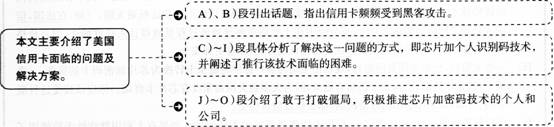
【参考译文】
信用卡手术
一张更好的信用卡可以抵挡更多黑客的攻击
A) 一条窄窄的磁条是你的信用卡信息和那些坏家伙之间的唯一障碍。而这些坏家伙一直费尽心机想要突破这层障碍。这就是2014年对立双方决定一决雌雄的原因:(50)银行、执法和技术公司都努力与黑客作斗争,这些黑客在盗用用户的账号、姓名、邮箱地址和其他关键的身份信息方面很有一手。去年ll月份以来发生的大多数黑客攻击中,塔吉特、尼曼·马库斯和迈克尔斯三大零售痞的1亿多客户都受到了一定程度的影响。
B) (47)“刷卡”是关键词:当你在商店里购物的时候,你的信用卡越来越容易受到攻击:在最近的几起事件当中,黑客通过将恶意软件秘密植入零售店的销售点结算登记系统·进而获取信用卡、借记卡或储值卡中的大量信息。黑客们随后会把这些数据卖给网络暗角的第二组犯罪团伙。不久之后,这些被窃取的数据就会出现在假的信用卡中,并用于网上购物。
C) 要解决这一问题,只需多花2美元得到一张发行的信用卡。这一锯决办法是一项安全加固技术,广泛用于美国以外的国家;(49)当美国的信用卡还在使用40年之前的磁条技术来处理信用卡交易的时候.国外许多国家都在使用一种利用芯片加密技术的信用卡·这种卡更智能。这种卡中嵌入了一个芯片.再加上一个客户个人识别码.就可以现场验证每一笔交易。如果购买者结算时不能输入正确的个人识别码.那么这次交易就无法完成:(网上购物也可以通过设立独立的交易码来完成。)
D) (52)为什么各大银行没有采用这项更为安全的技术呢?邮寄新的信用卡时,需要考虑相关成本,信用卡行业简报《尼尔森报告》的负责人大卫·罗伯逊说。“卡的成本,给信用卡加磁条,给卡编码并凸 印账号和有效期限,还有小信封,所有的这些加起来的成本就1美元了。’’目前,一张芯片加个人识别 码的卡大概要花费3美元,罗伯逊说道,因为芯片的价格高昂。(一旦大的发卡行一起更换卡片,芯片的成本就会降下来。)
E) 美国现在流通中的磁条信用卡和储值卡超过50亿张,我们可以用这个数字乘以3美元。那么,考虑一下,世界上估计共有l24亿美元资金陷入信用卡诈骗当中,罗伯逊说。而这当中,44%出现在美国,美国的信用卡诈骗的金额每年高达55亿美元。目前,信用卡发卡行预计,即使是承担塔吉特商店这样的大型黑客攻击案件的责任,也比换代所有的信用卡要实惠。
F) (54)这使美国零售商几乎已成为世界上唯一使用磁条技术收费的商家,而这也使美国消费者非常容易受到侵害。每个磁条有三条记录信息的轨道,支付安全专家杰瑞米·冈布利解释道,他本人也是电子支付公司“信用卡支付公司”的技术总监。其中,第一条和第三条轨道给银行或者信用卡发卡行使用。你的重要账户信息在第二条轨道上,这正是黑客努力去获取的信息。“恶意软件会实时扫描这些存储器以搜寻数据,”他说道,“这个软件能创建一个被盗的文本文档。”
G)相反,芯片加个人识别码信用卡能防止假冒卡片或提取信息,因为这种信用卡中会被搜寻到的信息已经加密。美国之所以坚持使用磁条技术,其历史原因非常讽刺,那就是因为这项技术曾经是美国的优势技术。我们的有线网络便宜、可信度高,这就使得电话信用卡验证畅通无阻。(48)在法国。信用卡公司之所以会创造芯片卡,部分原因在于电话垄断导致该过程低效得让人极度恼火,而且价格高昂。芯片卡这一解决方法能够让交易验证地方化,并且更加安全。
H)一些大银行,比如美国富国银行,现在正主动为客户提供将磁条卡转换为芯片加密码卡的服务。(事实上,这是一种混合卡,该卡仍然有磁条,因为大多数美国商家没有芯片卡终端。)你应该接受这种服务吗?(46)如果你要出国旅游的话,那么你就应该接受。
I) (51)但是也要记住,相比借记卡,信用卡能提供更好的责任保护。如果有人利用欺诈性手段使用了你的信用卡,那么应该是发卡行或者商家承担损失,而不是你。而借记卡有不同的责任限额,取决于银行和欺诈事件的具体情况。“如果条件允许,按理应去发卡行换一张芯片加密码的信用卡,信用卡圈内人网站的联合创始人埃里克·阿达莫夫斯基说道。“因为责任问题,比起借记卡,我宁愿使用信用卡。”使用现金也是一个很好的选择。
J) 零售商和银行很可能会是芯片加密码信用卡低欺诈率的受益者,然而多年来它们却一直不愿为这项技术投资建设新的基础设施,特别是在消费者无法使用的情况下。这就像是“鸡和蛋,,的问题:如果消费者不使用芯片卡,那么就没有人愿意花钱升级能读取这种芯片卡的销售点体系;但是如果商店没有能够使用那些信用卡的设备,消费者也不会去使用那些设计精巧的信用卡。(先前塔吉特商场曾试图向芯片加密码信用卡的方向发展。但没有取得任何进展。)冈布利称,大家都有一种一你先的心理,必须打破这个僵局。”
K)摩根大通总裁杰米·德曼近期表示愿意这样做,他提到,银行和商家在过去的十年中一直在交换费问题上互相指责——他们各自保留的交易价格比例——而没有解决越来越严重的黑客问题。摩根大通为消费者提供一张自身品牌下的芯片信用卡,另外还为英国航空公司和丽嘉酒店这类旅行相关的公司提供了数种其他类型的信用卡。
L) (53)塔吉特和尼曼发生的黑客事件也改变了成本计算:据凯捷公司的咨询师估计,要想将它们所有的存储设备都转变为与芯片加密码的信用卡兼容的设备,大约需要67.5亿美元,虽然零售商不愿花这笔钱,但是它们现在面临的潜在债务却在急剧增加。塔吉特公司遭到了来自被黑客攻击的消费者的集体诉讼。“这是最糟糕的噩梦,”一家知名连锁店的零售主管告诉《时代》周刊的记者。
M) 信用卡支付公司万事达和维萨正大力推进换代进程。两家公司对交易链中包括商家、网络公司和银行在内的所有参与方都发出了警告,截至2015年10月份,如果它们还不能做到与芯片信用卡兼容,那么透程最馒的一方将承担欺诈风险。
N) 同时.安装相应程序的智能手机和数字钱包都可以使用芯片技术,这一趋势给信用卡和现金带来了冲击。例如:贝宝正在测试—个应用程序,该程序运行时能让你利用手机在当地商家进行支付,而不用向商家提供信用卡的任何信息。更进一步的发展趋势是生物特征身份认证,如使用指纹等进行加密。
O) 然而.在可预见的将来,信用卡和借记卡还会继续存在,而如果我们坚持使用磁条技术,黑客也会继续存在。“我简直难以想象,一个拥有无数尖端技术的国家还在使用40年前的技术,”英国人冈布利说道。(55)这就是可能我们还是会依赖消费者来推进向芯片加密码方向发展的原因。罗伯逊说:“如果你让消费者感到担忧,感到不方便,那么这就是改变开始的时候了。”
【答案详解】
【定位】由题干中的international travel定位到H)段最后一句。
H)【精析】同义转述题。H)段首句指出,一些大银行正主动为客户提供将磁条卡转换为芯片加密码卡的服务。随后采用设问句给出了建议,即如果你 要出国旅游的话,那么你就应该接受这种服务,也 就是说,出国旅行时最好使用芯片卡。题干是对定位句的同义转述,故答案为H)。