简答题
小学英语
题号 #4610796
参考答案
暂无
答案解析
【参考设计】
Teaching Objectives:
Knowledge objectives:
(1) Students can learn the new words about jobs: teacher, doctor, nurse, singer, TV reporter, actor, actress, etc.
(2) Students can master the sentences: What does he/she do? He/She is a(n) ...
Ability objective:
Students can use the new words and sentences to talk about careers in real situation.
Emotional objective:
Students can establish a proper career aspiration.
Teaching Key and Difficult Points:
How to make students master the new words and sentences.
Teaching Procedures:
Step 1 Greetings
T: Hello, boys and girls. How are you today?
Ss: I'm fine, thank you. And you?
T: I'm very well, thanks.
Step 2 Lead-in
T: Well, boys and girls. Let' s listen to music--My father is a doctor. Can you guess what we will learn today?
Step 3 Presentation
(1) T: I teach lessons. I'm a teacher. (Point at herself) (The teacher shows some teachers' photos in turn and asks a question) What does he/she do?
(Guide students to answer) Ss: He/She is a teacher.
(2) T: (The teacher shows pictures of doctor and nurse one by one) Is he/she a teacher? Ss: No, he/she isn't.
T:.What does he do? (Write on the blackboard)
(Guide students to answer) Ss: He's a doctor. She's a nurse.
(Use the same method to teach singer, TV reporter, actor and actress)
(3) The teacher shows word cards and asks students to read after him/her.
Step 4 Practice and Consolidation
(1) Spelling
The teacher divides students into two groups, and gives each person a letter card. T: Teacher!
(Students who have t, e, a, c, h, e, r stand in a line)
(2) Finding your friends
The teacher distributes pieces of paper to each student, which tell "You are a(n) doctor/actor. Your friend is a(n) nurse/actress." Ask students to find their friends by asking "What do you do?""What does your friend do?"
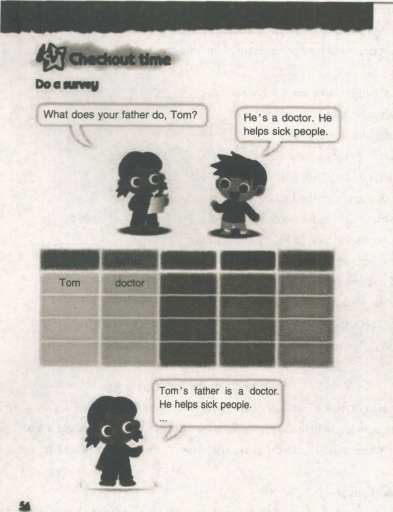
(3) Doing a survey
The teacher divides students into six groups, and asks them to do a survey about their family members' jobs.
S1: What does your father/mother/uncle/aunt do?
S2: He/She is a(n) ...
你可能感兴趣的试题
A.Sleeping hours and changes of genes.
B.Sleeping hours and diseases.
C.Changes of genes and diseases.
D.Genes and health.
A.The experiment was carried out to find the answer to how genes affect sleep.
B.The experiment took a period of more than two weeks to reach a conclusion.
C.His volunteers were divided into two groups with two different sleeping patterns.
D.Blood samples of the volunteers were checked afterwards to decide how many genes changed in sleeping.
A.The experiment was performed at the University of Surrey in early 2013.
B.Body-clock genes are associated with heart disease, cancer and Type 2 diabetes.
C.Sleep restrictions may contribute to disease like diabetes, insomnia, and heart disease.
D.7.5-8 hours' sleep pattern makes little difference compared with 6.5-7 hours' sleep pattern.