简答题
小学英语
题号 #4611201
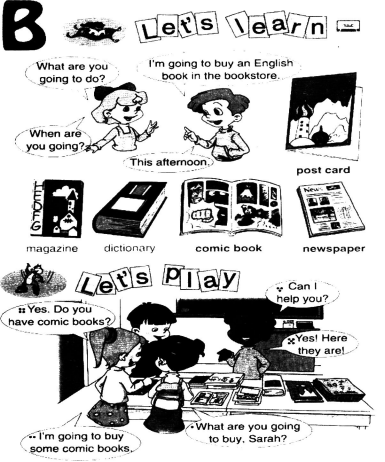
请就下面提供的教学材料,根据PPP(Presentation,Practice,Production)教学模式,用英语完成以下教学设计.设计意图可用中文表述。
1.确立本节课的教学目标;
2.设计Presentation环节的教学活动,并对设计意图加以说明;
3.设计Practice环节的教学活动,并对设计意图加以说明;
4.设计Production环节的教学活动,并对设计意图加以说明;
5.设计板书。
教学材料:
参考答案
暂无
答案解析
1. Teaching Objectives
Knowledge objectives:
(1) Students can recognize, read and use new words: postcard, magazine, dictionary, comic book, newspaper
(2) Students can master the sentence pattern: What are you going to do? / When are you going?
Ability objectives:
By taking part in conversations, students can develop spoken English and communicative skills.
Emotional objectives:
Through this class, students can develop the consciousness of cooperation and communication.
2. Presentation
(1) Learn new words
① T: Look! This is a beautiful card. It' s postcard. (Teacher takes out a postcard and writes "postcard" on the blackboard.)
② T: Do you like to watch TV?
Ss: Yes.
T: How about this? (Teacher takes out magazine and newspaper.) We can also get some information around the world from them. They are interesting. Do you want to read them?
Ss: Yes.
T: If you can speak these two words. I will lend them to you. (Teacher teaches students to learn the two words.)
③ T: When you meet some new words, you can look them up in dictionary. (Teacher shows a dictionary and explains its pronunciation. )
④ T: Do you like to read it? (Teacher takes out a comic book. )
Ss: Yes.
T: Do you want to know how to say it in English?
Ss: Yes. (The students listen and repeat.)
设计意图:通过实物进行新词的教授,学生直观地接受生词,加强对生词的熟悉与记忆程度。
(2) Learn new sentences
① T: When you talk to a friend, and want to know what he wants to do, you can use this sentence "What are you going to do?" (Teacher writes the sentence on the blackboard. )
T: If someone asks you "When are you going?" You should answer ...
Ss: This afternoon ...
② Play the video twice and ask students to read the dialogue following the tape.③Students work in pairs to use the noun in Let' s learn to make dialogue.
设计意图:通过对话学习新句型,了解用法,同时锻炼学生听力能力。通过置换单词练习句子,熟悉单词及句型。
3. Practice
(1) Ask students to read Let's learn in pairs and help them adjust pronunciation. (2) Let's play
Invite three students to give a demonstration. The first student asks questions; the second student holds word cards; the third student answers questions.
Student 1: Where are you going this afternoon?
Student 3: I'm going to the bookstore.
Student 1: What are you going to buy?
(The second student shows word cards: comic book/postcards/newspaper/magazine/dictionary. )
Student 3: I'm going to buy comic book/postcards/newspaper/magazine/dictionary.
Student 1: When are you going?
(The second student shows word cards: three/five. )
Student 3: I 'm going at 3 o 'clock.
Then, the teacher divides students in groups and asks them to practice the dialogues.
设计意图:通过小组问答练习对话,培养学生的团队意识,锻炼学生在大家面前开口说英语的勇气。
4. Production
Divide students into six groups, and ask them make a new dialogue with new words and sentences. And then invite two groups to come to the front to perform their dialogues.
设计意图:通过练习,让学生逐渐熟练运用所学单词及句型,对本节课所学内容作一个整体的巩固与复习。
5. Blackboard Design
|
What Are You Going to Do? Words: Postcard,magazine,dictionary,comic book,newspaper Sentences: What are you going to do?/When are you going? |
你可能感兴趣的试题
A.That' s very kind of you
B.Yes, you could
C.Good idea
D.With great pleasure
A.originally
B.namely
C.regularly
D.obviously
A.practical
B.avoidable
C.permanent
D.beneficial