简答题
高中英语
题号 #4696956
设计任务:请阅读下面学生信息和语言素材,设计20分钟的英语读写教学方案。该方
案没有固定格式.但须包含下列要点:
· teaching objectives
· teaching contents
· key and difficult points
· major steps and time allocation
· activities and justifications
教学时间:20分钟
学生概况:某城镇普通高中一年级(第一学期)学生,班级人数40人,多数学生已经达到
《普通高中英语课程标准(实验)》五级水平。学生课堂参与积极性一般。
语言素材:
In some countries in western Europe, such as France, Spain and Britain, the countryside is changing.
Life has become difficult for many villages, and some are disappearing. There are a number of reasons for this. Firstly, young people from villages usually want to live somewhere livelier and they often move to the towns and do not return. Secondly, people move to the cities to find work, as there are very few jobs in the countryside. Some villages still remain because people from the cities have bought a "second home" in the village, where they come and stay at weekends. The price of the homes goes up and people from the area cannot afford to buy a house there. Another problem is that it is becoming more and more difficult for farmers to make money from their farms. So they sell their land and find another job.
All these things mean that many villages in western Europe are fighting to survive. We can only hope that they will remain. The countryside would be a sadder and uglier place without them.
参考答案
暂无
答案解析
Teaching Contents: This class is about the problem that some villages are disappearing in western countryside.
Teaching Objectives:
(1) Knowledge objectives
①Students can get the main idea of the passage through reading by themselves.
②Students can learn some background that some western villages are disappearing and list the reasons men-tioned in the passage.
(2) Ability objectives
① By reading the passage, students' reading ability of skimming and scanning can be improved.
② By writing a short composition about the changes in their own hometown in the countryside, students' writing skills can be enhanced.
(3) Emotional objectives
Through group work and discussion, students can arouse the awareness of cooperation with others, and learn to enjoy the lives in their own hometown.
Teaching Key and Difficult Points:
(1) Teaching key point
Students can find the main idea about this passage and list the reasons by cooperation.
(2) Teaching difficult point
Students can train their reading ability and writing skill, and they can use this topic in their daily life.
Major Steps:
方案一:3P模式
Step 1 Presentation (8 minutes)
Activity 1 Fast reading
Skimming:
Ask students to read the passage quickly and get the gist of it.
Scanning:
Ask students to read the passage again and find the specific information about the following questions:
(1) Why do people move to the cities to find work?
(2) Why do people from the villages not buy houses in the village?
(3) Why do farmers sell their land?
Activity 2 Careful reading
Ask students to read the passage carefully and underline the ordinal numeral. Then divide them into some groups to discuss and finish the following chart to find the problems and give the reasons.

(Justification: The fast reading activities can improve students' skimming and scanning skills. Through discus-sion and group work, students can understand the passage better and their cooperation can be strengthened.)
Step 2 Practice (5 minutes)
Invite two of the students to narrate the passage in his or her own words standing on the platform. Then ask stu-dents to talk about changes in their own hometown and find the problems and the reasons.
(Justification: Narrating in their own words can train their concluding ability, meanwhile, it can also deepen their impression of the content of this class. Students can put it into practical use by talking about the topic. During the pro-cess, students will love their hometown more and cultivate the awareness to protect the environment .)
Step 3 Production (7 minutes)
Writing:
Ask students to put the ideas together to write a short composition about the changes in their own hometown in the countryside according to the outline of this passage and the above discussion. Then students exchange their com-positions to check with each other about the vocabulary, grammar and punctuation.
(Justification: It can practice students' writing skills, help students know their merits and shortcomings and en-courage them to learn useful expressions from others.)
方案二:PWP模式
Step 1 Pre-reading (4 minutes)
The teacher will play a VCR about some people who come from village and now work in cities. After that, ask students to discuss two questions:
(1) Why do they want to find jobs in cities even if they face a lot of problems?
(2) Why do some of them want to return to hometown?
(Justification: VCR can give students a more intuitive feeling. Through watching VCR, they can know what they will learn in this class and their curiosity will be stimulated. )
Step 2 While-reading (8 minutes)
Skimming:
The teacher will ask students to read the whole passage quickly to get the main idea, then ask someone to share it with the whole class.
Scanning:
The teacher will ask students to read the text again and underline the ordinal numeral. Then divide them into some groups to discuss the following questions and ask them not only to read the text but also to imagine:
(1) Why do some of them want to fred jobs in cities?
(2) Why do some of them want to return home?
(3) If you are one of the members in these villages, what's your choice?
After discussion, ask them to fill in the table on the screen.
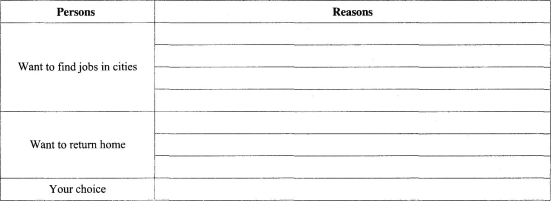
(Justification: Skimming can help students have a basic understanding of the passage. The discussion can not only cultivate their cooperation sense but also stimulate their imagination. Besides, filling in the table can help students un-derstand the passage better. )
Step 3 Post-reading (8 minutes)
Retelling:
In this step, the teacher will invite two of them to narrate the passage in his or her own words standing on the platform.
(Justification: Standing on the platform can give them much more confidence in expressing them. Narrating in their own words can train their concluding ability and deepen their impression of the content of this class.)
Writing:
In this step, the teacher will ask students to put the ideas together to write a short composition about the changes in their own hometown in the countryside according to the outline of this passage and the above discussion. Then stu-dents will exchange their compositions to check carefully the vocabulary, grammar and punctuation.
(Justification: It can practice students' writing skills, let students know their merits and shortcomings and encour-age them to learn useful expressions from others.)
Teaching Objectives:
(1) Knowledge objectives
①Students can get the main idea of the passage through reading by themselves.
②Students can learn some background that some western villages are disappearing and list the reasons men-tioned in the passage.
(2) Ability objectives
① By reading the passage, students' reading ability of skimming and scanning can be improved.
② By writing a short composition about the changes in their own hometown in the countryside, students' writing skills can be enhanced.
(3) Emotional objectives
Through group work and discussion, students can arouse the awareness of cooperation with others, and learn to enjoy the lives in their own hometown.
Teaching Key and Difficult Points:
(1) Teaching key point
Students can find the main idea about this passage and list the reasons by cooperation.
(2) Teaching difficult point
Students can train their reading ability and writing skill, and they can use this topic in their daily life.
Major Steps:
方案一:3P模式
Step 1 Presentation (8 minutes)
Activity 1 Fast reading
Skimming:
Ask students to read the passage quickly and get the gist of it.
Scanning:
Ask students to read the passage again and find the specific information about the following questions:
(1) Why do people move to the cities to find work?
(2) Why do people from the villages not buy houses in the village?
(3) Why do farmers sell their land?
Activity 2 Careful reading
Ask students to read the passage carefully and underline the ordinal numeral. Then divide them into some groups to discuss and finish the following chart to find the problems and give the reasons.
(Justification: The fast reading activities can improve students' skimming and scanning skills. Through discus-sion and group work, students can understand the passage better and their cooperation can be strengthened.)
Step 2 Practice (5 minutes)
Invite two of the students to narrate the passage in his or her own words standing on the platform. Then ask stu-dents to talk about changes in their own hometown and find the problems and the reasons.
(Justification: Narrating in their own words can train their concluding ability, meanwhile, it can also deepen their impression of the content of this class. Students can put it into practical use by talking about the topic. During the pro-cess, students will love their hometown more and cultivate the awareness to protect the environment .)
Step 3 Production (7 minutes)
Writing:
Ask students to put the ideas together to write a short composition about the changes in their own hometown in the countryside according to the outline of this passage and the above discussion. Then students exchange their com-positions to check with each other about the vocabulary, grammar and punctuation.
(Justification: It can practice students' writing skills, help students know their merits and shortcomings and en-courage them to learn useful expressions from others.)
方案二:PWP模式
Step 1 Pre-reading (4 minutes)
The teacher will play a VCR about some people who come from village and now work in cities. After that, ask students to discuss two questions:
(1) Why do they want to find jobs in cities even if they face a lot of problems?
(2) Why do some of them want to return to hometown?
(Justification: VCR can give students a more intuitive feeling. Through watching VCR, they can know what they will learn in this class and their curiosity will be stimulated. )
Step 2 While-reading (8 minutes)
Skimming:
The teacher will ask students to read the whole passage quickly to get the main idea, then ask someone to share it with the whole class.
Scanning:
The teacher will ask students to read the text again and underline the ordinal numeral. Then divide them into some groups to discuss the following questions and ask them not only to read the text but also to imagine:
(1) Why do some of them want to fred jobs in cities?
(2) Why do some of them want to return home?
(3) If you are one of the members in these villages, what's your choice?
After discussion, ask them to fill in the table on the screen.
(Justification: Skimming can help students have a basic understanding of the passage. The discussion can not only cultivate their cooperation sense but also stimulate their imagination. Besides, filling in the table can help students un-derstand the passage better. )
Step 3 Post-reading (8 minutes)
Retelling:
In this step, the teacher will invite two of them to narrate the passage in his or her own words standing on the platform.
(Justification: Standing on the platform can give them much more confidence in expressing them. Narrating in their own words can train their concluding ability and deepen their impression of the content of this class.)
Writing:
In this step, the teacher will ask students to put the ideas together to write a short composition about the changes in their own hometown in the countryside according to the outline of this passage and the above discussion. Then stu-dents will exchange their compositions to check carefully the vocabulary, grammar and punctuation.
(Justification: It can practice students' writing skills, let students know their merits and shortcomings and encour-age them to learn useful expressions from others.)
你可能感兴趣的试题
A.transcend
A.transcend
A.transcend
B.traverse
B.traverse
B.traverse
C.suppress
C.suppress
C.suppress
D.surpass
D.surpass
D.surpass
A.in'elevant
A.in'elevant
B.facetious
B.facetious
C.fictitious
C.fictitious
D.illogical
D.illogical
A.ever-present
A.ever-present
B.ever-presented
B.ever-presented
C.ever-presenting
C.ever-presenting
D.ever-presently
D.ever-presently