简答题 中学英语
题号 #4740827

In a teaching training, David Nunan asked a question: "What do you do?" One of the audiences answered:  "I teach English." David Nunan said:  "No, you teach kids." What do you do think of Nunan´s reply? Write a composition in English of no less than 150 words without any personal information.

进入在线模考

参考答案

暂无

答案解析

What Do You Teach, English or Kids?
What Nunan said truly triggered me a lot. It is universally acknowledged that there are two important and prevalent forms of class--teacher-centered and students-centered. In China, most of the classes are teacher-centered. Teachers spend a lot of class time speaking, while students are busy listening to their teachers or taking notes, so that their thinking time is reduced or even ignored, which is not good for their comprehensive development.
"You teach kids" means as a teacher we should have more time to think about the students and know more about their characteristics, knowledge level, interests and so on. Thus, A students-centered class should be highly praised and widely used by every qualified teacher instead of paying attention to the subject or teachers themselves, which are more advantageous than the former one. Firstly, the students are more likely to concentrate their minds and be enthusiastic towards class in which they can participate and interact more. Secondly, the students will be more active and willing to cooperate better with their teacher, and the teacher can get the feed backs through their students' corresponding responses and improve his teaching and choose the optimum teaching methods accordingly. Thirdly, autonomous learning and creative thinking abilities can be cultivated. They can share or express their own opinions freely in the class.
In a word, I firmly agree with Nunan' s viewpoint that teachers should attach more importance to the kids and the students-centered class needs to be encouraged.

你可能感兴趣的试题
2 以下是一篇八年级的阅读材料以及教学片段,请用中文从以下方面进行评析。
1.阅读教学模式;
2.活动设计。
阅读材料:
The shortest player in the NBA
Spud Webb was born in Texas in 1963. He was very small--much smaller than the other kids at school. However, he had a big dream--he wanted to play in the NBA.
While attending junior high, Spud tried out for the school team, but he was refused to play at first because he was too small. He did not lose heart. When he finally got the chance, he scored 20 points in his first game. From then on, he was the star of the team.
In senior high, Spud often had to sit in the stands because of his height. He practiced even harder and got the coach to change his mind. Spud went on to become leader of the team. In his last year of senior high, he was named player of the Year in Texas.
However, no university would invite him to play basketball simply because he was only 170 cm tall. He decided to play at a junior college. There he led his team to the national championship. This brought him to the attention of North Carolina State University. As a result, he succeeded in getting a scholarship.
Although he was a great player at university, the NBA was not interested in him because all its players were more than 20 cm taller than he was. After he graduated, he was forced to play in another basketball league. He remained there for about a year before the NBA took notice of him. In 1985, he joined the Atlanta Hawks and became the shortest player in the NBA at that time. He had many great achievements, but his proudest moment came in 1986--he won the Slam Dunk Contest.
Through hard work, Spud Webb proved that size and body type does not matter—you can do almost anything if you never give up.
教学片段:
Step I Pre-reading:
1. Students listen to a song and answer the following questions:
What is the song about? What are your dreams and goals?
2. Teacher divides the class into groups of 4 and sets a goal for them. The groups will have competition to get the cup of the basketball match as reward.
3. Students fill in the KWI chart then talk about what they know and want to know about the topic on Spud Webb and NBA in pairs.
Step Ⅱ While-reading:
1. Students try to give a proper title to the article after reading the first and last paragraphs.
2. Students answer the following questions to learn to criticize stereotype that the height is the key to success for a basketball player.
(1) What do basketball players look like?
(2) Which player will you choose, the shorter one or the taller one, if you are the coach of the NBA?
(3) Is it easy for Potato Webb to achieve his dream?
3. Students predict what would happen to Spud before reading the following 4 paragraphs. Then do the jigsaw in the group.
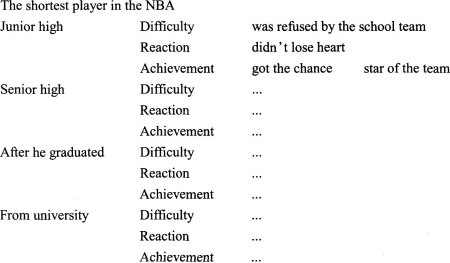
4. Students try to work out the key clues which lie in each paragraph. Students learn to draw a mind-map of the structure of the article as follows:
 
5. Students do a crossword puzzle by guessing the meaning of the new vocabulary in bold from the context with the help of English explanation given.
6. Students check their reading comprehension by playing a game called Basketball Journey.
Step Ⅲ Post-reading:
(1) Students try to introduce the story of Spud Webb with the help of their group mates.
(2) Students discuss the question in groups: What do you want to say to these people, Spud Webb, the coach who refused him and the coach who received him7
(3) Finishing the question "What have you learned about Spud Webb and NBA "in KWL chart, students come to have a scientific attitude that hard work and persistence are the key to success.
Step IV Homework
(1) Retell Spud Webb´s story, record their voice and send the recording to teacher´s E-mail.
(2) Read more articles online about those who never give up.
找试题 · 找答案 · 找资料 在线模考