简答题
初中英语
题号 #5375417
设计任务:请阅读下面学生信息和听力语言素材,设计20分钟的听力教学方案。教案没有固定格式,但必须包含下列要点:
●teaching objectives
●teaching contents
●key and difficult points
●major steps and time allocation
●activities and justifications
教学时间:20分钟
学生概况:某城镇普通中学八年级(初中二年级)学生,班级人数40人。多数学生已经达到《义务教育英语课程标准》(2011年版)三级水平。学生课堂参与积极性一般。
语言素材:
Part 1
Last Sunday,Jane took the children on a picnic.
Jane:Shall we have a treasure hunt?
John, Peter, Pasty, Annie : Oh, yes !
Jane hid some coins and drew a map. She gave the children the map and a set of clues. They found the treasure very quickly.
Part 2
Annie :The treasure isn't very valuable. Can we have another treasure hunt? Can you make the treasure more valuable?
Pasty:The hiding place isn't very interesting. Can you make it more interesting?
John :The map is very easy. Can you make it more difficult?
Jane hid something more valuable. She hid it in a more interesting place, and she gave the children a more difficult map.
Part 3
They looked for two hours but they could not find the treasure. Jane was not sorry. It was her new watch.
参考答案
暂无
答案解析
Teaching Objectives:
( 1 ) Knowledge and skills
①Students review the comparative form.
②Students get specific information from the listening material and conclude the main idea of each part.
(2) Process and methods
Students use listening skills such as predicting, in-felring, note-taking to do tasks and exercises.
( 3 ) Emotional attitudes and values
Students know how to evaluate something and ex-press their own ideas.
Teaching Contents:
The listening material is about a treasure hunt game.
The language focus is the comparative form.
Teaching Key Points:
Students listen to the material and clearly understand it.
Teaching difficult points:
Students efficiently get specific information from the material through listening.
Teaching procedures:
Step 1 Pre-listening(3 minutes)
Activity: About you
Let students answer some questions and give their own opinions.
①Which film is more interesting?
②Which subject is more difficult?
③Which sport is more exciting?
④Which thing is more valuable?
(Justification:The activity will ensure students initially perceive the language in the listening material. )
Step 2 While-listening( 10 minutes)
Activity 1 Fill in the blanks
T: Please listen to the first part of the text and fill in the blanks.
①Jane took the children_________.
②Jane hid_________and_________.
③Jane gave the children _________ and__________.
④The children _________ very quickly.
The answer: ① on a picnic ; ② some coins ; drew a map ;③the map ; a set of clues; ④found the treasure
(Justification: This activity is designed to develop students' ability to extract useful information. )
Activity 2 Question time
T:Please listen to the second part. Then let's ask and answer questions between boys and girls by imitating the language in the material. For example:
S1 :Can you make the treasure more valuable?
$2 :Yes ,I will hide something more valuable.
(Justification: This activity will develop students'ability to convert the input information to output information. )
Activity 3 Guess the end
T: As we have already learned the first two parts, how about the third part? Please" guess the end" in your group. Did the children find the treasure? What was the treasure in the third part?
After discussion for several minutes, some students share their prediction. Then, they listen to the third part to find out the right answer.
(Justification:The guess same can relax the listening at mosphereandmaintainstudents'interestin listening. )
Step 3 Post-listening(7 minutes)
Activity 1 Retell the story
Students rearrange the hstening material into a logi- cal story and write the story in their notebook. Then,students are divided into groups, four in one group, to discuss their story. Each group should select the best one and choose a representative to read the story to the whole class.
(Justification: This activity can examine students'understanding of the listening material. )
Activity 2 Survey
T:If you have a valuable thing, where will you hide it? We'll have a survev about it
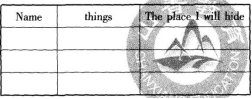
( Justification : The survey can apply the knowledge into real life. )
Homework:
(1) Create a treasure hunt with your friends after class and have fun.
(2) Please write a passage about what you have learned in class.
(Justification:The homework extends the class activity to real life and also trains students' writing skills. )
( 1 ) Knowledge and skills
①Students review the comparative form.
②Students get specific information from the listening material and conclude the main idea of each part.
(2) Process and methods
Students use listening skills such as predicting, in-felring, note-taking to do tasks and exercises.
( 3 ) Emotional attitudes and values
Students know how to evaluate something and ex-press their own ideas.
Teaching Contents:
The listening material is about a treasure hunt game.
The language focus is the comparative form.
Teaching Key Points:
Students listen to the material and clearly understand it.
Teaching difficult points:
Students efficiently get specific information from the material through listening.
Teaching procedures:
Step 1 Pre-listening(3 minutes)
Activity: About you
Let students answer some questions and give their own opinions.
①Which film is more interesting?
②Which subject is more difficult?
③Which sport is more exciting?
④Which thing is more valuable?
(Justification:The activity will ensure students initially perceive the language in the listening material. )
Step 2 While-listening( 10 minutes)
Activity 1 Fill in the blanks
T: Please listen to the first part of the text and fill in the blanks.
①Jane took the children_________.
②Jane hid_________and_________.
③Jane gave the children _________ and__________.
④The children _________ very quickly.
The answer: ① on a picnic ; ② some coins ; drew a map ;③the map ; a set of clues; ④found the treasure
(Justification: This activity is designed to develop students' ability to extract useful information. )
Activity 2 Question time
T:Please listen to the second part. Then let's ask and answer questions between boys and girls by imitating the language in the material. For example:
S1 :Can you make the treasure more valuable?
$2 :Yes ,I will hide something more valuable.
(Justification: This activity will develop students'ability to convert the input information to output information. )
Activity 3 Guess the end
T: As we have already learned the first two parts, how about the third part? Please" guess the end" in your group. Did the children find the treasure? What was the treasure in the third part?
After discussion for several minutes, some students share their prediction. Then, they listen to the third part to find out the right answer.
(Justification:The guess same can relax the listening at mosphereandmaintainstudents'interestin listening. )
Step 3 Post-listening(7 minutes)
Activity 1 Retell the story
Students rearrange the hstening material into a logi- cal story and write the story in their notebook. Then,students are divided into groups, four in one group, to discuss their story. Each group should select the best one and choose a representative to read the story to the whole class.
(Justification: This activity can examine students'understanding of the listening material. )
Activity 2 Survey
T:If you have a valuable thing, where will you hide it? We'll have a survev about it
( Justification : The survey can apply the knowledge into real life. )
Homework:
(1) Create a treasure hunt with your friends after class and have fun.
(2) Please write a passage about what you have learned in class.
(Justification:The homework extends the class activity to real life and also trains students' writing skills. )
你可能感兴趣的试题
A.progressive assimilation
B.liaison
C.regressive assimilation
D.incomplete plosive
A.stops
B.fricatives
C.affricates
D.plosives
A.Akin to
B.Prior to
C.In addition to
D.With reference to