简答题
初中英语
题号 #5644842
设计任务:
请阅读下面的学生信息和语言素材,设计20分钟的听说教学方案。教案没有固定格式,
但须包含下列要点:
·teachingobjectives
·teachingcontents
·key and difficult points
·major steps and time allocation
·activitiesand justifications
教学时间:20分钟
学生概况:某城镇普通中学七年级(初中一年级)学生,班级人数40人。多数学生已经达
到《义务教育英语课程标准(2011年版)》二级水平。学生课堂参与积极性一般。
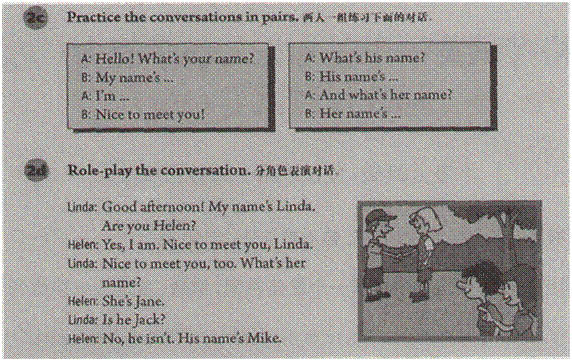
语言素材:
参考答案
暂无
答案解析
【参考设计】
TeachingContents:
Thislesson is mainly about greetings and self-introduction.
TeachingObjectives:
(1)Knowledge objectives
①Studentscan master the basic expressions of greeting.
②Students can master the sentence pattern:
--What'syour/his/her name?
--My/His/Hername is .../I'm ...
(2)Ability objective
Studentscan introduce themselves or friends to others fluently and learn to makefriends.
(3)Emotional objective
Studentscan be very interested in talking with others in English, and can be fond oftaking part in class activities.
TeachingKey and Difficult Points:
(1)Teaching key point
How tomake students master the basic expressions of greeting and the key sentencepattern.
(2)Teaching difficult point How to help students foster their interest in learningEnglish and use these sentences in daily life.
MajorSteps:
Step 1Pre-listening (6 minutes)
(1) Askstudents to discuss what they will talk about when they meet others for thefirst time. Then invite two students to share their answers with all ofstudents.
(2) Askstudents to practice the conversation of 2c in pairs and then invite some pairsto show it in front of the class.
(Justification:Discussion can help students exchange ideas with others and can strengthentheir speaking ability.
Practicethe short conversation can make a good preparation for their followinglearning.)
Step 2While-listening (8 minutes)
(1) Askstudents to listen to the conversation of 2d for the first time and summarizethe main idea of this
dialogue.
(2) Askstudents to read after the conversation of 2d and find out key expressions andsentence patterns. Pay
attentionto the pronunciation and intonation.
(Justification:Listening to the conversation can help students improve their summarizingability and master the
keysentence patterns. Reading after the conversation can improve students'pronouncing accuracy.)
Step 3Post-listening (6 minutes)
(1) Askstudents to role-play the conversation of 2d. And then invite some students toperform in front of the
classand others give evaluations.
(2) Askstudents to practice introducing themselves and others in groups.
(Justification:Students can use the expressions and sentence patterns they have learnedthrough performing in
front oftheir classmates and their courage to speak English in public can getstrengthened.)
你可能感兴趣的试题
A.One.
A. One.
B. Two.
B. Two.
C.Three.
C.Three.
D. Four.
D. Four.
A. Standover there ↘and you'll be able to see it↗better.
B. Standover there ↘ and you'll be able to see it ↘better.
C. Standover there↗and you'll be able to see it↗ better.
D. Standover there↗ and you'll be able to see it↘better.
A.Having convinced
A.Having convinced
B.Been convinced
B. Beenconvinced
C.Convincing
C.Convincing
D.Convinced
D.Convinced