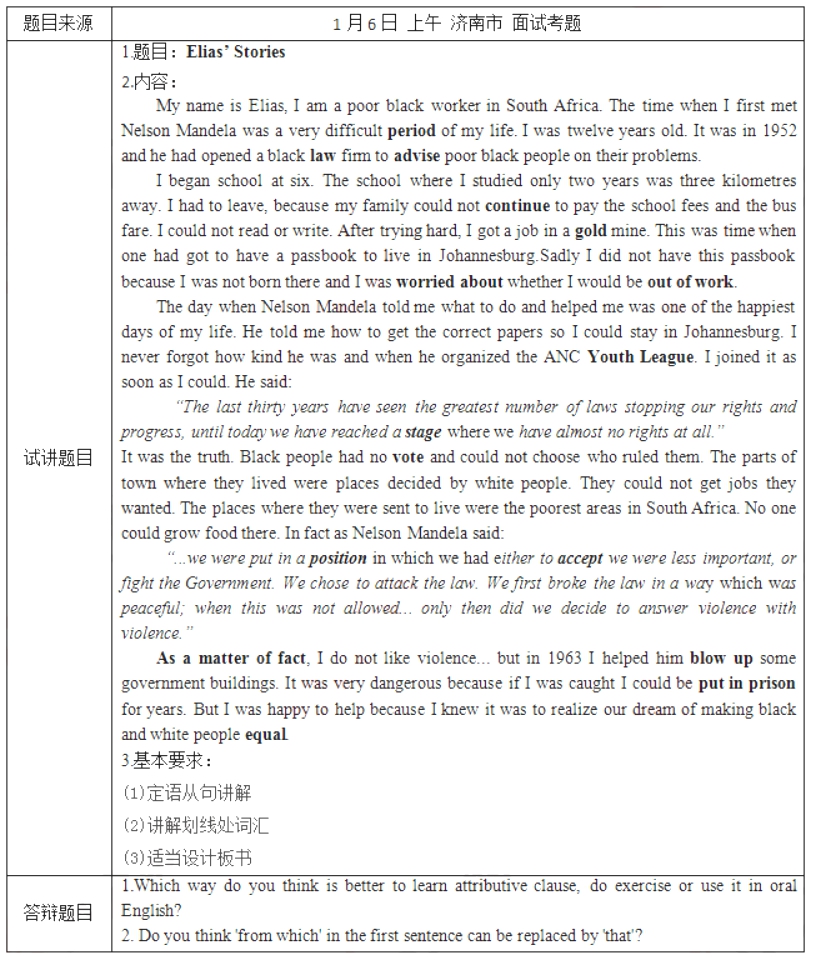
题目:
2.内容:
I am always the first one to get to the office. Meetings and phone calls take up a large part of the day.Every minute of the day is filled with urgent matters.By around eight o'clock,I usually find some time to do my own paperwork and answer some personal e-mail.
3.基本要求:
(1)十分钟全英试讲
(2)讲解划线处词汇
答辩题目What will you do if students can’t understand the words you explain?
参考答案
暂无
答案解析
【教案】
Teaching aims:
Knowledge aim:
Students are able to master the meaning and the usage of underlined words and know the relative words and phrases:get to, take up, be filled with,arrive in/at, occupy,occupation,be full of
Ability aims:
(1) Students can guess the meaning of new words and phrases while reading
(2)After this lesson, students can learn how to use these and relative words and phrases to describe their daily life.
Emotional aim:
Students are able to love learning English after this lesson.
Key and difficult point:
Key Point: master the meaning and the usage of new words and phrases :get to, take up, be filled with,arrive in/at, occupy,occupation,be full of
Difficult Point: understand the meaning of the new words and phrases and use them in their daily life.
Teaching procedures:
Step 1: Warming-up 1. Greetings.
2. Play a video about a person who is busy with his work life and ask students several questions:
What can you see from this video?
Can you describe information in detail using your own language?
Step 2: Presentation
1. Present the paragraph on the PPT. And then ask students to read this passage to guess the meaning of underlined words and phrases. Give students 5 minutes to discuss in the group. And Invite students to give the answers.
2.Then paraphrase these words in English using the pictures. For example, get to means arrive in/at or reach. If something takes up a particular amount of time, space, or effort, it uses that amount. At the same time, present a picture with a man coming the office through the door.
3. Besides introduce the relative phrases, such as take over, take on, take in and so on.
Step 3: Practice
1.Make sentences: ask students to make sentences using the new words. Then correct the grammar mistakes and give the positive feedbacks.
2.Make up a new story: Give students several pictures in disorder and ask them to describe these pictures using the sentences which concludes the new words that have just learnt. Then rank these sentences into a new story. Give students 5 minutes to discuss with their deskmates and then invite several students to share their stories.
Step4: Production
1. Discussion: Ask students to use the words and expressions learnt to describe their daily life with their partner. After 5 minutes, invite several students to share their daily life.
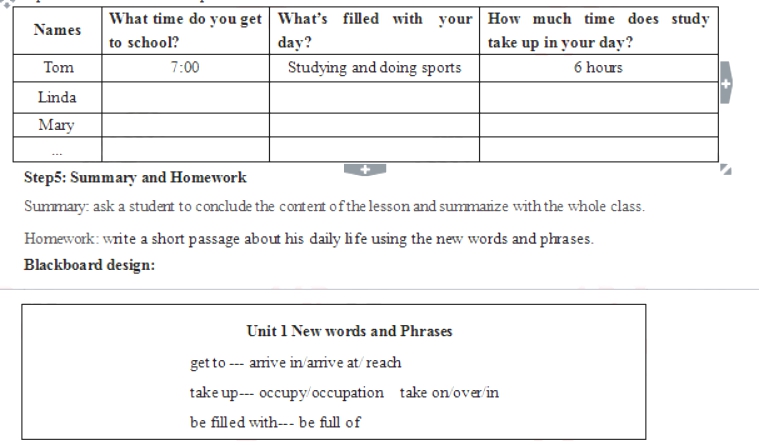
2. Survey: Ask students to make a survey about your classmates’ daily life using three questions in the group. Four person in one group and finish the chart in 10 minutes.Then invite the representatives to make a report for the whole class.
【答辩题目解析】
What will you do if students can’t understand the words you explain?
【参考答案】
First, if students can’t understand the words that I explain, I will change another way to try my best way to explain this words again. Maybe last way isn’t fit for our students. For example, our students are in high school so last way may be the paraphrase, which is just in language not use other methods or approaches. I will add the video or pictures to help students to understand the new words.
Second, after class, I also need to reflect myself. Not only do I need to learn more ways to use in our class, but also I should know more my students, especially their understanding to the new knowledge in case the same situation comes again.
2. Do you have the experience in teaching?
【参考答案】Yes, I do. I have taught a teenager in high school. She was the junior. I mainly taught her grammar. I found her grammar was not very systematic. So I taught her from the grammar in words to the grammar in sentences in order to make her master the whole grammar, especially those always appeared in her exams. And during the teaching, I find the most important that it is the teacher should have a better understanding of the whole grammar and the high school English course. Besides, the teacher should pay more attention to the patience. It will make students relax when their learning and get along with the students.
Teaching aims:
Knowledge aim:
Students are able to master the meaning and the usage of underlined words and know the relative words and phrases:get to, take up, be filled with,arrive in/at, occupy,occupation,be full of
Ability aims:
(1) Students can guess the meaning of new words and phrases while reading
(2)After this lesson, students can learn how to use these and relative words and phrases to describe their daily life.
Emotional aim:
Students are able to love learning English after this lesson.
Key and difficult point:
Key Point: master the meaning and the usage of new words and phrases :get to, take up, be filled with,arrive in/at, occupy,occupation,be full of
Difficult Point: understand the meaning of the new words and phrases and use them in their daily life.
Teaching procedures:
Step 1: Warming-up 1. Greetings.
2. Play a video about a person who is busy with his work life and ask students several questions:
What can you see from this video?
Can you describe information in detail using your own language?
Step 2: Presentation
1. Present the paragraph on the PPT. And then ask students to read this passage to guess the meaning of underlined words and phrases. Give students 5 minutes to discuss in the group. And Invite students to give the answers.
2.Then paraphrase these words in English using the pictures. For example, get to means arrive in/at or reach. If something takes up a particular amount of time, space, or effort, it uses that amount. At the same time, present a picture with a man coming the office through the door.
3. Besides introduce the relative phrases, such as take over, take on, take in and so on.
Step 3: Practice
1.Make sentences: ask students to make sentences using the new words. Then correct the grammar mistakes and give the positive feedbacks.
2.Make up a new story: Give students several pictures in disorder and ask them to describe these pictures using the sentences which concludes the new words that have just learnt. Then rank these sentences into a new story. Give students 5 minutes to discuss with their deskmates and then invite several students to share their stories.
Step4: Production
1. Discussion: Ask students to use the words and expressions learnt to describe their daily life with their partner. After 5 minutes, invite several students to share their daily life.
2. Survey: Ask students to make a survey about your classmates’ daily life using three questions in the group. Four person in one group and finish the chart in 10 minutes.Then invite the representatives to make a report for the whole class.
【答辩题目解析】
What will you do if students can’t understand the words you explain?
【参考答案】
First, if students can’t understand the words that I explain, I will change another way to try my best way to explain this words again. Maybe last way isn’t fit for our students. For example, our students are in high school so last way may be the paraphrase, which is just in language not use other methods or approaches. I will add the video or pictures to help students to understand the new words.
Second, after class, I also need to reflect myself. Not only do I need to learn more ways to use in our class, but also I should know more my students, especially their understanding to the new knowledge in case the same situation comes again.
2. Do you have the experience in teaching?
【参考答案】Yes, I do. I have taught a teenager in high school. She was the junior. I mainly taught her grammar. I found her grammar was not very systematic. So I taught her from the grammar in words to the grammar in sentences in order to make her master the whole grammar, especially those always appeared in her exams. And during the teaching, I find the most important that it is the teacher should have a better understanding of the whole grammar and the high school English course. Besides, the teacher should pay more attention to the patience. It will make students relax when their learning and get along with the students.