简答题 英语(二)
题号 #5826239
进入在线模考

参考答案

暂无

答案解析

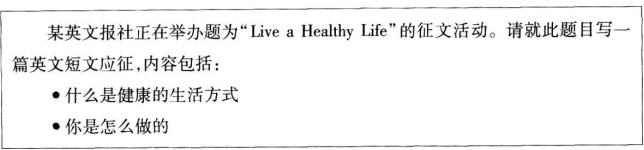
范文(略)
1)评分原则
本题总分为30分,按5个档次评分。
阅卷人应就总体印象给分,而不是按照语言错误的数量扣分。
评分时,先根据文章的内容要点、篇章结构和语言运用初步确定其所属的档次,然后依照该档次的具体
要求酌情增减分数,最后给分。
应避免分数趋中现象,即不能只给中间档次的分数。该给高分时就应给高分(包含满分),该给低分时就应给低分(包含0分)。
拼写和标点符号是语言准确性的一个方面。评分时,应视其对交际的影响程度予以考虑。英式、美式
拼写及用法均可接受。
如书写较差难以辨认,以致影响交际,或字数明显少于要求,将分数降低一个档次。

你可能感兴趣的试题

1 根据下面资料,回答题
The Inventor of LED
When Nick Holonyak set out to create a new kind of visible lighting using semiconductor(半导体) alloys(合金), his colleagues thought he was unrealistic.Today, his discovery of light-emitting diodes, or LEDs,are used in everything from DVDs to alarm clocks to airports. Dozens of his students have continued his work, developing lighting used in traffic lights and other everyday technology.
On April 23,2004, Holonyak received the $500,000 Lemelson-MIT Prize at a ceremony in Washington. This marks the 10th year that the Lemelson-MIT Program at the Massachusetts Institute of Technology (MIT) has given the award to prominent inventors.
"Anytime you get an award, big or little, it' s always a surprise," Holonyak said.
Holonyak ,75, was a student of John Bardeen, an inventor of the transistor( 晶体管), in the early 1950s. After graduate school, Holonyak worked at Bell Labs. He later went to General Electric,where he invented a switch now widely used in house dimmer switches.
Later, Holonyak started looking into how semiconductors could be used to generate light. But while his colleagues were looking into how to generate invisible light, he wanted to generate visible light. The LEDs he invented in 1962 now last about 10 times longer than incandescent bulbs, and are more environmentally friendly and cost effective.
Holonyak, now a professor of electrical and computer engineering and physics at the University of Illinois ,said he suspected that LEDs would become as commonplace(平凡的) as they are today,but didn' t realize how many uses they would have.
"You don' t know in the beginning. You think you' re doing something important, you think it' s worth doing, but you really can' t tell what the big payoff(成果) is going to be, and when, and how.You just don' t know," he said.
The Lemelson-MIT Program also recognized Edith Flanigen ,75, with the $100,000 Lemelson-MIT Lifetime Achievement Award for the work on a new generation of "molecular(分子) sieves (滤网)" that can separate molecules by size.
Holonyak' s colleagues thought he would fail in his research on LEDs at the time when he started it.
A. True
B. False
C. Not Given
找试题 · 找答案 · 找资料 在线模考