简答题
题号 #5906011

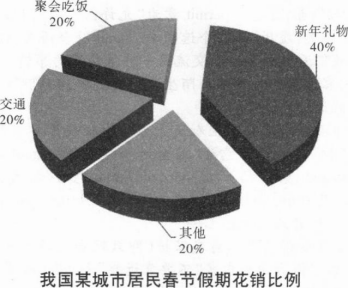
Write an essay based on the following chart. In your writing, you should
(1) interpret the chart, and
(2) give your comments.
You should write about 150 words on the ANSWER SHEET. ( 15 points)
进入在线模考

参考答案

暂无

答案解析

The pie chart above presents the different proportion of residents' consumption in a Chinese city during Spring Festival. To be specific, the percentage of consumption on New Year's gifts, party,traffic and others is 40%,20%,20% and 20% respectively. Surprisingly, the pertinent number about gifts is 40%. Isolated as the figures seem to be, they are connected to one another closely.
Undoubtedly, the purpose of the graph is to showcase the diversity of residents'consumption during holidays in China, especially over-consumption on gifts as a frequent way of interpersonal communication. What exactly contribute to this phenomenon? It's a thought-provoking question. First and foremost, advertisements of mass media, such as radio, television and Internet, might be misleading.
Plus, pertinent action taken by the public to put an end to this trend might be little and limited.
Therefore, people, men and women, old and young, in mounting numbers are spending too much on holiday gift which floods everywhere.
To sum up, there is an upward tendency for people these days to spend money on festival presents rather than other things, which I believe will not change in a short time. To reverse the trend is not a piece of cake, which requires a good awareness of consumption value and interpersonal communication. Only in this way can we have colorful festivals and relaxing times.
【写作点拨】
今年的饼状图(pie chart)作文避开了热点话题,考查主题中规中矩,是关于我国某城市居民春节假期花销比例问题(生活类话题)。针对这篇文章,三个段落的结构分别如下:
第一段描述这个饼状图,包括其中各自的数据组成,并且可以将其中最大的一部分,即新年礼物的数据突出。最后再简要地交代一句,尽管数字看似孤立,但是数字之间联系紧密。
第二段的写法多种多样,如果针对这种送新年礼物的风气进行评析,可以作为一个负面话题来分析原因或者举例子;也可以作为一个正面话题来谈论,谈一谈这种人际交往的形式——互送礼物,增进朋友家人的感情;甚至可以作为一个中立话题来谈一谈在不同的方面的假期开销,消费方式的多种多样。
第三段的写法就是传统地预测一下趋势,对这个事情简要评析一下,再对多姿多彩的社会
和假期生活憧憬一下即可。可能用到的单词有:消费(consume,consumption),聚会(party,reunion),交通(traffic),新年礼物(gifts)。

你可能感兴趣的试题

1 根据下面资料,回答题
Happy people work differently. They're more productive, more creative, and willing to take greater risks. And new research suggests that happiness might influence 1 firms work, too.
Companies located in place with happier people invest more, according to a recent research paper. 2 , firms in happy places spend more on R&D( research and development). That's because happiness is linked to the kind of longer-term thinking 3 for making investment for the future.
The researchers wanted to know if the 4 and inclination for risk-taking that come with happiness would 5 the way companies invested.  So they compared U. S.  cities' average happiness 6 by Gallup polling with the investment activity of publicly traded firms in those areas.
7 enough, firms' investment and R&D intensity were correlated with the happiness of the area in which they were 8 . But is it really happiness that's linked to investment, or could something else about happier cities 9 why firms there spend more on R&D?To find out, the researchers controlled for various 10 that might make firms more likely to invest--like size, industry,and sales--and for indicators that a place was 11 to live in, like growth in wages or population.
The link between happiness and investment generally 12 even after accounting for these things.
The correlation between happiness and investment was particularly strong for younger firms, which the authors 13 to "less confined decision making process"and the possible presence of "younger and less 14 managers who are more likely to be influenced by sentiment. " The relationship was 15
stronger in places where happiness was spread more 16. Firms seem to invest more in places where most people are relatively happy, rather than in places with happiness inequality.
17 this doesn't prove that happiness causes firms to invest more or to take a longer-term view, the authors believe it at least 18 at that possibility. It's not hard to imagine that local culture and sentiment would help 19 how executives think about the future. "It surely seems plausible that happy people would be more forward-thinking and creative and 20 R&D more than the average, " said one researcher.
第(1)题选
A.why
A.why
A.why
B.where
B.where
B.where
C.how
C.how
C.how
D.when
D.when
D.when
A.In return
A.In return
B.In particular
B.In particular
C.In contrast
C.In contrast
D.In conclusion
D.In conclusion
A.sufficient
A.sufficient
B.famous
B.famous
C.perfect
C.perfect
D.necessary
D.necessary
找试题 · 找答案 · 找资料 在线模考