简答题
初中英语
题号 #5968894
设计任务:请阅读下面的学生信息和语言素材,设计20分钟的英语阅读教学方案。教案没有固定格式,但须包含下列要点:
·teaching objectives
·teaching contents
·key and difficult points
·major steps and time allocation
·activities and justifications
教学时间:20分钟
学生概况:某城镇普通中学八年级(初中二年级)学生,班级人数40人。多数学生已达到《义务教育英语课程标准(2011年版)》三级水平。学生课堂参与积极性一般。
语言素材:
参考答案
暂无
答案解析
【参考设计】
Teaching Contents:
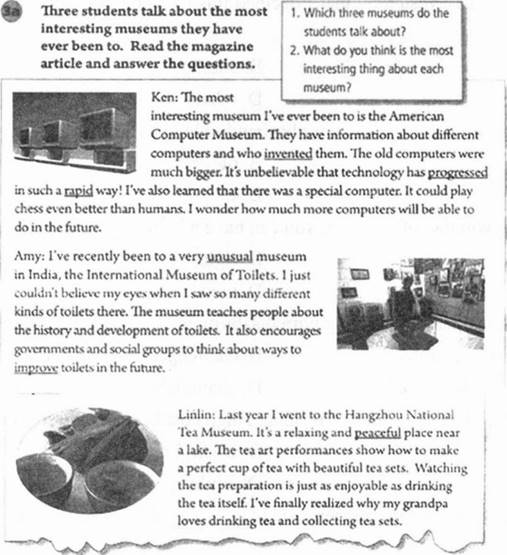
Theteaching material for this reading lesson is a magazine article about three unusual museums introduced by three people.
Teaching Objectives:
(1)Knowledge objectives
①Students can grasp the meanings of the words "invent, progress, rapid,unusual, improve, peaceful" .
②Students can know more about the history of computer, toilet and tea.
(2) Ability objective
Students can acquire the reading ability to find the detailed information through answering the questions given.
(3)Emotional objective
Students can be interested in the history of computer, toilet, and tea.
Teaching Key and Difficult Points:
(1)Teaching Key Point
How to make students understand the main idea of the article.
(2)Teaching Difficult Point
Make students acquire the ability to find the answers to the questions.
Major Steps:
Step 1Pre-reading (5 minutes)
Activity1 Teaching new words
Theteacher teaches new words by showing some pictures on the PPT.
Theteacher shows two pictures on the PPT: one is a train, the other is ahigh-speed rail train.
T: Whichis faster? The first one or the second one?
Ss: Thesecond one.
T: Yes,very good. We can say the train is slow, while the high-speed rail train is rapid.
Then theteacher leads students to read the word "rapid" a few times.
Theteacher teaches other words in the same way.
(Justification:Students can get the idea of the article easily after learning the new words.)
Activity2 Predicting
The teacher asks students to predict what the article is about. The multiplechoices to this question are given.
A. Themuseums about computer, toilet and tea.
B. Thecomputer, toilet and tea in the past
C. Thecomputer, toilet and tea in the future
(Justification:The activity can reduce the difficulty for the following reading.)
Step 2While-reading (10 minutes)
Activity1 Fast reading
T: Nowread the passage quickly and check if you have made the right prediction beforeand answer the question.
Which three museums do the students talk about?
(Justification:Fast reading cultivates students' ability to find the main idea quickly.)
Activity2 Careful reading
T: Read the article again and find the answers to the following questions.
(1) What does Ken say about the American Computer Museum?
(2) What can we learn at the International Museum of Toilets?
(3) Why is the Hangzhou National Tea Museum a nice place to enjoy tea?
(4) What do you think is the most interesting thing about each museum?
(Justification:Careful reading trains students' reading ability to scan for detailedinformation and thinking ability.Students can have a good understanding of the article after answering the questions.)
Step 3 Post-reading(5 minutes)
Activity Designing and showing
The teacher divides the whole class into groups of four. Then the teacher asks each group to talk about what the computer and toilet will be like in the future and design the most ideal model. After students finish, the teacher asks
some groups to show or describe their models in front of the class. And then the teacher gives evaluations of their performances.
(Justification:Designing models can stimulate students' imagination and innovation and make them have a deeper impression of the knowledge they've learned in class.)
你可能感兴趣的试题
A./ʌ/
B./ə/
C./ɒ/
D./ɑː/
A.Avoiceless alveolar fricative.
B.Avoiceless post-alveolar affricate.
C.A voicedpalatal affricate.
D.Avoiced alveolar fricative.
A.other
A.other
A.other
B.another
B.another
B.another
C.the other
C.the other
C.theother
D.others
D.others
D.others