简答题
初中英语
题号 #5968927
设计任务:请阅读下面的学生信息和语言素材,设计20分钟的英语阅读教学方案。教案没有固定格式,但须包含下列要点:
·teaching objectives
·teaching contents
·key and difficult points
·major steps and time allocation
·activities and justifications
教学时间:20分钟
学生概况:某城镇普通中学初中三年级第一学期学生,班级人数40人。多数学生已达到《义务教育英语课程标准》四级水平。学生课堂参与积极性一般。
语言素材:
参考答案
暂无
答案解析
【参考设计】
Teaching Contents:
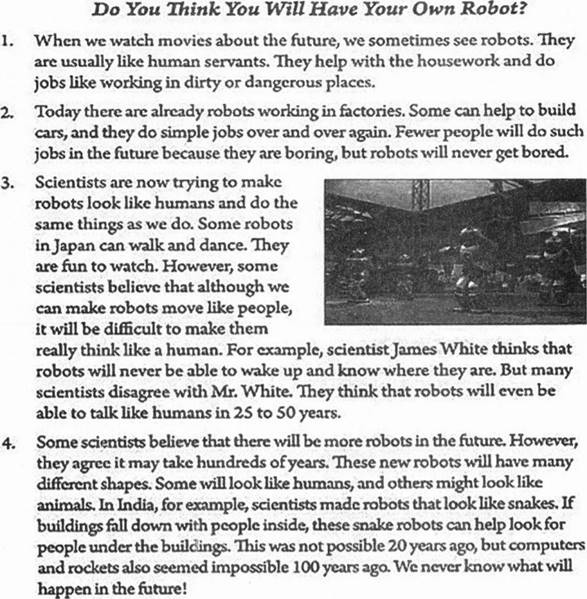
This article for the reading lesson introduces the state of robots and scientists' different views on robots.
Teaching Objectives:
(1)Knowledge objective
Students can know more knowledge about robots and master the usage of the future indefinite tense.
(2)Ability objective
Students can improve their reading and speaking abilities, and develop their imagination.
(3)Emotional objective
Students can be interested in robots.
Teaching Key Point:
Students can learn the future indefinite tense.
Teaching Difficult Point:
Students can use "will" to make predictions in daily life.
Major Steps:
Step 1Pre-reading (4 minutes)
Show some pictures about robots and ask students some questions.
(1) Do you know what robots can do for us now?
(2) Can you imagine what robots will become in the future?
(Justification:This step can catch students' attention and lay better English learning surroundings for the further study.)
Step 2While-reading (10 minutes)
(1) Fast reading
Ask students to read this passage quickly and conclude the main idea of each paragraph, then choose some students to share their ideas.
(2)Careful reading
① Ask students to read this passage carefully and judge the following statements as true or false.
Some scientists think we will have our own robots in the future. ()
James White thinks that it's easy for a robot to do the same things as a person. ()
Some scientists think that robots can talk to people now. ()
Robots working in factories look more like huge arms. ()
After an earthquake now, a snake robot can help look for people under buildings.()
② Ask students to underline all the sentences of the future indefinite tense and teach them how to use "will" to make predictions. Then divide students into several groups to talk about the futureby using "will".
(Justification:This step can help students to get a better understanding of this article and master the usage of the future indefinite tense.)
Step 3Post-reading (5 minutes)
(1) Ask students to talk about these questions: In what ways do you think a robot will help or block you in the future? What do you think of the future of robots, optimistic or pessimistic?
(2) Ask students to write down their ideas about robots and invite some to share their ideas with classmates.
(Justification:This step can improve students' writing and speaking abilities.)
Step 4ummary and Homewor(1 minutes)
Ask students summarize the lesson together. Make sentences by using new words and key sentence structures.
你可能感兴趣的试题
A.systeMatic
B.Systematic
C.syStematic
D.systemaTic
A.focus
A.focus
B.sense
B.sense
C.conflict
C.conflict
D.conscience
D.conscience