简答题
初中英语
题号 #5969092
设计任务:请阅读下面的学生信息和语言素材,设计20分钟的英语听说教学方案。教
案没有固定格式,但须包含下列要点:
·teachingobjectives
·teachingcontents
·key and difficult points
·major steps and time allocation
·activitiesand justifications
教学时间:20分钟
学生概况:某城镇普通中学七年级(初中一年级)学生,班级人数40人。多数学生已达到《义务教育英语课程标准(2011年版)》二级水平。学生课堂参与积极性一般。
语言素材:
Conversation1
Tom:Hey, Peter.
Peter:Hi, Tom.
Tom:How's the weather down there in Shanghai?
Peter:It's cloudy.How's the weather in Moscow?
Tom:It's snowing right now.
Conversation2
Peter:Hi, Aunt Sally.
AuntSally: Hello, Peter.
Peter:How's the weather in Boston?
AuntSally: Oh, it's windy.
Conversation3
Peter:So, how's the weather in Beijing?
Julie:It's sunny.
参考答案
暂无
答案解析
【参考设计】
TeachingContents:
Theteaching material for this listening and speaking class is three dialoguesabout the weather.
TeachingObjectives:
(1)Knowledge objectives
①Students can master some words about weather, such as "cloudy, snow,windy, sunny" .
②Students can talk about weather with others by using the sentence patterns"How's the weather in ...?"
"It's..." .
(2)Ability objectives
①Students can improve their listening abilities through extensive listening andintensive listening.
②Students can develop their speaking abilities through role-play.
(3)Emotional objectives
①Students are willing to communicate with each other in English.
②Students can become interested in using English to describe weather in theirdaily life.
TeachingKey Point:
Studentscan master the words about weather and sentence patterns "How's theweather in ...?" "It's ..." .
TeachingDifficult Point:
Studentscan use new sentence patterns to talk about the weather correctly.
MajorSteps:
Step 1Pre-listening (4 minutes)
Teachthese new words by presenting pictures of different weather conditions on thescreen, and then, let students read the words after the tape.
(Justification:This step can arouse students' interest and pave the way for students'listening activities.)
Step 2While-listening (10 minutes)
Task 1
Play thetape and ask students to summarize the main idea, then talk about and writedown which cities are mentioned in the listening material.
Forexample: Shanghai, Moscow, Boston and Beijing.
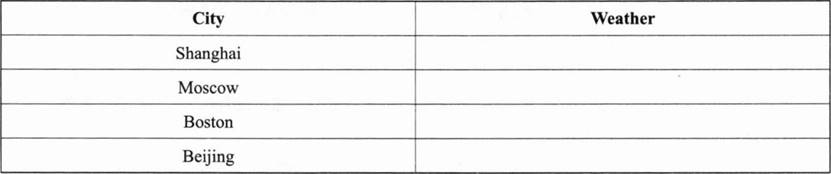
Task 2
Askstudents to listen to the tape for the second time and fill in the followingtable.
Task 3
Askstudents to find out the key sentences describing weather. Then let studentspractice the sentence patterns by using the new words.
E.g.--How's the weather in Beijing?
--It'ssunny.
(Justification:Through extensive listening, students will grasp the main content of thislistening material.
Throughintensive listening, students will enhance their ability of grasping specificinformation.)
Step 3Post-listening (6 minutes)
Groupwork: Role-play
Askstudents to role-play in groups of four. Students act as weather reporters togive weather forecast of different cities in turn. After 3 minutes, each groupwill choose a representative to perform it in front of the class.
Forexample:
Goodmorning, ladies and gentlemen. Here is the weather forecast of our city. It'scloudy tomorrow, and it's very cold, so you should wear more clothes when yougo outside. There is going to be a strong wind in the afternoon,and it will beraining the day after tomorrow.
(Justification:With practice, students can not only review the knowledge that they havelearned, but also develop their speaking ability.)
TeachingContents:
Theteaching material for this listening and speaking class is three dialoguesabout the weather.
TeachingObjectives:
(1)Knowledge objectives
①Students can master some words about weather, such as "cloudy, snow,windy, sunny" .
②Students can talk about weather with others by using the sentence patterns"How's the weather in ...?"
"It's..." .
(2)Ability objectives
①Students can improve their listening abilities through extensive listening andintensive listening.
②Students can develop their speaking abilities through role-play.
(3)Emotional objectives
①Students are willing to communicate with each other in English.
②Students can become interested in using English to describe weather in theirdaily life.
TeachingKey Point:
Studentscan master the words about weather and sentence patterns "How's theweather in ...?" "It's ..." .
TeachingDifficult Point:
Studentscan use new sentence patterns to talk about the weather correctly.
MajorSteps:
Step 1Pre-listening (4 minutes)
Teachthese new words by presenting pictures of different weather conditions on thescreen, and then, let students read the words after the tape.
(Justification:This step can arouse students' interest and pave the way for students'listening activities.)
Step 2While-listening (10 minutes)
Task 1
Play thetape and ask students to summarize the main idea, then talk about and writedown which cities are mentioned in the listening material.
Forexample: Shanghai, Moscow, Boston and Beijing.
Task 2
Askstudents to listen to the tape for the second time and fill in the followingtable.
Task 3
Askstudents to find out the key sentences describing weather. Then let studentspractice the sentence patterns by using the new words.
E.g.--How's the weather in Beijing?
--It'ssunny.
(Justification:Through extensive listening, students will grasp the main content of thislistening material.
Throughintensive listening, students will enhance their ability of grasping specificinformation.)
Step 3Post-listening (6 minutes)
Groupwork: Role-play
Askstudents to role-play in groups of four. Students act as weather reporters togive weather forecast of different cities in turn. After 3 minutes, each groupwill choose a representative to perform it in front of the class.
Forexample:
Goodmorning, ladies and gentlemen. Here is the weather forecast of our city. It'scloudy tomorrow, and it's very cold, so you should wear more clothes when yougo outside. There is going to be a strong wind in the afternoon,and it will beraining the day after tomorrow.
(Justification:With practice, students can not only review the knowledge that they havelearned, but also develop their speaking ability.)
你可能感兴趣的试题
A./t/
A./t/
B./d/
B./d/
C./Id/
C./Id/
D./It/
D./It/
A.Slapand clap.
B.Prideand prejudice.
C.Knockand dock.
D.Philosophyand geography.
A.chance
B.access
C.permission
D.attachment