简答题
初中英语
题号 #5969158
设计任务:请阅读下面的学生信息和语言素材,设计l5分钟的英语阅读教学方案。教
案没有固定格式,但须包含下列要点:
·teachingobjectives
·teachingcontents
·key and difficult points
·major steps and time allocation
·activitiesand justifications
教学时间:15分钟
学生概况:某城镇普通中学八年级(初中二年级)学生,班级人数40人。多数学生已达到《义务教育英语课程标准(2011年版)》三级水平。学生课堂参与积极性一般。
语言素材:
Have YouEver Been to Disneyland?
Most ofus have probably heard of Mickey Mouse and Donald Duck, and many other
famousDisney characters.Perhaps we have even seen them in movies.But have you everbeen to Disneyland? In fact, there are now several different Disneylandamusement parks around the world.
Disneylandis an amusement park, but we can also call it a theme park.It has all thenormal attractions that you can find at an amusement park, but it also has atheme.The theme, of course, is Disneyland movies and Disney characters.Forexample, you can find a roller coaster in amusement parks, but in Disneyland,the theme of the roller coaster is Disney characters.This means that you canfind Disney characters all over the roller coaster.You can also watch Disneymovies, eat in Disney restaurants and buy Disney gifts.And you can see Disneycharacters walking around Disneyland all the time!
Have youever heard of a Disney Cruise? These are huge boats that also have Disneytheme.
You cantake a ride on the boat for several days, and you can sleep and eat on board.Thereare also many attractions on board, just like any other Disneyland, you canshop, go to Disneyland parties,and eat with Mickey Mouse! The boats takedifferent routes, but they all end up in the same place.
That isDisney's own land.
It isjust so much fun in Disneyland!
参考答案
暂无
答案解析
【参考设计】
TeachingContents:
It's areading class about reading a passage about an amusement park.
TeachingObjectives:
(1)Knowledge objective
Studentscan know about the Disneyland and what a theme park is.
(2)Ability objectives
①Students can develop their reading skills through fast reading and carefulreading.
②Through pair work, students can describe a theme park.
(3)Emotional objective
Throughreading the passage, students can enjoy the beauty of Disneyland and theiraffection for life can be cultivated.
TeachingKey and Difficult Points:
(1) Howto help students grasp the main idea and detailed information of the passage.
(2) Howto enable students to master the structure of the passage and to make use of itin their description of a theme park.
MajorSteps:
Step 1Pre-reading (4 minutes)
(1) Askstudents whether they have ever heard about or been to the Disneyland, andwhether they like it, why or why not.
(2) Askstudents to make a prediction about what the passage talks about.
(Justification:This step leads students to predict the passage, and stimulates theirinterest.)
Step 2While-reading (8 minutes)
(1) Fastreading
Askstudents to read the passage quickly and divide the passage into three parts,and conclude the main idea of each part.
Mainidea:
Paragraph1--Introduction--Disneyland is scattered around the world.
Paragraphs2 and 3--Main body--Things one can do in Disneyland.
Paragraph4--Conclusion--It's fun in Disneyland.
(2)Careful reading
Askstudents to read Paragraphs 2 and 3 carefully and find out the answers to thefollowing questions:
① What'sthe theme of Disneyland?
② What'sthe Disney Cruise?
③ Whatcan you do in Disneyland?
Then,ask some of them to share their answers with the class.
(Justification:Fast reading can develop students' ability to get the general idea and carefulreading helps them understand the passage better.)
Step 3Post-reading (3 minutes)
(1) Askstudents to introduce a theme park to their partners based on the followingtable and use the means of expression in the passage.
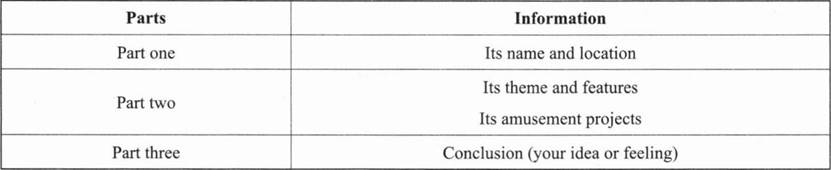
(2)Invite one student to introduce his or her theme park to the class, and askothers to draw a brief picture of this student's theme park.
(Justification:The two steps can lead students to practice what they have learnt in class.)
TeachingContents:
It's areading class about reading a passage about an amusement park.
TeachingObjectives:
(1)Knowledge objective
Studentscan know about the Disneyland and what a theme park is.
(2)Ability objectives
①Students can develop their reading skills through fast reading and carefulreading.
②Through pair work, students can describe a theme park.
(3)Emotional objective
Throughreading the passage, students can enjoy the beauty of Disneyland and theiraffection for life can be cultivated.
TeachingKey and Difficult Points:
(1) Howto help students grasp the main idea and detailed information of the passage.
(2) Howto enable students to master the structure of the passage and to make use of itin their description of a theme park.
MajorSteps:
Step 1Pre-reading (4 minutes)
(1) Askstudents whether they have ever heard about or been to the Disneyland, andwhether they like it, why or why not.
(2) Askstudents to make a prediction about what the passage talks about.
(Justification:This step leads students to predict the passage, and stimulates theirinterest.)
Step 2While-reading (8 minutes)
(1) Fastreading
Askstudents to read the passage quickly and divide the passage into three parts,and conclude the main idea of each part.
Mainidea:
Paragraph1--Introduction--Disneyland is scattered around the world.
Paragraphs2 and 3--Main body--Things one can do in Disneyland.
Paragraph4--Conclusion--It's fun in Disneyland.
(2)Careful reading
Askstudents to read Paragraphs 2 and 3 carefully and find out the answers to thefollowing questions:
① What'sthe theme of Disneyland?
② What'sthe Disney Cruise?
③ Whatcan you do in Disneyland?
Then,ask some of them to share their answers with the class.
(Justification:Fast reading can develop students' ability to get the general idea and carefulreading helps them understand the passage better.)
Step 3Post-reading (3 minutes)
(1) Askstudents to introduce a theme park to their partners based on the followingtable and use the means of expression in the passage.
(2)Invite one student to introduce his or her theme park to the class, and askothers to draw a brief picture of this student's theme park.
(Justification:The two steps can lead students to practice what they have learnt in class.)
你可能感兴趣的试题
A.connotative
A.connotative
B.conceptual
B.conceptual
C.associative
C.associative
D.complementary
D.complementary
A.continued
A.continued
A.continued
B.immediate
B.immediate
B.immediate
C.careful
C.careful
C.careful
D.general
D.general
D.general