简答题
题号 #6015936

Directions:
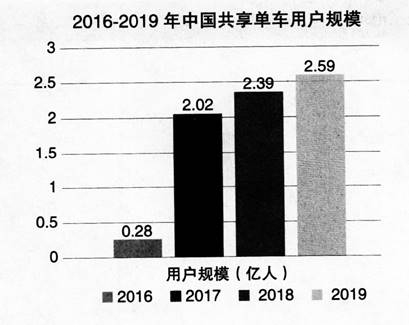
Write an essay based on the following chart.In your essay you should
1) describe the chart, and
2) give your comments.
You should write at least 150 words.
Write your essay on the ANSWER SHEET.(15 points)
进入在线模考

参考答案

暂无

答案解析

According he bar chart, the number of shared bike users has been rapidly rising during the past four years and the number of users in 2019 is surprisingly 9  times as that in 2016,reaching 259million.What the tendency reveals is that sharing economy represented by shared bikes is booming and more and more people can benefit from it.
The fundamental factors that contribute to the phenomenon may be summarized as follows.First of all, the popularity of shared bikes makes people's travelling easier and mere convenient. People can easily ride through narrow and winding lanes that buses and taxies cannot get in. During rush hours shared bikes can be less affected by traffic jams so as to save people's time on the way. Second, using shared bikes can reduce the cost of buying a bike and expenses on transportation. Although a bike is not expensive for an average family,it's hard to find a place to put it.But you can have access to shared bikes virtually everywhere and they are just convenirnt to use as your own bike. If you reduce the times of taking a taxi,the subway or a bus and turn to shared bikes as often as possible,you can save a lot of transportation costs.Furthermore,riding shared bikes is greatly environment-friendly and serves as a good way of exercise.If more people choose to ride shared bikes to commute,traffic jams would surely be reduced, and terrible air quality,improved. And it's a good
opportunity for sedentary young people to have some exercise by riding a bike to and from work.  
In the end,I firmly believe that a promising future is waiting upon shared bikes  with so many strengths and I sincerely recommend that people use shared bikes more.

你可能感兴趣的试题

1 根据以下材料,回答题
Skeptics of higher education often complain that universities offer too many boring degrees with little value in the workplace. 1 elite universities tend to produce higher-earning graduates than less selective institutions do, you might 2 them to teach more practical courses. 3 data from Britain's Department for Education show the opposite.Undergraduate students at 4 universities are more likely to study purely academic 5 such as philosophy and classics, whereas those at less choosy ones tend to 6 vocational topics such as business or nursing.
What could 7 this seeming contradiction? One reason is that employers treat a 8 from a top university as anindicator for intelligence.This means that students at elite institutions can study bookish subjects and still succeed 9 .The median Cambridge graduate in a creative-arts subject—the university's least profitable group of courses, including fields such as music—earns around ₤25,000 ($32,400) at age 26.Economics students from less elite universities, such as Hull, make a similar 10.
Yet even though Oxbridge students can pretend to read "Ulysses" for years and still expect a 11 salary,they end 12 paying a large opportunity cost by pursuing the arts.That is because employers reserve the highest starting wages for students who both attended a leading university and also13 amarketable subject.
Many gifted arts students would struggle to deal with numbers.But for those who can excel at both, the cost of sticking with the arts is 14 .Cambridge creative-arts students have A-level scores close to those of economics students at Warwick, but 15 about half as much.
Who can 16 such indulgence? The answer is Oxbridge students, who often have rich parents.At most universities, students in courses that 17 high-paying jobs, such as economics and medicine, tend to come from wealthier families, partly because such 18 are more likely to have the examination scores necessary to be accepted.At Oxbridge,19 , no such association exists.History and philosophy students there come from richer parts of Britain, on average,than their 20 studying medicine do.
第1题答案是
A.Since
A.Since
B.If
B.If
C.Unless
C.Unless
D.Until
D.Until
A.urge
B.intend
C.expect
D.promise
A.Even
B.Yet
C.Likewise
D.As
找试题 · 找答案 · 找资料 在线模考