简答题
题号 #6054630

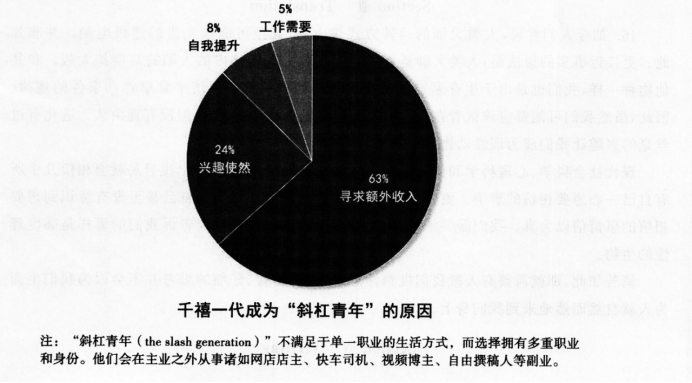
Write an essay based on the chart below. In your writing, you should
1) interpret the chart, and
2) give your comments.
You should write about 150 words on the ANSWER SHEET. (15 points)
 

进入在线模考

参考答案

暂无

答案解析

This pie chart illustrates the reasons why millennials are inclined to become part of what is known as the slash generation, a group of people who prefer pursuing multiple careers at the same time to specializing in a single area. Over 60 percent of the respondents say they do so for extra income, while only 8 percent for self-improvement. It is noteworthy that nearly a quarter say they made this decision merely for fun.
Behind this recent phenomenon is the mounting pressure to achieve financial independence as well as a sense of job insecurity. For many, a lucrative sideline ensures both a higher quality of life for the presenl and a lower risk of being replaced in the future. Moreover, the demand for self-satisfaction also plays an indispensable role. Those who manage to translate their passions into profits often feel a deep sense ot accomplishment. Another crucial factor is the rapid advancement in digital technology, which helps pave the way for this trend.
Admittedly, starting side businesses may well be an effective way to handle uncertainty and expand career options. But chances are that someone jumping on the bandwagon will end up as a jack of all trades, master of none.
参考译文:
该饼图阐明了为何千禧一代愿意加入被称作“斜杠青年”的群体,这一群体更青睐同时从事多种职业,而非专攻单一领域。超过60%的受访者表示,这么做是为了赚取额外收入,而仅有8%是为了自我提升。值得一提的是,有近四分之一的人表示,他们做出这一抉择仅仅为了好玩。
这一新兴现象的背后是与日俱增的实现经济独立的压力和工作安全感的缺失。对许多人来说,一份能赚钱的副业既能确保提升当下的生活品质,又能降低未来被替代的风险。此外,自我满足的需要也起着不可或缺的作用。能成功将爱好转化为收益的人通常都会获得巨大的成就感。另一个关键因素是数字技术的迅猛发展,它为这一趋势铺平了道路。
诚然,发展副业不失为应对不确定性和拓宽职业选择的有效途径。但盲目跟风的人到头来可能变得样样皆通,样样稀松。

你可能感兴趣的试题

1 根据下面资料,回答题
For years, thought leaders like Sheryl Sandberg have been offering remedies for the
"work-life balance dilemma," most aimed   1   at women. Some experts told women to lean in,   2   others advised stepping back. A few even maintained that the only way forward was to return to "ultra-traditional" gender roles. What all these strategies have in common is the    3   that the conflict between work and family can be solved by changing our institutions and relationships.
But   4   there is no solution? More than a century ago, the kibbutz movement made a dramatic attempt to   5work-family conflict once and for all. In these small communal settlements, children didn't live with their parents6spent most of their time in "children's houses,"   7   they ate meals, attended school and even slept. The idea was to free mothers and fathers from the burdens of caregiving, giving them the opportunity to   8 fully in the work of the kibbutz.
Yet even when work-life conflicts appeared to have been solved, mothers weren't   9
with the arrangement. A study10on in-depth interviews with 123 mothers from 13
kibbutzim, found that nearly all the mothers believed their children were happy in the children's houses;   11   they still wanted more contact with their offspring than kibbutz life  12 In the end, mothers drove the kibbutzim to13communal child-rearing arrangements.
The   14   of all our attempts to end work-family conflict suggests that we need to stop thinking of it as a problem to be solved, and15understanding it as a tragedy in the ancient Greek sense--a conflict between two competing goods. In our careers, we are   16 beings, honing our talents and earning financial rewards~ as members of a family, we prioritize our connection to those we love.
17   of these identities can be given up without a cost. We wouldn't want to "solve" our desire to care for our children, or lose our motivation to work.18lamenting the difficulty of balancing the two endeavors, then, we can try to appreciate the productivity that results from forces in   19Having conflicting obligations and playing different roles is    20   for physical and emotional health, forcing us to engage in activities that are good for us, such as physical activity and social engagement.
第(1)题选
A.specifically
A.specifically
B.accidentally
B.accidentally
C.implicitly
C.implicitly
D.unreasonably
D.unreasonably
A.since
A.since
B.so
B.so
C.unless
C.unless
D.while
D.while
A.recognition
A.recognition
B.assumption
B.assumption
C.justification
C.justification
D.conclusion
D.conclusion
找试题 · 找答案 · 找资料 在线模考