简答题
题号 #6054678

Write an essay based on the chart below. In your writing, you should
1) interpret the chart, and
2) give your comments.
You should write about 150 words on the ANSWER SHEET. (15 points)
 

进入在线模考

参考答案

暂无

答案解析

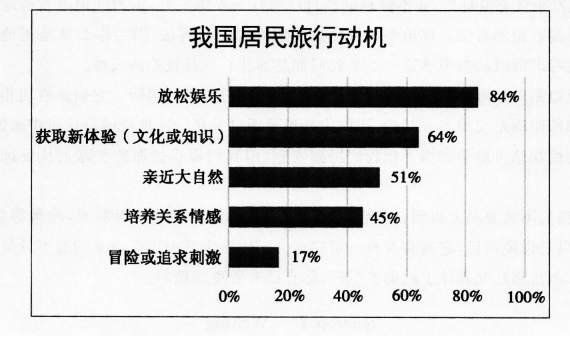
Thechart lists, in descending order of preference, the motivations of Chinese residents to travel. As can be seen noticeably, the top reason for people to go on a journey is relaxation and recreation, with 84% of the interviewed saying so.Next comes the desire to acquire new cultural experiences and knowledge, according to 64% of the respondents.Other motivations for travel include immersion in nature,he fostering of closer relationships and the pursuit of adventure and excitement, accounting for 51%, 45% and 17% respectively.
Given the intense stress of modern life, it is understandable that most people travel for leisure and recreation. A relaxing trip helps relieve stress by pulling people out of the daily grind, and one often feels refreshedand energized after a vacation.Moreover, with the increasing emphasis on spiritual needs,people begin to pursue deeper and more meaningful travel experiences. When travelling, they want to get immersed in another culture and explore new horizons.
The tourism sector may gain some inspirations from this survey.Diversified services, such as exhibitions of local artworks and activities that involve teamwork, could be provided to meet various
needs of tourists.
参考译文;
图表按偏好降序列出了我国居民的旅游动机。可以明显地看出,84%的受访者称想要放松娱乐,这是人们_出游的首要原因。其次,64%的受访者表示渴望获取新的文化体验和知识。其他的旅游动机还包括亲近大自然、培养亲近关系、冒险或追求刺激,各占比51%、45%和17%。
考虑到现代生活压力巨大,大多数人为了休闲娱乐而旅游情有可原。一场放松的旅行能让人们远离日常琐碎,有助于缓解压力;而且一个人度假之后通常会感觉神清气爽、充满能量。此外,随着精神需求越来越受重视,人们开始追求更深层次且富有意义的旅行经历。旅行时,他们想要沉浸于另一种文化,探索新的视野。
旅游产业或许可以从该调查中获得一些启发。譬如,提供当地艺术作品展和团队合作活动等多元化服务,以满足游客的各种需求。

你可能感兴趣的试题

1 根据下面资料,回答题
Anger may feel uncomfortable, but it can be healthy. "A lot of people think they have to 1 their anger," says Patrick Keelan, a registered psychologist in Calgary, Alberta. "But anger is an emotion built into us to signal that something needs to be addressed. " When we take 2 of that signal and actually 3 the problem instead of ignoring it, we're usually much better for it.
4 , we're raised to keep emotions hidden. Increasingly, research is suggesting that this can have long-term effects on our health. People who 5 their emotions may die sooner than those who are better at expressing emotions. When we're angry, stress hormones are released, which can make us prone to 6 a wide range of diseases.
Is it better, then, to scream and holler 7 something makes you mad? That's the rationale behind the "rage rooms" that have popped up in many American cities, where folks are 8 to release their anger 9 violently smashing stuff in a "safe" environment.
"The theory is that you get the anger out of your system 10 aggressive actions," says Keelan. "But the research indicates that when we 11 our anger aggressively, it can actually increase the 12 of the anger—and increase the likelihood of aggressive actions in the future. " It doesn't take much 13 to predict how a furious rage can 14 your relationships with your spouse, your kids, or your coworkers.
If you shouldn't bottle up your angry feelings but aggressive behavior isn't healthy 15 , how should you handle things that tick you off?
Start by looking 16 the superficial trigger to your fury. Anger is often caused by 17 feelings of fear, anxiety, disappointment, and guilt. Maybe you're furious that your spouse is late, but it's really because you were afraid he or she had 18 a car accident in the bad weather.
19 , pay closer attention to your triggers—those daily irritations that you know will set you off. Do you get angry at the long lines at the grocery store? Take a step back and 20 that it isn't personal. Everyone in the line has dinner to make, just like you.
第(1)题选
A.get rid of
A.get rid of
A.get rid of
B.make use of
B.make use of
B.make use of
C.face up to
C.face up to
C.face up to
D.get used to
D.get used to
D.get used to
A.charge
A.charge
B.message
B.message
C.notice
C.notice
D.care
D.care
A.anticipate
A.anticipate
B.expose
B.expose
C.prevent
C.prevent
D.rectify
D.rectify
找试题 · 找答案 · 找资料 在线模考