根据下面资料,回答题
Today, telehealth has revived the house call more than a century after it fell out of favor.
This renewal of a bygone practice is less intimate than having a doctor sitting at your bedside, but more personal than sitting on your doctor's exam table. It allows doctors to once again observe daily details of their patients' health that they might not otherwise glimpse.
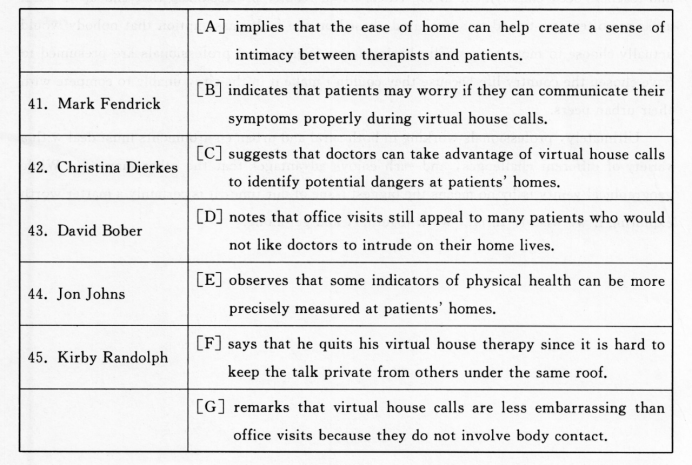
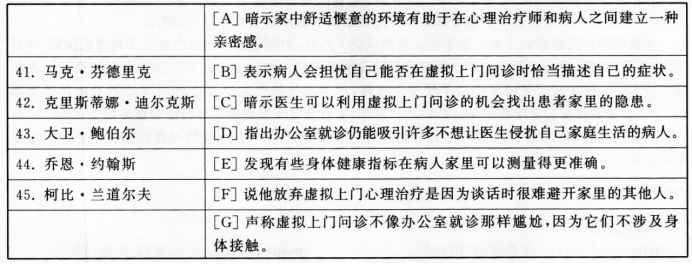
"The doctor's office is a stressful place for everyone," Mark Fendrick, a primary-care doctor with Michigan Medicine, said. "There are some things we look for that are more artificial in a doctor's office and more rea[world at home. " Studies have shown, for example, that automated blood-pressure measurements taken when a patient is sitting alone in a quiet place are more accurate. People with white-coat hypertension regularly experience higher blood pressure in clinical settings as a result of anxiety or fear. At-home tests, Fendrick said, can better capture a person's usual blood pressure.
A virtual house call can also improve the quality of treatments. Christina Dierkes, a 37-year-old from Columbus, Ohio, usually dreads the end of an intense therapy session. "You bare your soul to this person," she said, "and then you're running into somebody in the elevator and sitting in the car crying and driving home. " Since March, she's connected with her [therapist over the phone. "I was at home, in my own space, in sweatpants. It made it easier to imagine I was talking to myself or someone I feel really safe with," she said.
i This advantage is, to some degree, subjective. David Bober, a 51-year-old in Maryland, struggles to find a quiet spot at home where he won't be overheard or interrupted during psythiatry sessions and is ready to return to in-person therapy. And having to verbalize bodily concerns to a doctor who can't touch or examine a patient up close can be a source of discomfort. Jon Johns, a 54-year-old in eastern Ohio, had his annual physical over video conference in April. "But what if I was in pain or something was wrong.9" he says. "I would be anxious about how well I was describing my symptoms. "
Whatever might be missing from the patient's descriptions, doctors can collect information through telemedicine that they wouldn't otherwise have access to. And this might be the true magic of the virtual house call. For example, over video, Carman Ciervo, a primary care physician for Jefferson Health in Philadelphia, monitors the video's background for railings or potential tripping hazards if a patient has mobility issues. "Just observing how they climb the stairs can give you a wealth of information," Ciervo says. "These are all safety problems they might not be aware of, and that might not come up in an office visit. "
However, as the Kansas City University medical historian Kirby Randolph points out,
keeping one's personal life private might be the point of going into a generic doctor's office.
"A lot of patients don't want the doctor to see their home environment, because they're sell conscious," she said. Domesticating medicine's turf won't cure the biases baked into its history that could color how a clinician interprets a patient's surroundings.
"The very deep social determinants of health and illness seem so unmanageable that
finding a technological solution that might short-circuit them is enormously appealing. " said Jeremy Greene, a Johns Hopkins medical historian. The virtual house call challenges the notion that medicine exists only in clinical settings, and offers doctors a view into the space where a person's health exists as a lived experience.
第(41)题选
参考答案
E
答案解析
根据题干Mark Fendrick定位至第二段。段中①②句引述其话语指出“由
于医生办公室会给人压力,某些体征在病人家里更接近真实情况”。E是对人物观点的同义改写。