简答题
题号 #6054774

Directions ..
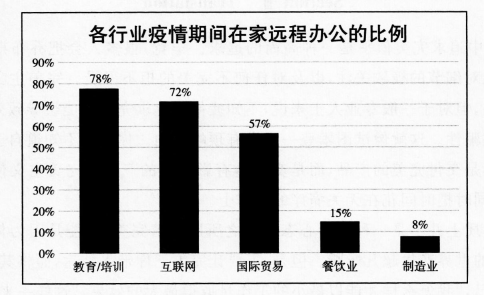
Write an essay based on the chart below. In your writing, you should
1) interpret the chart, and
2) give your comments.
You should write about 150 words on the ANSWER SHEET. (15 points)
 

进入在线模考

参考答案

暂无

答案解析

参考范文:
As can be seen from this chart, the educationtraining sector ranks the highest in terms of the rate of remote working during the pandemic, reaching 78%,followed by the internet sector and the international trade sector. By comparison, the catering sector and the manufacturing sector have much lower rates of employees working remotely, at 15 % and 8% respectively.
This largely corresponds to the extent to which work in different industries can be adapted as remote work. As information technologies have enabled the transmission of all kinds of information regardless of distance, work that traditionally involves plenty of paperwork in office can be easily shifted online.
Moreover, a wide range of applications aimed to facilitate online collaboration have made it unnecessary to meet in person for work's sake.That is why sectors such as educationtraining, internet and international trade enioy such high rates of remote working. On the other hand, due to their inadaptable business models which heavily rely on physical presence, the catering and the manufacturing sectors have a hard time shifting their business online.
The pandemic has demonstrated the potential of remote working.Perhaps it is time for both employers and employees to consider which mode of working suits them best and which brings about the utmost efficiency.
参考译文:
从图中可以看出,教育培训行业在疫情期间采用远程工作方式的比例最高,达到78%,其次是互联网行业和国际贸易行业。相比之下,餐饮业和制造业远程办公人员所占的比例要低得多,分别占了15%和8%。
这与各行业的工作能否被调整为远程办公的程度基本一致。由于信息技术使各种信息不受距离限制地传递,传统上涉及大量文书内容的工作可以很容易地转移到线上。此外,用于促进在线协作的各种应用程序使人们不必再为了工作而见面。这就是为什么教育培训、互联网和国际贸易之类的行业能有如此高的远程办公比例。另一方面,由于业务模式严重依赖实体,适应性弱,餐饮和制造业很难将其业务转移到线上。
疫情让我们看到了远程办公的潜力。也许现在是时候让雇主和雇员都考虑一下哪种工作模式最适合自己以及哪种模式能带来最大效率了。

你可能感兴趣的试题

1 根据下面资料,回答题
  As demand grows for new and emergent skills, including cybersecurity and data science, workers around the world are struggling to keep up. According to a recent survey  1  by the World Economic Forum, nearly 8 in 10 global CEO’s say they’re concerned about the  2  of people with the right skills.
   3 , organizations have responded by engaging in a war for talent—that is, buying or stealing it, rather than growing it from  4 . As they compete to fill roles, many have been willing to spend billions on recruiting, while  5  to invest in training their existing workers or unskilled ones. According to a recent survey, 70% of employers either have  6  workers due to the implementation of new technology or anticipate doing so. Meanwhile, companies like Netflix have gone so far as to offer new hires double their previous pay to  7  them away from their current employers.
  Those numbers  8  a classic tragedy of the commons—fueled by employers who are fishing ever farther  9  the sea of talent in search of job-ready workers  10  helping present or younger employees develop the skills they need to fill tomorrow’s roles.
  To be sure, some companies may find their worst fears  11 : They invest in talent only to see emerging stars  12  to competitors. But, if more business leaders changed their approach, we predict that a positive cycle will develop  13 : Today’s “talent-donors” become tomorrow’s  14  of the training their competitors have provided.
  Companies that invest in their people also become talent magnets. Research suggests that education is  15  the most valued benefits for modern employees. And, while it’s true that corporate loyalty is at all time lows and  16  rates are at all time highs, the data suggest that training programs  17  retention of staff. For example, Discover Financial reports that it has seen $1.44 in  18  for every dollar it has spent on staff training, a rate that nearly doubled for tough-to-retain call center employees.
  As the labor market  19 , the expectations of employers must too. Steal-and-release is no longer a sustainable model for talent acquisition. Investments in talent that  20  our individual interests can help to build a far more sustainable and fruitful economic ecosystem.

第1题选
A.expressed
A.expressed
A.expressed
B.conducted
B.conducted
B.conducted
C.secured
C.secured
C.secured
D.suspended
D.suspended
D.suspended
A.reliability
A.reliability
A.reliability
B.vulnerability
B.vulnerability
B.vulnerability
C.suitability
C.suitability
C.suitability
D.availability
D.availability
D.availability
A.Back then
A.Back then
A.Back then
B.Over time
B.Over time
B.Over time
C.So far
C.So far
C.So far
D.At last
D.At last
D.At last
找试题 · 找答案 · 找资料 在线模考