单选题
题号 #6054813

It is advised that UNESCO

进入在线模考

参考答案

C

答案解析

文章建议,UNESC0应该——。
[A]承认夜空的独特性[B]将夜空当作人类共同遗产来保护
[C]将夜空公布为世界遗产地[D]界定值得保护的观星地点
[信息锁定]由题干关键词UNESC0定位至第四段。该段首先指出“UNESC0设有世界遗产地登记机构,但登记仅限于特定地区,不涵盖天空,因此天空无法得到保护”,随后提出愿景“联合国应打破陈规、设法保护夜空(即将天空列入世界遗产地)”,C正确。
[排除干扰]A干扰来自④句the unique quality,但此处实际在阐述问题“天空‘不隶属于任何地区的这一独特性使其无法像其他世界遗产地一样得到保护”,而非在提出建议“承认夜空的独特性”。B将④句所述“具体事实:UNESC0已经宣布天空是人类共同遗产”歪曲为“作者建议:UNESC0应将夜空当作人类共同遗产来保护”。D利用②句defining、worthy等词汇捏造干扰,原文实际在阐释夜空的重要性“夜空决定了某些地区成为世界遗产地”,而非在提建议“界定哪类观星地点值得保护”。

你可能感兴趣的试题

A.enables us to know the other parts of the universe
B.reminds us of our remote ancestral past
C.is still beyond human comprehension
D.is a common resource already overexploited
2 根据下面资料,回答题
The coronavirus pandemic has forced UK universities to rapidly shift online, and no date has been confirmed for campuses tp reopen. So if universities are online, will studens still come? So far, the Universities and Colleges Admissions Service reports that very few have reneged on their offers. And for those already at university, a National Union of Students survey found that almost half of students were happy with their online learning.
Katie Barrett, a student at the University of West England, has enjoyed her online experience so far. I'm still getting all my lectures and seminars, so the learning itself hasn't been disrupted much," she says. "My lecturers are doing extra Q&As via Zoom, for example, so some of the material actually feels more accessible. "
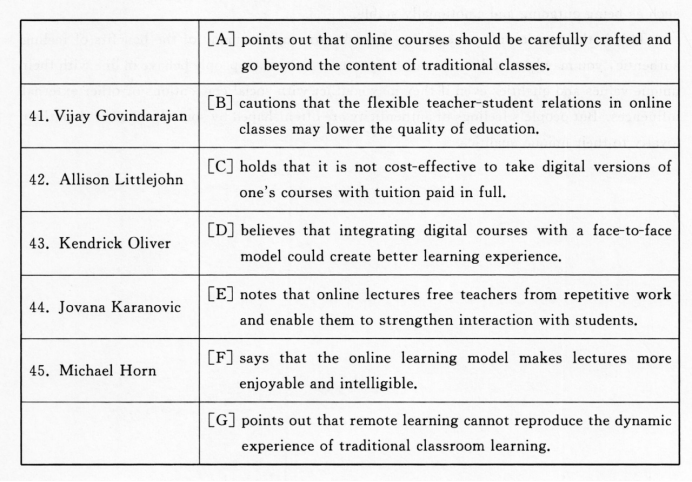
These positive experiences may permanently transform universities, believes Vijay Govindarajan, a business innovation professor at Dartmouth College in the US. "Universities can create high-quality multimedia experiences online. Lectures can be recorded in HD (High Definition) and reused, so more of professors' time can be spent on interacting with students. This will improve the overall quality of learning," he says. "Online learning might have been a long time coming in higher education, but it's here to stay. "
Online learning shouldn't be seen as a quick-fix solution to the pandemic. Allison Littlejohn, director of the UCL Institute of Education's knowledge lab, cautions that quality online courses take time and effort to create. "It's crucial the online learning experience is well-designed and we don't simply shift existing content from one format to another," she says.
Equally, for many students, the value of university goes deeper than coursework and qualifications. Research by Universities UK found that almost 60% of students and recent graduates felt the social element of the campus experience helped them broaden their life experience, become more independent and confident, and develop skills like teamwork and time management.
"Learning remotely isn't the same as the visceral experience of expressing and debating ideas in a physical space," agrees Jesper Ryynanen, a student at the London School of Economics (LSE). "I chose LSE for its public events and renowned speakers, yet there'll be none of that this semester. " Some students may feel that paying the same fees for digital versions of their courses would be poor value. The tuition for Ryynanen's one-year MSc(Master of Science) at the LSE is ₤29,000—far more expensive than fully online options from renowned names like Harvard University and Wharton Business School.
Kendrick Oliver, a professor at the University of Southampton, agrees too. "Nothing can replace the classroom experience. Being physically together in a space means rich communication, and more energy and experimentation from everyone involved. " But he acknowledges: "Habit and routine are powerful. Months of online working will make digital more of a default. "
There are also reputational risks to moving online, says Jovana Karanovic, a researcher in digital platforms at VU Amsterdam in the Netherlands. "Online learning may produce an unstable gig economy to connect students and educators," she explains. "This competitive, fragmented learning landscape could raise accountability issues, prompt a loss of academic expertise and lower teaching standards. "
The future of UK universities may lie in mixing online curriculums and offline experiences, known as blended learning. Many are already planning to introduce this to enable social distancing on campus. "This can enhance students' experience of studying," says Michael Horn, co-founder of the Christensen Institute, a global education thinktank. "I expect to see a lot more universities offering blended courses post-pandemic. "

第(41)题选
A.A
A.A
B.B
B.B
C.C
C.C
D.D
D.D
E.E
E.E
F.F
F.F
G.G
G.G
A.A
B.B
C.C
D.D
E.E
F.F
G.G
找试题 · 找答案 · 找资料 在线模考