根据以下材料,回答题
What is the price of anarchy?
Technically, in transportation engineering, the price of anarchy describes the difference between what happens when every driver selfishly picks the fastest route and what the socially optimal traffic outcome would be.In the pre-mobile-app days,drivers' selfishness was limited by their knowledge of the road network.In those conditions, both simulation and real-world experience showed that most people
stuck to the freeways and arterial roads.Sure, there were always people who knew the crazy, back-road routei,but the bulk of people just stuck to the routes that transportation planners had designated as the preferred way to get from A to B.
But a new body of research at the University of California's Institute of Transportation Studies suggests that the reality is far more complicated.In some scenarios, traffic-beatingapps might work for an individual, but make congestion worse overall.And autonomous vehicles, touted as an answer to trafficy streets, could deepen the problem.
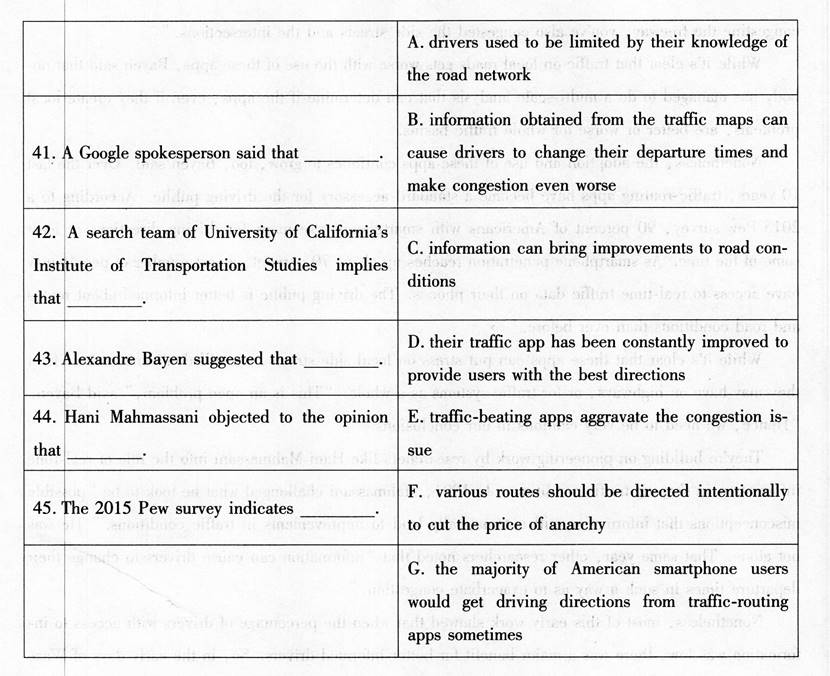
"This problem has been vastly overlooked," Alexandre Bayen, the director of UC Berkeley's Institute of Transportation Studies, told me."It is just the beginning of something that is gonna be much worse." "The situation then gets much worse because hundreds of people just like you want to go on the side streets,which were never designed to handle the traffic," Bayen says."So,now, in addition to congesting the freeway, you've also congested the side streets and the intersections.While it's clear that traffic on local roads getsworse with the use of these apps, Bayen said that nobody has managed to do amulti-scale analysis that can determine if the apps, even if they create local problems,are better or worse for whole traffic basins.
Nonetheless, the adoption and use of these apps continues to grow, too, Bayen said.Over the last 10 years, traffic-routing apps have become a standard accessory for the driving public.According to a 2015 Pew survey, 90 percent of Americans with smartphones use maps for driving directions at least some of the time.As smart phonepenetration reaches up above 70 percent, a vast number of people now have access to real-time traffic data on their phones.The driving public is better informed about routes and road conditions than ever before.
While it's clear that theseapps can put stress on local side streets, we still don't know what effect they may have on highways, or for traffic systems as a whole."This is an open problem," said Bayen.
"Hence, we need to bevery cautious in our conclusions."
They're building on pioneering work by researchers like Hani Mahmassani into the role of real-time information in shaping traffic conditions.In 1991, Mahmassani challenged what he took to be"possible misconceptions that information will automatically lead to improvements in traffic conditions." He was not alone.That same year,other researchers noted that "information can cause drivers to change their departure times in such a way as to exacerbate congestion."
Nonetheless, most of this early work showed that when the percentage of drivers with access to information was low, there was a major benefit for better-informed drivers.So,in the early days of Waze and Google Maps and automated routing at UPS, many individuals did experience substantial benefits from these applications.The roads, as a whole, were probably also flowing better.
"Google Maps strives to accurately model and reflect the ever-changing real world.Our algorithm takes a number of different factors into account when creating routes, including aggregated and anony mized historical data," a Google spokesperson told me."We're constantly working to improve our algorithm in order to provide users with the best directions on Google Maps."
Bayen does, in fact, have a suggestion for improving these apps, but the companies might not like it.He thinks the apps should spread out drivers on different routes intentionally,which would require collaboration among the mapping apps.Given the cutthroatnature of competition in Silicon Valley, that's a tough sell, but it might help bring down the price of anarchy.
第41题答案是
参考答案
D
答案解析
题目对应信息在倒数第二段最后一句:a Google spokesperson told me.“We’re constantly working to improve our algorithm in order to provide users with the best directions on Google Maps.”意思是“我们不断在努力改进我们的算法,以便在谷歌地图上为用户提供最佳路线指示。”