简答题
题号 #6055903

Directions:
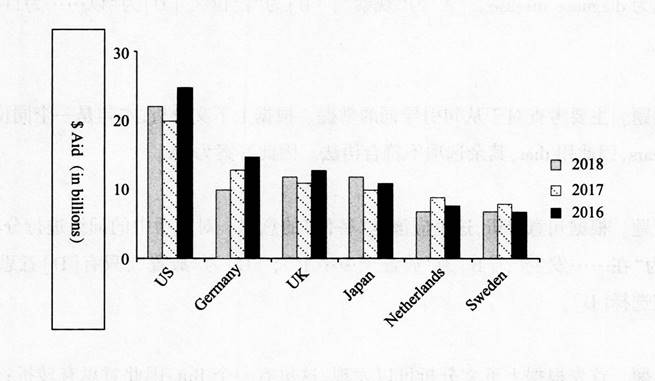
The chart below shows the aid from six developed countries to developing countries from 2016 to 2018.In your writing, you should summarize the information by selecting and reporting the main features and make comparisons where relevant.You should write about 150 words on the ANSWER
SHEET.( 15 points)
进入在线模考

参考答案

暂无

答案解析

The chart illustrates aids delivered from the US, Germany,the UK, Japan, Netherlands and Sweden to the developing world, from 2016 to 2018.
America made the largest contribution three years in a row--allover 20 billion dollars. Germany,the UK and Japan ranked second, donating over 10 billion dollars each year to the developing countries.
And Netherlands and Sweden also helped by aiding just less than 10 billion every year.
Regarding to the performance on the yearly basis, the US, the UK and Japan donated most in 2018. Germany made their best contribution in 2016, Netherlands and Sweden in 2017.
 However, the aids most countries carried out fluctuated in those three years except for Germany.
For the US, the UK, and Japan, the number dumped in 2017 to the lowest. As for Netherlands and Sweden, their number peaked in 2017 and went down again in 2018.

你可能感兴趣的试题

1 根据以下材料,回答题
High ideals have a way of seeming like high barriers when time is running out.1 someone you love has been told they have just months to live,and there is a drug that might 2 them even a few months more,it suddenly matters 3 that the drug isn’t cost-effective,or that it was approved 4 a small trial and its risks and benefits remain 5.What matters is that it might buy precious time right now.
Such dilemmas are 6 the US Food and Drug Administration(FDA)and similar agencies around the world aim to strike a balance between efficacy and expediency,speed and safety when it 7 to approving new medications.In the 1970s,it took the FDA nearly three years to usher a new drug 8 its evaluation process.But in 9to public demand after the AIDS crisis of the 1980s,the agency began to 10 expedited approval processes to get new medicines to market much faster.
Today,there are several 11 used to speed things up,and more than half of medicines are now evaluated through some kind of expedited pathway.To pay for the staff to 1 2 the pace of approvals,13,the FDA has come to rely more heavily on pharmaceutical industry fees--and 1 4 those funds in exchange for keeping to set time lines.
The trouble is,the kind of research needed to 1 5 that drugs are safe and effective takes time.Faster approvals may be based on smaller studies or measure things that are proxies for the desired 16.Medication that is rushed to market in this way is more likely to be withdrawn later over safety 17 or to tum out not to work as 18.
There is a growing group of researchers raising thealarm over this trend.They don’t dispute the need for quicker 19 to new treatments or pretend that it is a straightforward problem to solve.And they don’t expect regulatory agencies to do it without help from companies.20,there is no shortage of ideas about how to strike a better balance.
第1题答案是
A.Unless
A.Unless
B.Whereas
B.Whereas
C.If
C.If
D.Though
D.Though
A.confirm
A.Confirm
B.present
B.Present
C.cultivate
C.cultivate
D.offer
D.offer
A.less
A.1ess
B.more
B.More
C.further
C.further
D.either
D.either
找试题 · 找答案 · 找资料 在线模考