单选题
题号 #6057094

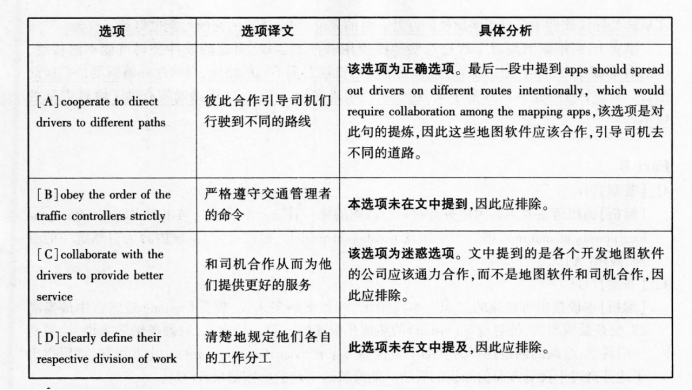
According to the last paragraph, Bayen suggests that the mapping apps should_______.

进入在线模考

参考答案

A

答案解析

According to the last paragraph,Bayen suggests that the mapping apps should_________.
根据最后一段,拜耶豪认为地图软件应该_________。
细节题。根据题干信息可定位到文中的最后一段。最后一段提到拜耶豪认为,各导航应用程序应该彼此配合,有意将司机规划到不同的路线。虽然很难实现,但是这样做确实有助于减小混乱的代价。
 
全文翻译
混乱的代价是什么?
(36)严格来说,在交通工程方面,混乱的代价就是当每一位司机都自私地选择最快路线时,产生的结果与采用社会最优方案时的区别。在移动软件大行其道之前,司机不太了解道路网,因此在选择路线时并不会太自私。这时,无论是场景模拟还是真实状况都表明,大多数人坚持选择走高速公路和交通主干线。当然,总会有人走一些疯狂的、偏僻的小路,但多数人仍会选择交通规划员指定的路,即从A地到B地的最优路线。
但加利福尼亚大学交通研究院的一项新的调查表明,现实情况其实更为复杂。在某些情况下,避免交通堵塞的软件会帮助到个别人,但却加重了整个交通的拥堵状况。此外,被吹捧可以缓解交通压力的无人驾驶汽车,也使得堵车问题越来越严重。
英国伯克利交通研究院院长亚历山大·拜耶豪告诉我说:“一直以来我们都忽视了交通问题。这只是开始,以后的状况只会更糟。”他提道:“交通状况会更加恶化,因为所有人都和你想的一样,想要走偏僻小路。但这些小路并没有舒缓交通的能力。(37)所以现在,你不仅堵塞了高速公路,还堵住了偏僻小路和十字路口。”
很明显,地图应用软件会把交通压力转嫁到地方小路上,但我们仍然不知道这会怎样影响高速公路,怎样影响整个交通系统。拜耶豪说:“这是个开放性的问题,所以我们在做结论时需要非常谨慎。”
他们以哈尼·马赫马萨尼等研究人员的开创性工作为基础,研究了实时信息对交通状况的影响。(38)1991年,马赫马萨尼对“信息会自然而然地带来交通状况的改善”的看法提出质疑,称它可能是错误的想法。不只是他这么认为。同年,其他研究人员指出,“信息会使司机改变他们的出发时间,从而加剧拥堵。”
尽管如此,大部分早期的研究表明:(39)有条件获取信息的司机的比例较低时,司机能够享受到信息灵通的巨大好处。因此,在位智、谷歌地图以及UPS自动路线规划诞生初期,许多人确实从这些导航软件中获得了实质性的好处。总的来说,那些道路的交通可能也得到了改善。
事实上,拜耶豪倒是有个改进这些地图应用软件的建议,但这些软件公司可能不愿接受。(40)拜耶豪认为,各导航应用程序应该有意将司机规划到不同的路线,当然这样就需要他们彼此配合。考虑到硅谷竞争的残酷本质,这个想法很难实现。不过,这样做确实有助于降低混乱的成本。

你可能感兴趣的试题

1 根据下面资料,回答题
The Mind of Leonardo Da Vinci
Across the centuries, each generation has interpreted Leonardo da Vinci (1452-1519), findinghim to be remarkably modem. At the 500th anniversary of his death (May 2, 2019)we can considerLeonardo's meaning in our era. Our fundamental nature as human beings has not changed in 500 years,but our environment has transformed at an extraordinary rate, along with our perspectives on hisaccomplishments--and our own.
41._______.
Leonardo's science was grounded in the Aristotelian world as shaped by18 centuries ofinterpreters. He developed a system of what he called the four powers of nature: movement, weight,force and percussion. Although he struggled to define these concepts, and many of the ideas arearchaic, it is telling that he developed a coherent model for all natural phenomena ranging from themacrocosm to the microcosm.
I believe he was excited about his conception of the four powers and how they informed his art andscience. We are on a similar kind of path today, seeking the grand unification of the laws of physics aswe study natural phenomena from subatomic particles to the history of the universe. Few of us extend thisattempt at unification to the arts as well.
42._______.
To Leonardo, vision is the noblest of the senses and of paramount importance, and his passion forvision was extreme. "The eye is the window of the human body through which the soul views and enjoysthe beauties of the world. " he writes in his Paragone ( comparison of the arts). To Leonardo, paintingwas a science, and the creative act of painting is useful to visualize the world. As an anatomist andphysiologist he decided at one point that the sense of vision is so important that it must be mediated byits own brain region, the" imprensiva. "
43._______.
Leonardo was most comfortable relying on his senses as the basis of meaningful experience. "To me itseems that those sciences are vain and full of error which are not born of experience, firsthand experiencewhich in its origins, or means, or end has passed through one of the five senses. And if we doubt thecertainty of everything which passes through the senses, how much more ought we to doubt things contraryto these senses such as the existence of god or of the soul or similar things over which there is alwaysdispute and contention," he writes in his Treatise on Painting. For Leonardo, this faith in experience waslargely visual. In the 21st century we understand we cannot derive all knowledge from sensory experience,
and many us studying genomes or otherwise using computers have encountered the limits of empiricism.
Confronted with today's world, no doubt Leonardo would have been brilliant at visualizing information.
44._______.
Leonardo's thinking was interdisciplinary. When he injected wax into the brain or into the heart tomake casts of the inner workings of the body, he was borrowing the "lost wax" technique familiar tosculptors. When he studied friction and invented roller bearings and ball bearings he reasoned thatfrictional resistance differs according to the nature of the surfaces in contact, and increases in direct
proportion to load, and he even estimated (for the first time) a coefficient of friction. But he went furtherto realize its relevance not just to machines but to the movements of tendons over bones ; to the creationof heat by the heart;and to the production of voice by the friction of air on the vocal cords.
45._______.
Creativity is productivity marked by imagination. Creativity is as basic to art as to science. We canbe creative as teachers, as students, as writers and readers. We can appreciate the many facets ofLeonardo's creativity, and it can inspire us today.
keonardo combined science, art and engineering in a unique way. In his time "scientia" referred toknowledge while "ars" referred to manual proficiency. The modem distinction between the sciences andhumanitiesi, famously described by C. P. Snow, did not exist as it does today. For keonardo, the artist's creative,
noble purpbse is to depict the natural world. The artist must understand the entire world as a scientist would.
A.A unified vision of nature's laws
B.Creativity in science and art
C.Faith in experience
D.Fulfillment of human potential
E.Interdisciplinary science
F.The nature of genius
G.Visualized knowledge
第(41)题选
找试题 · 找答案 · 找资料 在线模考