单选题
题号 #6057141

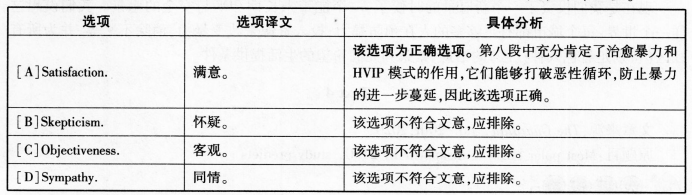
What's the author's attitude towards Cure Violence and HVIP?

进入在线模考

参考答案

A

答案解析

What’S the author's attitude towards Cure Violence and HVIP?
作者对于治愈暴力和HVIP是什么态度?
观点态度题。根据题干关键词Cure Violence and HVIP提示可定位于第八段。
 
全文翻译
在美国和世界各地的许多城市,数百万人举行抗议活动,要求更换警察。在加州奥克兰,过去几年的暴力干预项目表明,除了派遣武装警察之外,还有其他方法来解决社区暴力问题,(31)这些方法可以帮助拯救生命和使人们得到更公平的对待。
这是一个我们现在就有机会创造的世界。(32)当今,美国正在认真讨论投资于其他公共安全战略,以减少执法对我们社区的影响。许多社区正在质疑执法部门超出职责施加作用,例如:应对诸如心理健康和无家可归等社会挑战;或者管理那些参与非犯罪或非严重活动的人,比如在车里睡觉;或者在非暴力的情况下使用致命武力,或者对可能使用20美元的假钞采取行动。
这是重要的。然而,社区可以走得更远。执法部门在处理暴力或可能的暴力行为方面的作用也必须重新设想。暴力是一个公共卫生问题,需要采取基于健康和社区驱动的解决办法。由像约瑟夫这样受过训练的社区成员进行谨慎、及时的干预,增加了安全性,减少了暴力,因此减少了监禁的必要性,同时也减少了警察参与的必要性。
令人惊讶的是,暴力是唯一不受卫生部门管理的“卫生流行病”。然而,也有一些证明有效的减少暴力的卫生方法。它们不将强制执行作为第一道应对措施。
“治愈暴力”是一种以社区为基础的综合模式,它将暴力视为一种传染性卫生流行病,并利用暴力阻断者等卫生工作者来阻止枪击、改变行为和改变规范。(33)在过去的20年里,“治愈暴力”已经在美国、拉丁美洲、非洲和中东的几十个城市得以应用。在美国许多暴力最猖獗的城市,这些模式行之有效。这种方法已经显示持续减少了40%到70%的暴力:纽约市南布朗克斯减少了63%,芝加哥罗杰斯公园社区减少了73%,巴尔的摩樱桃山社区减少了54%。
(34-1)以医院为基础的暴力干预项目(HVIPs)解决了暴力循环的另一个方面,即防止受害者受二次伤害。在没有干预的情况下,五分之一的枪支暴力幸存者会在五年内死于另一起枪伤。作为这些项目的一部分,来自社区的干预人员提供长期的资源,通过为受害者在康复时提供咨询。帮助他们解决各种问题,包括教育、贫困、住房、医疗和家庭关系,来帮助他们防止再次受伤。换句话说.这些方案解决了影响健康的社会因素。
(34-2)芝加哥的一项关于HVIP模型的研究发现,暴力受害者在参加了一个为期六个月的医院项目后,再次成为受害者的可能性降低了。在巴尔的摩,再受伤率从36%降至5%。巴尔的摩、密尔沃基和旧金山等城市的其他医院项目也显示了类似的结果。
(35)治愈暴力和HVIP模式都在关键时刻进行干预,以打破恶性循环,防止暴力的进一步蔓延。这项工作是由当地社区成员进行的,因为当地社区成员是最可信和值得信赖的人。这些保健方法也一再证明具有成本效益,既节省了资金,又挽救了生命。
现在是我们投资于一个新愿景的时候了,一个能带来长期和平与安全的愿景。我们设想这样一个世界:每个城市都有足够多的人在预防暴力,投入资源来改变暴力,消除不平等,并为所有社区(特别是有色人种社区)的治愈、繁荣和充满希望的生活提供条件。

你可能感兴趣的试题

1 根据下面资料,回答题
Scientists have predicted for the first time when, where and how polar bears are likely to disappear, warning that if greenhouse gas emissions stay on their current trajectory all but a few polar bear populations in the Arctic will probably be gone by 2100.
By as early as 2040, it is very likely that many polar bears will begin to experience reproductive failure, leading to local extinctions, according to a study published in Nature Climate Change.
The study examines how the bears will be affected under two different greenhouse gas emissions scenarios. The researchers found that under a business-as-usual emissions scenario, polar bears will likely probably only remain in the Queen Elizabeth Islands--the northernmost cluster in Canada's Arctic archipelago--at the end of the century. And even if greenhouse gases are moderately mitigated, it is still likely that the majority of polar bear populations in the Arctic will experience reproductive failure by 2080.
Scientists estimate that there are fewer than 26,000 polar bears left, spread out across 19 different subpopulations that range from the icescapes of Svalbard, Norway, to Hudson Bay in Canada to the Chukchi Sea between Alaska and Siberia. Polar bears are unable to find enough sustenance on land and rely on sea ice from which to hunt. They often stake out seal breathing holes in the ice, waiting hours for a blubbery meal to break the surface. But as that sea ice declines because of climate change, so, too, will the polar bears.
"It's been clear for some time that polar bears are going to suffer under climate change," said Peter Moln6r, a biologist at the University of Toronto Scarborough, and lead author of the study. "But what was not fully clear was when we would expect major declines in the survival and reproduction of polar bears that could ultimately lead to their extirpation. We didn't know whether that would happen early or later in this century. "
Polar bears draw on energy reserves built up during the winter hunting season to make it through lean summer months on land or time spent on ice in unproductive waters. Though the bears are used to fasting for months, their body condition, reproductive capacity and survival will eventually diminish if they are forced to go too long without food. In Alaska's southern Beaufort Sea population, biologists have already seen polar bear numbers drop 25-50% during low ice periods when the bears have been forced to fast for too long. And in western Hudson Bay, one of the southernmost polar bear habitats, the population has declined by roughly 30% since 1987.
To figure out when bears might reach their critical physiological limit, Moln6r and his colleagues estimated how thin and fat polar bears can be and modelled the animals' energy use to derive the threshold number of days they can fast before cub and adult survival rates decline. Then they combined those thresholds with the projected number of future sea ice-free days to determine how populations will be affected in different parts of the Arctic.
"Even if we mitigate emissions, we are still going to see some populations go extinct before the end of the century," Moln6r said. This includes the polar bears in the vulnerable, southernmost ice areas of western Hudson Bay, Davis Strait, and southern Hudson Bay. "But we would have substantially more populations persisting by the end of the century, even with reduced reproduction, compared with a business-as-usual emissions scenario. "
"It's important to highlight that these projections are probably on the conservative side," said Steven Amstrup, chief scientist for Polar Bears International and a co-author of the study. The models, he explained, may assume a better-than-reality body condition of the bears at the start of fasting periods. And the team used a cautious baseline estimate for how much energy a bear uses to maintain its body condition. "The impacts we project are likely to occur more rapidly than the paper
suggests."
Unlike other species threatened by hunting or deforestation, polar bears can only be saved if their habitat is protected, which requires tackling climate change at a global level. Previous research has shown that even if we reduce greenhouse gas emissions tomorrow, it will still take another 25 to 30 years for sea ice extent to stabilise because of all the carbon dioxide already in the atmosphere. It's important that the public understand the urgency of the issue, Amstrnp said. But a timeline for possible extirpation was also an important tool for managers in northern communities living alongside polar bears.
The passage begins with_______.
A.a research on polar bear reproduction
B.a prediction of polar bear extinction
C.a call for people to protect polar bears
D.a study of the living habits of polar bears
A.Greenhouse gas emissions are going to be mitigated in polar areas.
B.Most polar bears will be at risk of breeding failure in the future.
C.Greenhouse gas emissions will cause the extinction of all polar bears.
D.Bears in the Queen Elizabeth Islands are hardly affected by Greenhouse gas.
A.the decrease of the sea ice
B.the increase of savage sea animals
C.the reduction of prey in the sea
D.the reduction of sustenance on land
找试题 · 找答案 · 找资料 在线模考