根据下面资料,回答题
Albert Einstein once remarked that God is subtle, but not malicious. The material world, hethought, was unpredictable. This made the world interesting but not impenetrable. Einstein, who brought
lucidity to the deeply hidden, reasoned that "nature hides her secret because of her essential loftiness,but not by means of ruse". Seen like this, science advances as much through what thinkers get right aswhat they get wrong. A scientific theory aims to understand the world. But it is only when nature revealsan error that it can be refined.
Few understood this better than Freeman Dyson, an insightful and brilliant theoretical physicist,who died last week. His cosmic genius roamed freely. Dyson wrote about religion, biology and the futureof human society. He was a cheerful heretic--for example, calling work on nuclear fusion a "welfareprogramme" for engineers. He was also absurdly wrong about global warming. But his refusal to conformwas essential to his view of a scientist as someone who produced theories that were right and wrong butbetievec in them with equal conviction.
Progress always involves making mistakes and then recognising them. That is because we are allstruggling to understand why and how things are the way they are. When Dyson considered the idea thatthe limit to an energy supply that a species could have is all of the starlight in their solar system, logicwould d_ctate that a sophisticated civilisation would build a structure to harness the entire power of itssun. This seemed eccentric at the time. Yet in 2015 it was discovered that a star 1,500 light years awaywas beirg shielded by matter circling the star. The speculation was that this mass could be the elusive"Dyson Sphere".
A scientist will be leniently judged if led astray by a false hypothesis. Their reputation, however,may not survive if the work is sloppy or if they claim to have discovered a fact that turns out to bewrong. There is a concern, especially in social sciences and medicine, about the preponderance ofstudies that have proved impossible to reproduce. If the original errors do not get corrected whenscientists try to take the work further, then science's capacity to remedy itself will be called intoquestion. There are questions here about the value system in academic publishing and the fundingmechanisms that have led to too many researchers thinking it is fine to move on from mistakes withoutpublicly acknowledging them.
Science must be self-correcting and allow for even its greatest practitioners to be wrong. History islittered with examples of major figures who erred. Charles Darwin is famous for his theory of evolution bynatural selection but came up with a bizarre--and mistaken--theory to explain why inheritance is arandom process. It was Gregor Mendel, the father of genetics, who worked out the first set of rules ofheredity. Mendel's brilliance was unrecognised in his lifetime. He left science for God, later becoming anabbot. In every century and every science there are brilliant blunders. The trick is to learn from them.
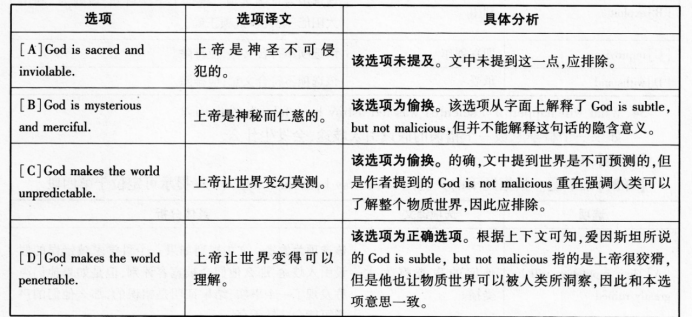
What does the sentence "God is subtle, but not malicious" said by Einstein mean?
参考答案
D
答案解析
文章来源:The Guardian,Mar.8th.2020
原题目:the Guardian view on scientific progress:it's important to get things wrong
选项分析
What does the sentence“God is subtle,but not malicious’’said by Einstein mean?
爱因斯坦说的“上帝很狡猾,但并无恶意”这句话是什么意思?
推断题。根据题干关键信息God is subtle,but not malicious可定位于第一段的第一行。
原题目:the Guardian view on scientific progress:it's important to get things wrong
选项分析
What does the sentence“God is subtle,but not malicious’’said by Einstein mean?
爱因斯坦说的“上帝很狡猾,但并无恶意”这句话是什么意思?
推断题。根据题干关键信息God is subtle,but not malicious可定位于第一段的第一行。
你可能感兴趣的试题
A.strongly opposes Einstein's view of the world
B.has made mistakes in his scientific research
C.never admits his mistakes in the research
D.goes out of his way in scientific research
A.control
B.exploit
C.improvise
D.withstand
A.Their reputation will be greatly ruined.
B.They can be understood and forgiven.
C.Their academic ability will be questioned.
D.Their mistakes will be corrected immediately.