根据以下材料,回答题
When geriatrician ( 老年医学专家 ) Bill Thomas first sat down to reimagine American nursing homes, the risk of a deadly pandemic wasn't on his mind.Hisvision was of elder-directed care on a human scale, an alternative to the"big box" homes staffed and run like hospitals.
Nearly two decades on, the Green House movement he birthed has spread to 300 homes in 32 states.And when COVID-19 hit,its design features--clusters of small buildings with private rooms and bathrooms--helped to reduce infections, even in hard-hit cities like Boston and Detroit.
Dr.Thomas says these features provide a sense of belonging which most nursing homes lack.And they lead to better health outcomes."If you fix the broken heart it's also good for the body, and it's good for preventing infections," he says.
For decades, reformers like Dr.Thomas have attempted to improve nursing homes.They have built alternative models--less institutional, smaller scale, better staffed--that appear to have done better during the pandemic.
But the greater prize is to help more elders age in their homes and communities.As COVID-19 disorders the nursing home industry and the federal spending behind it, that goal may be in reach, reformers say.
"Most people would prefer to age in place, at home, if at all possible.The COVID epidemic might strengthen that, as people feel safer at home," says Anne Montgomery, co-director of eldercare improvement at Altarum Institute, a nonprofit health consultancy.
The vast majority of Americans aged 65 and older currently live at home.But seniors who require support services often end up in nursing homes because they rely on Medicaid to pay for long-term care.
In recent years, alternatives to institutional care have expanded in many states,using Medicaid waivers.
More than half of Medicaid dollars are spent on home-and community--based services today.
now COVID-19 has shined a spotlight on the often-obscured lives of around 1.5 million Americans, with more than a third of deaths coming in nursing homes.The pandemic has upended the finances and reputations of home operators.It has disrupted the profitable flow of new residents discharged from hospitals.And it has forced the industry more generally to defend its poor record on infection control and other measures of quality and safety.
"The compact that people have made is to trade away certain freedoms and autonomy, and even respect and dignity, in return for a promise of security and safety.The COVID-19 pandemic has revealed that they [nursing homes] have not been able to fulfill that," says KavanPeterson, a Seattle-based
advocate and co-founder with Dr.Thomas of ChangingAging.
Nursing homes have pushed back against critics, pointing to the rapid spread of COVID-19 in urban are as where hard-hit homes were located.They also say public-health officials failed to provide needed equipment and guidance.Regardless, the challenges they face are significant.
"Nursing homes have been set up to fail.They have extremely vulnerable populations," says
MichaelBarnett, assistant professor of health policy and management at the Harvard T.H.ChanSchool
of Public Health."They have workers who are underpaid and are largely immigrants and minorities who
live in communities that are the worst affected."
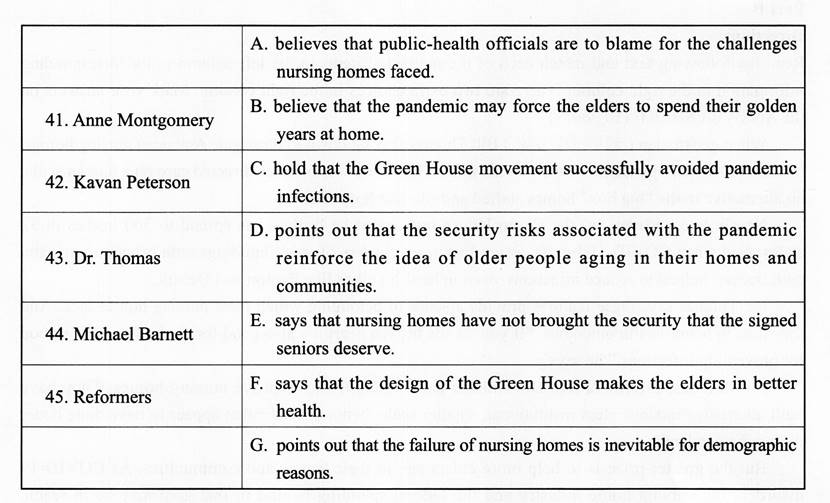
41题答案是
参考答案
D
答案解析
总体分析
本文节选自The Christian Science Monitor(《基督教科学箴言报》),原文标题为Why the Future of Elder Care May Be Fewer Nursing Homes(为什么老年护理的未来是养老院越来越少)。本文主要从老年人自身、新冠肺炎疫情的影响、养老院本身存在的问题三个方面讲了养老院会越来越少的原因。
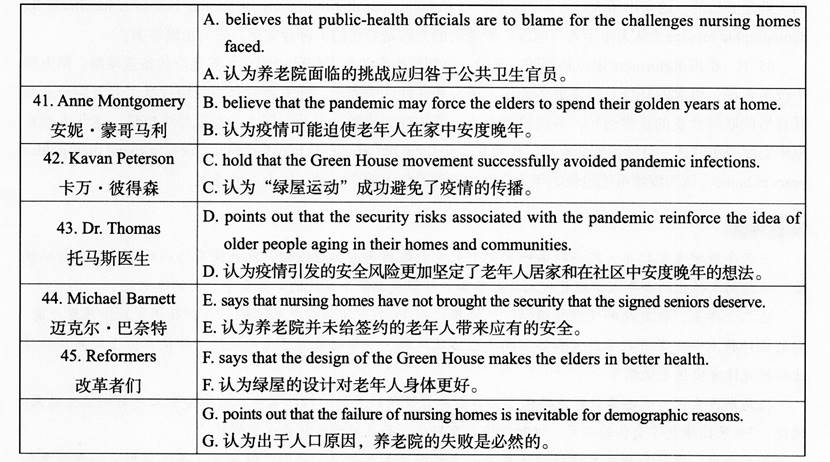
根据AnneMontgomery定位到第六段。安妮.蒙哥马利说,如果可能的话,大多数人都希望在家里安度晚年(Most people would prefer to age in place,athome),新冠疫情可能会让这种感觉变得更加强烈(strengthen that),因为人们感觉在家里更安全。D项中的tlle security risks associated with the pandemic指新冠疫情带来的安全问题;reinforce the idea of older people aging in their homes and communities与该段中的 Most people would prefer to age in place,at home、strengthen that相对应,故D项正确。
本文节选自The Christian Science Monitor(《基督教科学箴言报》),原文标题为Why the Future of Elder Care May Be Fewer Nursing Homes(为什么老年护理的未来是养老院越来越少)。本文主要从老年人自身、新冠肺炎疫情的影响、养老院本身存在的问题三个方面讲了养老院会越来越少的原因。
根据AnneMontgomery定位到第六段。安妮.蒙哥马利说,如果可能的话,大多数人都希望在家里安度晚年(Most people would prefer to age in place,athome),新冠疫情可能会让这种感觉变得更加强烈(strengthen that),因为人们感觉在家里更安全。D项中的tlle security risks associated with the pandemic指新冠疫情带来的安全问题;reinforce the idea of older people aging in their homes and communities与该段中的 Most people would prefer to age in place,at home、strengthen that相对应,故D项正确。