1.题目:口语教学试讲
2.内容:
Li Ming: Excuse me, may I borrow some English workbooks?
Girl: Of course. Many students are using them.
(The girl looks for the books on the shelves.)
Girl: Here you are.
Li Ming: Great! How long can I keep them?
Girl: Two weeks. You must return them on time.
Li Ming: Sure, I will. Thank you.
Girl: You're welcome.
3.基本要求:
(1)朗读所给对话。
(2)组织学生完成口语交际情景活动。
(3)配合教学内容适当板书。
(4)用英文授课。
(5)试讲时间10分钟。
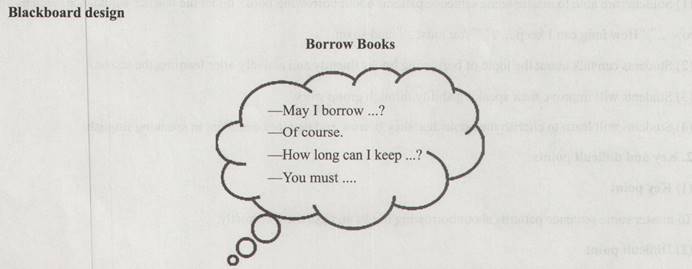
Borrow Books
1. Teaching aims
(I) Students are able to master some sentence patterns about borrowing books under the teacher's guidance, such as"May I borrow ..." "How long can I keep ... ?" "You must ..." and so on.
(2) Students can talk about the topic of borrowing books fluently and actively after learning the lesson.
(3) Students will improve their speaking ability through group work.
(4) Students will learn to cherish the books that they borrow and be more confident in speaking English.
2. Key and difficult points
(1) Key point
To master some sentence patterns about borrowing books and use them correctly.
(2) Difficult point
To improve the speaking ability through group work.
3. Teaching procedures
Step 1 Lead-in
(1) Show two video clips about two different ways of borrowing things and ask students to compare these two ways.
Invite some volunteers to share their ideas and tell students that the second video is better because it is more polite.
(2) Later, ask students to have a free talk about the two questions:
Q 1: What's the last thing that you borrowed recently?
Q2: Whom did you borrow it from?
Then introduce today's topic naturally.
Step 2 Presentation
(1) Read the dialogue for students and ask them to find out the main idea of the conversation. Check the answer with students:a dialogue about borrowing books.
(2) Make students listen to the dialogue again and figure out how Li Ming asks to borrow books, how the girl answers, and how long Li Ming can keep them. Explain the sentence patterns "--May I borrow ...? --Of course."
(3) Lead students to summarize the useful expressions in the dialogue about borrowing books.
Step 3 Practice
Ask students to practice the dialogue in pairs. After that, invite some pairs to perform in front of the class.
Step 4 Production
Set a situation that students need to borrow several books from the school library. Ask students to role-play in pairs. One acts as the student and the other acts as the librarian. They need to make their own conversations according to what they've
just learned. Lead students to notice the pronunciation and intonation. Ten minutes will be given to them. Walk around the classroom and offer some help when they need.
Step 5 Summary and homework Summary:Invite a student to lead the class to read the dialogue and review the sentence patterns. Remind students to take good care of the borrowed books and be polite when borrowing things from others.
Homework: Ask students to make up new dialogues about borrowing things and oractice it with their oartners or friends.
1.如何提高学生的口语能力?
How do you improve students' speaking ability?
2.口语课上,你如何给学生纠错?
How do you correct students' mistakes in a speaking class?
参考答案
暂无
答案解析
1.学生口语能力的提高不是一蹴而就的,需要老师和学生共同为之付出不懈努力才能实现。我认为可以从以下几个 方面提升学生的口语表达能力。
首先,在课堂上,老师应以学生为主体,多创设条件让学生开口说英语。除了口语课,在其他课型上老师也应组织交际性活动,让学生有机会锻炼口语。
其次,老师应关注全体学生,尤其是平时不敢开口说英语的学生。老师可以通过小组合作的形式,将任务具体分配到个人,保证每个学生都能有机会发言。
此外,学生在课后也不能放松对口语的学习。老师可以在班上成立英语角,让学生自由地用英语交流,也可以给学生提供更多的口语练习材料如音频和视频,让学生在家中模仿练习。
总之,我相信,只要老师付出耐心,坚持不懈,学生的口语能力一定能逐渐提高。
[ Suggested version ]
The improvement in students' speaking ability is not accomplished overnight, which requires unremitting efforts by both teachers and students. I think the following measures can help students improve their speaking ability.
First of all, in class, teachers should take students as the main body of the class and create chances for students to speak English as much as possible. In addition to speaking classes, teachers should also organize communicative activities in other types of class so that students can have opportunities to practice oral English.
Secondly, teachers should pay attention to the development of all students, especially those who are too shy to speak English.
Teachers can ask students to work in groups, and assign tasks to every member to make sure that each student has the chance to speak.
Besides, students should keep learning after school. Teachers can set up an English comer in the class so that the students can communicate freely in English. Teachers should also provide students with English audio or video materials to help them
imitate and practice at home.
In a word, I believe that as long as teachers are patient and persistent in doing so, students' speaking ability will be gradually improved.
2.学生在英语课堂上犯错误是难以避免的,及时纠正也是必要的。然而在口语课上,纠错方式会略有不同。
一方面,纠错时要注意措辞,避免因纠错影响学生学习的积极性。例如,老师不应直接对学生说“你的回答是错 的”或“你不可以这样回答”。相反,老师可以通过重复学生答案的方式让学生意识到不妥之处,使其自行改正。老师还可以给学生提供一种正确的表达,让学生在自己的表达和老师的表达之间做出选择。
另一方面,老师也可让其他学生帮助犯错的学生改正错误。
此外,老师应注意确保学生表达的完整性和流利性,不应在学生发言过程中打断并纠错。
总之,老师在口语课上纠错应以帮助学生提高口语表达能力为目的,不能过分纠错。
[ Suggested version ]
It is inevitable for students to make mistakes in English classes, and it is necessary to correct them in time.However, in the speaking class, the ways to correct mistakes are different.
On the one hand, the teacher should pay attention to his/her words when he/she corrects students' mistakes so as not to weaken their enthusiasm. For example, the teacher should not directly correct a student with "Your answer is wrong." or "You can't answer that way." Instead, the teacher can repeat the student's answer to make the student aware of the mistake and correct it by himself/herself. Or the teacher can provide the student with a correct expression and let the student choose
between his own expression and the teacher's expression.
On the other hand, the teacher can ask other students to help the student correct the mistake.
Besides, the teacher should ensure the entirety and fluency of students' expressions, and should not interrupt and correct mistakes when students speak.
In short, the teacher should correct mistakes with the purpose of helping students improve their oral English and speaking ability rather than overly focus on the mistakes themselves.