1.题目:语法教学试讲
2.内容:
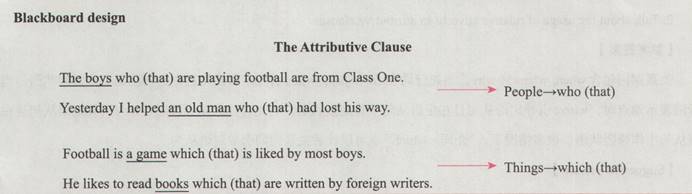
The boys who (that) are playing football are from Class One.
Yesterday I helped an old man who (that)had lost his way.
Football is a game which (that) is liked by most boys.
He likes to read books which (that) are written by foreign writers.
3.基本要求:
(1)配合教学内容适当板书。
(2)全英文授课,试讲时间10分钟。
(3)针对所给材料,设计运用该语法项目的教学活动。
The Attributive Clause
1. Teachin~aims
(1) Students will know the form and usage of attributive clauses led by "who, which, that" .
(2) Students can apply attributive clauses to daily communication.
(3) After this lesson, students will have a better understanding of the components of English sentences.
2. Key and difficult points
(1) Key point
The definition of attributive clauses and usage of relative pronouns.
(2) Difficult point
To use the attributive clause in speaking and writing.
3. Teaching procedures
Step 1 Lead-in
(1) Greetings.
(2) Enjoy the song She from the movie Notting Hill, and lead students to focus on the two sentences with attributive clauses:She may be the face I can't forget. She may be the song that summer sings.
Step 2 Presentation
(1) Show the four sentences on the blackboard and ask students to translate them into Chinese.
The boys who (that) are playing football are from Class One.
Yesterday I helped an old man who (that)had lost his way.
Football is a game which (that) is liked by most boys.
He likes to read books which (that) are written by foreign writers.
Invite some students to share their answers and introduce the attributive clause: An attributive clause is used to modify the preceding word or phrase (antecedent).
(2) Let students observe these sentences and summarize the usage of relative pronouns.
The rules are shown below.
In attributive clauses, we use"who" or "that" to refer to people.
In attributive clauses, "that"and "which" are used to refer to things.
Step 3 Practice
Ask students to combine some sentences with attributive clauses.
I don't like people. They smoke a lot.
Don't drink the water. It has not been boiled.
Step 4 Production
Divide them into groups of four and give them five minutes to discuss the impressive person who has made a great
influence on them. Try to use the attributive clause.
Step 5 Summary and homework
Summary: Ask several students to summarize the usage and function of the attributive clause.
Homework: After class, please search for more information about the attributive clause.
1.如何使你的课堂具有活力和交流感?
1. How do you make your class active and interactive?
2.请谈谈定语从句中关系副词的用法。
2. Talk about the usage of relative adverbs in attributive clauses.
参考答案
暂无
答案解析
1.充满活力和交流感的气氛是一堂课最基本的要求,英语课也不例外。我认为可以从以下几个方面来实现这一 目标。
首先,自身应该充满激情。老师的激情会提高学生的专注度,使他们对所学内容更加热情,进而会展现出更多的潜力。
其次,使师生交流有意义。应尽可能多地使用简短的句子并配合肢体语言向学生传达信息,使学生真正懂得老师的意图;寻找学生感兴趣的话题,提供不同的看待问题的角度,使学生有交流的欲望。
再次,组织多样的课堂活动。分组合作、竞赛、角色扮演、猜谜等活动能够吸引学生的注意力,引起学生的学习兴趣,活跃课堂氛围。
最后,为学生提问和回答问题创设舒适的氛围。对学生持宽容态度,给学生提供尝试、创造和犯错的机会。
“好…‘不错哦!”这样的夸赞不仅能使学生在课堂上积极表现,还能使他们在学习中产生成就感。
[ Suggested version ]
It is a basic requirement for a class to have an active and interactive atmosphere. English class is no exception. In my opinion, we can take the following measures to achieve the goal.
Firstly, be energetic. Teacher's passion can influence students, making them more concentrated and enthusiastic on what they'relearning, and then they will show more potential.
Secondly, make the communication between the teacher and students meaningful. Use short and simple sentences with body language, which enables students to understand more easily. Finding topics that students are interested in and providing different perspectives can arouse students' talking desire.
Thirdly, organize various class activities. Pair work, competitions, role-play, guessing games are all good choices. They can draw students' attention, raise students' interest and activate the class atmosphere.
Last but not least, create comfortable atmosphere for students to ask and answer questions. We should be generous and offer students opportunities to try, to create, and to make mistakes. Simple expressions like "Good!" and "Well done!" not
only make them active in class but also foster their sense of achievement in learninz.
2.关系副词包含when,where和why。当先行词表示时间时,when引导定语从句且在定语从句中作时间状语。当先 行词表示地点时,where引导定语从句且在定语从句中作地点状语。当先行词表示原因时,why引导定语从句且在定 语从句中作原因状语。很多情况下,“介词+which”也可以代替关系副词引导定语从句。
[ Suggested version ]
Relative adverbs consist of when, where and why. We often use the relative adverb "when" to lead attributive clauses after nouns meaning time, moment, day, season, year, etc. We often use the relative adverb "where" to lead attributive clauses
after nouns representing place, house,city, country, world, etc. We use the relative adverb "why" to lead attributive clauses after nouns meaning reason. "Where, when and why"often can be replaced by the structure "a preposition + which" in attributive clauses.