简答题
初中英语
题号 #6173860
设计任务:请阅读下面学生信息和语言素材,设计30分钟的英语口语教学方案。
教案没有固定格式,但须包含下列要点:
· teaching objectives
· teaching contents
· key and difficult points
· major steps and time allocation
· activities and justifications
教学时间:30分钟
学生概况:某城镇普通中学八年级(初中二年级)学生,班级人数40人。多数学生已经达到《义务教育英语课程标准》(2011年版)三级水平。学生课堂参与积极性一般。
语言素材:
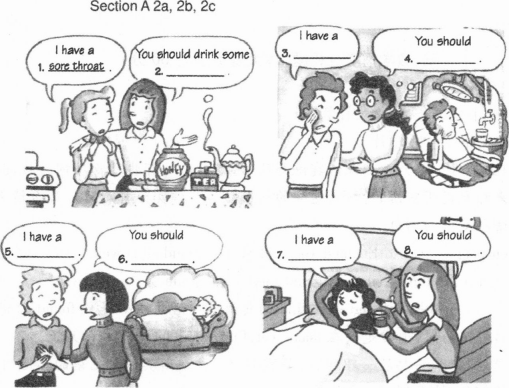
参考答案
暂无
答案解析
Teaching Objectives:
Knowledge objectives:
①Students can master the pronunciation,meaning and spelling of the names of diseases:fever,sore throat,sore back,stomachache,headache,toothache,cold,cough;
②Students can learn the expressions of giving advice:lie down and rest,drink hot tea with honey,see a dentist,take this medicine;
③Students can talk about health problems by using“What’s the matter?I have a…”and give advice by using“You should…You shouldn’t…”
Ability Objectives:
①Students can talk about one’s health problems and give advice fluently;
②Students can role play doctor and patient;
Emotion objectives:
①Students can improve the cooperative spirit through pair work and role playing;
②Students will care more about themselves and their family members’health.
Teaching Contents:
This is a lesson about asking people’s feelings.
Teaching Key Points:
①Master the names of diseases:fever,sore throat,sore back,stomachache,headache,toothache,cold,cough;
②Master the expressions of giving advice:lie down and rest,drink hot tea with honey, see a dentist,take this medicine ;
③Talk about health problems by using "What's the matter? I have a..." and give advice by using "You should... You shouldn't..."
Teaching Difficult Points:
①Remember all the target new words in the class;
②Give appropriate advice to the certain disease.
Teaching Procedures :
Step 1 Warming up (3 minutes)
Greet students by asking them:How are you today?
Then write the sentence" I'm not feeling well;today. "on the blackboard and guide students to read it and get students to guess the reason freely. If students can't get the answer, the teacher will tell them that she didn't have a good sleep last night and have a headache. (say this by doing a gesture)
(Justifications:Narrow the distance between students and the teacher, as well as easily lead in the teaching material. )
Step 2 Presentation (5 minutes)
(1) Show students a bandage and tell them there issomething wrong in the place where the bandagelies. Then get students to guess the health problems.
(2) Use body language to guide students to guessanother two names of diseases :cold, cough.
(3) Show students pictures of diseases half hidden,and get students to guess the names of diseases:fever, sore throat, toothache, sore back, cold, cough.
(Justification:Throughthemethodof showingbandage to students, students' attentionwill beattracted. The new words can be lead in naturally. )
Step 3 Pair-work (5 minutes,)
Put the bandage on the part of a student's body and ask:“What's the matter?”and guide him to use the pattern:I'm not feeling well.I have a... Then ask students to work in pairs and talk about health problems by using the bandage given and using the target language:What's the matter? I'm not feeling well. I have a...
(Justification:This activity can activate students'desire to join in it. Make more students want to speak English. )
Step 4 Presentation of expressions of giving advice( 5 minutes)
(1) Tell students that I have a cold/cough, ask them:What should I do? Students may give different answers, collect their answers and help them to use:You should/shouldn't do... Then showsome pictures of other diseases mentioned before and ask them to give advice to each problem by using target language:You should/shouldn't do... During this activity, some phrases will be learned:lie downand rest, drink hot tea with honey, see a dentist,drink lots of water, take some medicine.
(2) Show students two bags. In one bag, there are pieces of paper with problems while in the other one, there are pieces of paper with advice. Have acompetition between boys and girls. Take turns to get paper.
(Justification:Showing students the pictures about diseases to help them consolidate the new learned knowledge. )
Step 5 Production (8 minutes)
Ask students to make a four-people group, one ofthem is a doctor,the other three are patients. Ask the students to role play the dialogue above. Then ask several groups to perform before the class by usingsome tools :bandage, a uniform, a stethoscope. Ask other students to select the best doctor and the best patient.
(Justification:To create a real context to activate students interest in oral English and also a test of the new knowledge. )
Step 6 Summary and homework (4 minutes)
Summary:The teacher, together with students, uses the blackboard to do the summary.
Homework:Students work in groups to make up adialogue by imitating the given material after class and act it out the next class.
(Justification:This step can help the teacher check whether the students have mastered the language point of asking other people's feelings and also help students consolidate the knowledge they have learned. )
Board design :
New words and phrases:
fever, sore throat, sore back, stomachache, headache,toothache, cold, cough
drink hot tea with honey;lie down and rest;see a dentist ;take this medicine
--What's the matter?
--I have a...
--You should.../You shouldn't...
你可能感兴趣的试题
A.way
B. track
C.path
D.lane
A.for which
B. in which
C. in that
D.for that