简答题
高中英语
题号 #6181740
设计任务:请阅读下面学生信息和语言素材,设计一节英语阅读教学方案。
教案没有固定格式,但须包含下列要点:
·Teaching objectives
·Teaching contents
·Key and difficult points
·Major steps and time allocation
·Activities and justifications
教学时间:45分钟
学生概况:某城镇普通中学高中二年级学生,班级人数40人。多数学生已经达到《普通高中英语
课程标准》(实验)六级水平。学生课堂参与积极性一般。
语言素材:
A Master of Nonverbal Humour
As Victor Hugo once said, " Laughter is the sun that drives winter from the human face", and up to now nobody has been able to do this better than Charlie Chaplin. He brightened the lives of Americans and British through two world wars and the hard years in between. He made people laugh at a time when they felt depressed, so they could feel more content with their lives.
Not that Chariie's own life was easy! He was born in a poor family in 1889. His parents were both poor music hall performers. You may find it astonishing that Charlie was taught to sing as soon as he could speak and dance as soon as he could walk. Such training was common in acting families at this time, especially when the family income was often uncertain. Unfortunately his father died, leaving the family even worse off, so Charlie spent his childhood looking after his sick mother and his brother. By his teens, Charlie had, through his humour, become one of the most popular child actors in England.He could mime and act the fool doing ordinary everyday tasks. No one was ever bored watching him--his subtle acting made everything entertaining.
As time went by, he began making films. He grew more and more popular as his charming character, the little tramp, became known throughout the world.The tramp, a poor, homeless man with a moustache, wore large trousers, worn-out shoes and a small round black hat. He walked around stiffly carrying awalking stick. This character was a social failure but was loved for his optimism and determination to overcome all difficulties. He was the underdog who was kind even when others were unkind to him.
How did the little tramp make a sad situation entertaining? Here is an example from one of his most famous films, The Gold Rush. It is the end of the nineteenth century and gold has just been discovered in Alaska. Like so many others, the little tramp has rushed there in search of gold, but without success.Instead he and another man are hiding in a small hut during a snowstorm with nothing to eat. They are so hungry that the little tramp tries boiling one of his leather shoes for dinner.
Charlie cuts off the leather top of the shoe and shares the shoe with the other fellow. He tries cutting and chewing the bottom of the shoe as if it were the finest steak. Then he picks out the lace of the shoe and eats it as if it were spaghetti. He eats each mouthful with great enjoyment. The acting is so convincing that it makes you believe that it is one of the best meals he has ever tasted.
Charlie Chaplin wrote, directed and produced the films he starred in. In 1972 he was given a special Oscar for his outstanding work in films. He lived in England and the USA but spent his last years in Switzerland, where he was buried in 1977. He is loved and remembered as a great actor who could inspirepeople with great confidence.
参考答案
暂无
答案解析
Teaching objectives :
(1) Knowledge Objective: Students can get the knowledge about Charlie Chaplin's life experience through reading this passage.
(2) Ability Objective: Students can improve their reading ability by skimming or scanning this passage; Students can talk about some types of English humour and Chinese humour and then find their differences.
(3) Emotional Objective: Students can realize that humour is to let people be optimistic about everything around.
Teaching contents:This passage is an introduction about Charlie Chaplin who is a master of nonverbal burnout.
Teaching key points:
Students can understand this passage and know about Charlie Chaplin's nonverbal humour.
Teaching difficult points:
How to understand the differences between English and Chinese humours.
Teaching methods :
Using pictures ,group discussion ,reading and imitation.
Teaching procedures :
Step 1 Warming up(5 minutes)
Warm up by defining "Humour".
The teacher can ask students a question like,"What is ' Humour'? Does anyone of you know anything about Humour?" Then, the teacher will ask students to look at the screen and read the definition of
Humour from the Internet. (Definition omitted. )
After that, the teacher can lead students to enjoy a humourous story.
Whose job?
This is the story about four people named Everybody, Somebody, Anybody andNobody. There was an important job to be done,and Everybody was sure that somebody would do it. Anybody could have done it,but Nobody did it.
Somebody got angry about that because it was
Everybody's job. Everybody thought Anybody could do it, but Nobody realized that Everybody wouldn't do it. It ended up that Everybody blamed somebody when Nobody did what Anybody could have done.
(Justification:Stimulate students' curiosity about English humour and get students involved in talking about this topic. )
Step 2 Pre-reading( 10 minutes)
Before reading the passage, the teacher can ask students to think and present their opinions about the topic,"Telling the truth--what do you like to laugh at?" After students' presentation ,the teacher can tell students the story of The Emperor's New Clothes.
(Justification: Through discussing the topic of "Telling the truth--what do you like to laugh at?",students' curiosity about English humour can be activated further and they will be prepared for the reading part. )
Step 3 While-reading( 15 minutes)
(1) Reading aloud
The teacher can play the recording of the text and ask students to listen and read aloud. The students need to pay attention to the pronunciation of each word and pauses twice and then shall read aloud together twice, too.
(2) Reading and underlining
Next the students will be asked to read and underline all the useful expressions or collocations in the passage. And students should copy them to their notebook after class as homework.
(3) Reading to identify the topic sentence of each paragraph. Let students skim the text and identify the topic sentence of each paragraph. They may find it either at the beginning, the middle or the end of the paragraph.
(4) Reading and transferring information. Read the text again to complete the table.
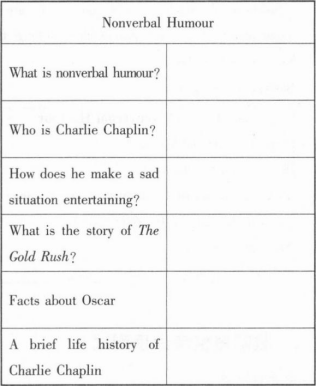
(5) Reading and understanding difficult sentences. As students have read the text several times, they can surely tell which sentences are difficult to understand.So the students can put forward their questions concerning the difficult points at this stage.
(Justification:Students' reading ability of getting the general ideas and locating the specific information can be trained and improved by skimming and scanning practice. )
Step 4 Post-reading( 10 minutes)
The teacher asks students to discuss the most humourous story which happened in: their daily lifein groups. After discussion the teacher asks them to recommend the most humourous story in each group, and let one student share the story with the whole class.
(Justification: Help the students have a better understanding of the topic of humour. )
Step 5 Summary and Homework(5 minutes)
Summary: To end the lesson by watching a silent humourous movie called Making a Living by Charlie Chaplin.
Homework: Do the comprehending exercises in the work book.
(Justification: Summary and homework are of importance for students to master the knowledge they have learned in class. )
Blackboard Design :
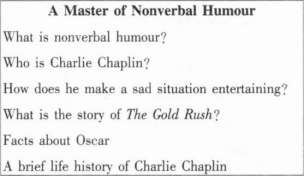
(1) Knowledge Objective: Students can get the knowledge about Charlie Chaplin's life experience through reading this passage.
(2) Ability Objective: Students can improve their reading ability by skimming or scanning this passage; Students can talk about some types of English humour and Chinese humour and then find their differences.
(3) Emotional Objective: Students can realize that humour is to let people be optimistic about everything around.
Teaching contents:This passage is an introduction about Charlie Chaplin who is a master of nonverbal burnout.
Teaching key points:
Students can understand this passage and know about Charlie Chaplin's nonverbal humour.
Teaching difficult points:
How to understand the differences between English and Chinese humours.
Teaching methods :
Using pictures ,group discussion ,reading and imitation.
Teaching procedures :
Step 1 Warming up(5 minutes)
Warm up by defining "Humour".
The teacher can ask students a question like,"What is ' Humour'? Does anyone of you know anything about Humour?" Then, the teacher will ask students to look at the screen and read the definition of
Humour from the Internet. (Definition omitted. )
After that, the teacher can lead students to enjoy a humourous story.
Whose job?
This is the story about four people named Everybody, Somebody, Anybody andNobody. There was an important job to be done,and Everybody was sure that somebody would do it. Anybody could have done it,but Nobody did it.
Somebody got angry about that because it was
Everybody's job. Everybody thought Anybody could do it, but Nobody realized that Everybody wouldn't do it. It ended up that Everybody blamed somebody when Nobody did what Anybody could have done.
(Justification:Stimulate students' curiosity about English humour and get students involved in talking about this topic. )
Step 2 Pre-reading( 10 minutes)
Before reading the passage, the teacher can ask students to think and present their opinions about the topic,"Telling the truth--what do you like to laugh at?" After students' presentation ,the teacher can tell students the story of The Emperor's New Clothes.
(Justification: Through discussing the topic of "Telling the truth--what do you like to laugh at?",students' curiosity about English humour can be activated further and they will be prepared for the reading part. )
Step 3 While-reading( 15 minutes)
(1) Reading aloud
The teacher can play the recording of the text and ask students to listen and read aloud. The students need to pay attention to the pronunciation of each word and pauses twice and then shall read aloud together twice, too.
(2) Reading and underlining
Next the students will be asked to read and underline all the useful expressions or collocations in the passage. And students should copy them to their notebook after class as homework.
(3) Reading to identify the topic sentence of each paragraph. Let students skim the text and identify the topic sentence of each paragraph. They may find it either at the beginning, the middle or the end of the paragraph.
(4) Reading and transferring information. Read the text again to complete the table.
(5) Reading and understanding difficult sentences. As students have read the text several times, they can surely tell which sentences are difficult to understand.So the students can put forward their questions concerning the difficult points at this stage.
(Justification:Students' reading ability of getting the general ideas and locating the specific information can be trained and improved by skimming and scanning practice. )
Step 4 Post-reading( 10 minutes)
The teacher asks students to discuss the most humourous story which happened in: their daily lifein groups. After discussion the teacher asks them to recommend the most humourous story in each group, and let one student share the story with the whole class.
(Justification: Help the students have a better understanding of the topic of humour. )
Step 5 Summary and Homework(5 minutes)
Summary: To end the lesson by watching a silent humourous movie called Making a Living by Charlie Chaplin.
Homework: Do the comprehending exercises in the work book.
(Justification: Summary and homework are of importance for students to master the knowledge they have learned in class. )
Blackboard Design :
你可能感兴趣的试题
1
Which of the following shows the proper pronunciation of the segment "did you" in connected speech?
A./dɪdʒu:/
A./dɪdʒu:/
B./dɪdju:/
B./dɪdju:/
C./di:dju:/
C./di:dju:/
D./dɪdjʊ/
D./dɪdjʊ/
A.manner of articulation
B.openness of mouth
C.place of articulation
D.voicing
A.bargain
A.bargain
B.discuss
B.discuss
C.calculate
C.calculate
D.quarrel
D.quarrel