简答题
题号 #6192408

Write an essay based on the chart below. In your writing.
you should
1) interpret the chart, and
2) give your comments
进入在线模考

参考答案

暂无

答案解析

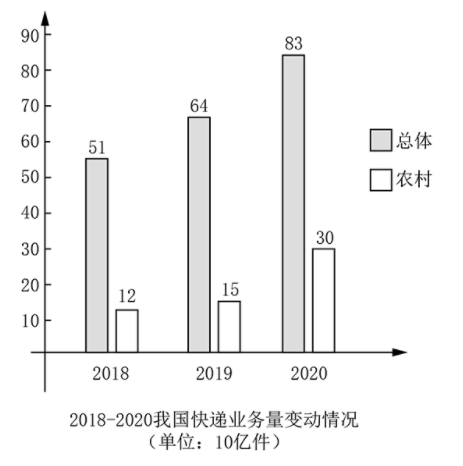
There is a bar chart illustrating remarkable changes have taken places with regard to the total and rural amount of China expressage from 2018 to 2020. The total number of China's expressage increased from 51 billion in 2018 then to about 83 billion in 2020, with its number of the rural area significantly jumping from about 12 billion to 30 billion in the same period.
Three reasons, in my belief, can account for this thend. Firstly, with the acceleration of the society and economy enormously boosting people's livelihood, the dramatic increase of expressage has inevitably turned out to be a prevailling trend. Moreover, the fast pace of modem life and fierce competition society result in people's gradually changed values, leading more and more people tend to put much emphasis on their convenience in order to save time and energy. Furthermore, relevant policies issued by the authorities and government advance the development of the China's expressage, especially in the rural areas.
From what has been analyzed above,we can confidently make a conclusion that this is the natural result of social and economic development, which complies with the interest of both the country and the people. Accordlingly, it can be predicted that with the collaboration of the government and individuals, people in mounting number prefer to purchase goods online delivered by the expressage which will ascends significantly both in total and rural area.

你可能感兴趣的试题

1 根据以下材料,回答题
  We know that greenhouse gas emissions can and do warm the planet, but we don’t know one very basic thing: how hot, exactly, is it going to get.9 The main reason for this, of course, is that human behavior is so hard to predict. How will the people of the late twenty-first century get their energy? Will they need as much as we do, or will they have reconciled themselves to fundamentally different lives?
  To some extent, we know why we don’t know. I have been sternly informed by communication experts that “global warming” is a better term for what’s happening than “climate change.” I have also been told the opposite. But the two are inseparable: they feedback upon each other. Rising temperatures change the planet, and these changes can speed up or, if we are very lucky, slow down the warming we’ve caused. However, we are not very lucky.
  To study the effects of these changes, we use something artificial but useful: the concept of climate “sensitivity.” In our climate models, we abruptly double atmospheric carbon dioxide from its preindustrial value of 280 parts per million, let the model Earth evolve for a few hundred years, and then measure the increase in its temperature. In the first generation of climate models, this varied from about a degree and a half Celsius to about four and a half degrees. The best guess was about three Celsius degrees. Decades of new science and advances in computing power later, and nothing about these estimates or their uncertainty have substantially changed.
  We don’t know everything, but we don’t know nothing. We have, after all, emitted carbon dioxide, and the planet has warmed in response. Our Earth is about a degree Celsius warmer than it was before the Industrial Revolution. This is dangerous, but not yet catastrophic, and some have suggested it might be indicative of a planet relatively insensitive to carbon dioxide. But the past is not the future, and we have good reason to believe that there are no analogues for the future into which we are hurtling. Right now, heat is being mixed into the deep ocean, which is cold and vast but not infinite. It will warm up in time, over hundreds or thousands of years, and the changes it will trigger may be different than any we have ever observed. Clouds may dissipate, ice will melt, and the warming will get worse.
  Uncertainty is no excuse for inaction. Even in the improbable event that climate sensitivity is very low, “business as usual” still warms the planet and leads to unpleasant consequences. In the event that climate sensitivity is high, “business as usual” means disaster.

What makes it difficult to exactly predict how hot our planet will be?
A.The solar system is always changing.
B.Current technologies are not advanced enough.
C.Energetic forms and amount are difficult to measure.
D.Global climate is always changing.
A.indifferent.
B.synergistic.
C.incoherent.
D.independent.
A.technical limitation influenced the prediction of climate change.
B.industrial revolution was the main cause of global warming.
C.the Earth’s temperature increased by around 3 degrees Celsius.
D.our planet may not be sensitive to the increase of emitted dioxide.
找试题 · 找答案 · 找资料 在线模考