简答题
题号 #6314204

Directions:
Write an essay based on the chart below.In your writing, you should
1 ) interpret the chart, and
2) give your comments.
You should write about 150 words on the ANSWER SHEET.( 15 points)
进入在线模考

参考答案

暂无

答案解析

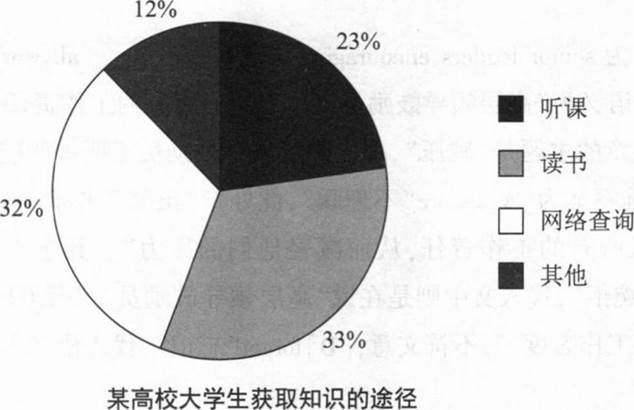
The chart shows the information about the ways of how university students acquire knowledge.Reading books ranked first with 33% of the participants, followed by searching the Internet (32%) andattending classes( 23% ).
  Researching and using materials to back up one's study is an essential aspect of studying andlearning.  Undoubtedly, academic textbooks remain the primary source of information when one isengaged in a formal study program. However, it should not be overlooked that the Internet has alreadybecome a main source of information in the internet age, especially regarding information relevant totechnology or current affairs. This is because the Internet allows people to learn information about anytopic and offers answers to any questions. Using a search engine like Baidu or Bing, users could askany question and find a web page with an answer to that question instantly.
  However, despite the above-mentioned benefits of the Internet, it is also recommended to bevigilant when using the Internet for academic research since the authorship, credibility, and authenticityof Internet documents are often difficult to establish.
 

你可能感兴趣的试题

1 根据以下材料,回答题
The livestock's outsize impacts have become more prominent in environmental  1  lately and forgood reason.Beef and dairy are  2  for more greenhouse gas emissions than any other food source bya long shot, largely  3  methane from cattle's digestion, emissions from manure, and the  4  ofcarbon-rich forest to pasture and cropland for animal feed.
While the development of meat and dairy  5  , such as plant-based meat, is helping shift dietsin rich countries, the world is still  6  more beef and milk every year.As emerging economies grow,we can expect their beef consumption to follow in  7   While this increase signals that more peopleare able to afford richer, more varied diets, it  8  grim prospects for the climate.But there's a  9story as well--one that is underappreciated and provides hope that livestock's impact can be reduced:the story of peak pasture.
In the past 20 years, something   10   has occurred, something few predicted: after severalcenturies of expansion, global pasture area has begun to  11  .According to the United Nations' mostrecent data, there are a  12  140 million fewer hectares of pasture than there were in 2000, an arearoughly the size of Peru. Because pasture is one of the largest   13   of deforestation in manyregions--and of the habitat loss and carbon  14  that follow--this is good news for the environment.
This positive trend has a strikingly simple explanation: rising   15   of pasture land andlivestock.Thanks to modern breeding efforts and more resource-efficient  16  , the world is producinga greater  17  of meat and milk than ever before, even as pasture area has shrunk.Average globalbeef production per cow, for instance, has grown about 30 percent since 1961, and land managersacross continents have begun growing specific grasses for cattle to eat that can   18   productionseveralfold.
Analogous to the green revolution of the 20th century that brought unprecedented levels of cropproductivity, it's fair to say that the world has undergone a "livestock revolution"--not the whole world,however.Most notably, productivity remains low in sub-Saharan Africa, where widespread overgrazing  19  the quality of grazing land. Rapid population and economic growth in the region,   20persistently low productivity, could augur a major re-expansion of global pasture.
 
A.precaution    
B.civilization    
C.preservation    
D.habitat
2  
A.artificial    
B.critical     
C.ceaseless    
D.responsible
3  
A.because of   
B.in order to    
C.in spite of    
D.available to
找试题 · 找答案 · 找资料 在线模考