Directions:
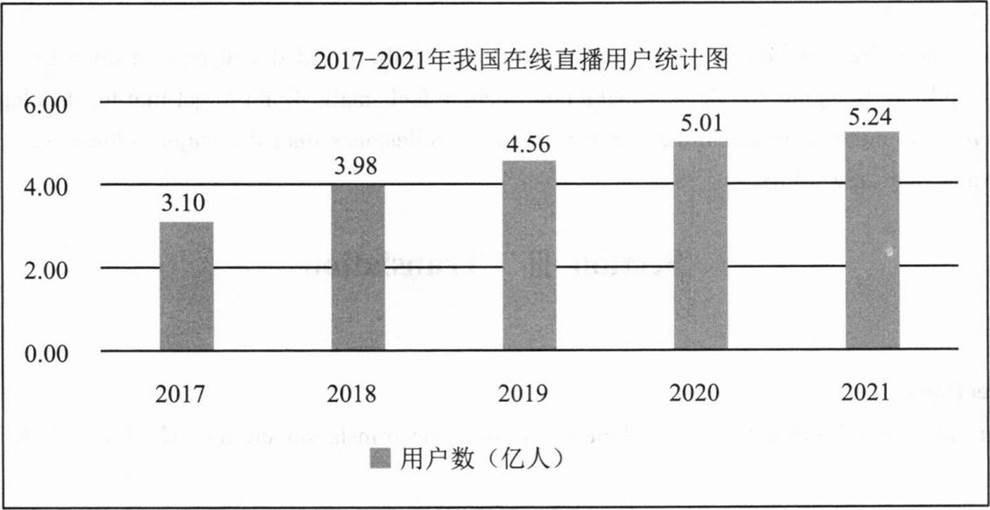
Write an essay based on the chart below.In your writing, you should
1 ) interpret the chart, and
2) give your comments.
You should write about 150 words on the ANSWER SHEET.(15 points)
参考答案
暂无
答案解析
范文
The chart above clearly demonstrates that an increasing number of people in China are getting in-volved in the livestream and webcast. The figure jumped from about 0.3 billion in 2017 to over 0.5 bil-lion in 2021, nearly doubled in the past 5 years.
It's of no difficulty for us to come up with some possible factors to account for this trend. First, withthe rapid development of the digital technology, companies from various industries have been drawingcustomers to certain websites and apps, changing their way of shopping, entertaining, learning, and liv-ing. Such media which provide us with easy access are so convenient that we now just can't live withoutthem. Not only the companies aiming at making money but also the customers expecting high -qualitygoods and services can benefit from them. Second, since the online business can generate huge profit,both celebrities and grassroots stars have all plunged into this emerging industry, which brings ever moresupporters and clicks.
Based on the analysis above, as an efficient and convenient way, the livestream and webcast willkeep thriving in the near future. All we need to do is to embrace the digital era and make the best of it.
参考译文
上图清晰地说明,近年来,越来越多的中国人开始参与到网络直播中来,人数从2017年的3亿左右猛增至2021年的5亿多,几乎增长了l倍。
对我们来说,提出一些可能的因素来解释这一趋势并不困难。首先,随着数字技术的快速发展,各行各业的公司都在吸引顾客使用特定的网站和app,改变他们的购物、娱乐、学习和生活方式。这些媒体为我们提供了访问的方便,它们是如此的便捷,以致于我们现在离不开它们。那些以赚钱为目标的公司与那些期待高质量产品和服务的顾客都能从中受益。其次,由于网络业务可以产生巨大的利润,名人和草根明星都投入了这个新兴的行业,带来了越来越多的支持者和点击量。
基于以上分析,网络直播作为一种高效便捷的方式,未来将会持续发展。我们所要做的就是,拥抱数字时代,充分利用它。
你可能感兴趣的试题
A.conflict
A.conflict
A.conflict
A.conflict
A.conflict
A.conflict
B.correlation
B.correlation
B.correlation
B.correlation
B.correlation
B.correlation
C.gap
C.gap
C.gap
C.gap
C.gap
C.gap
D.difference
D.difference
D.difference
D.difference
D.difference
D.difference
A.by
A.by
A.by
A.by
B.at
B.at
B.at
B.at
C.during
C.during
C.during
C.during
D.after
D.after
D.after
D.after
A.athletic
A.athletic
A.athletic
B.commercial
B.commercial
B.commercial
C.professional
C.professional
C.professional
D.academic
D.academic
D.academic