根据以下材料,回答题
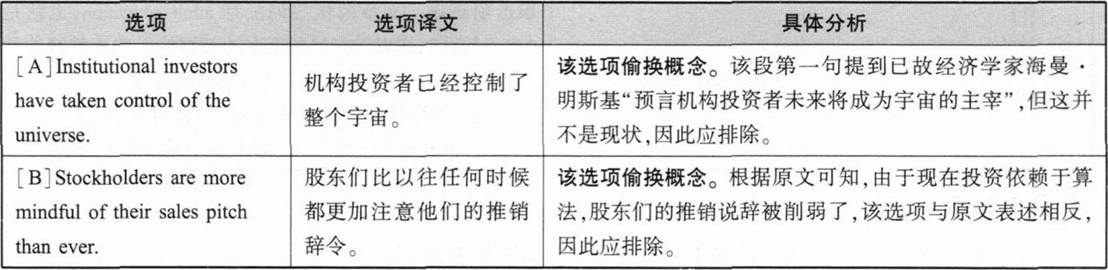
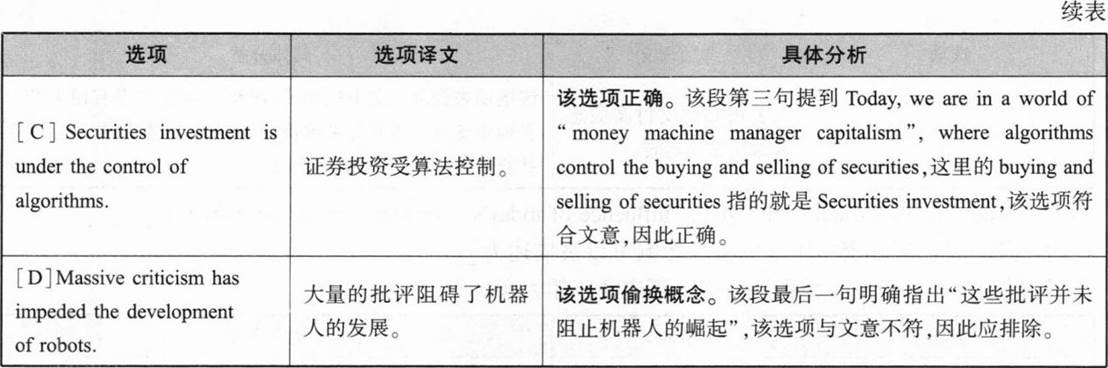
The late economist Hyman Minsky was a pioneer in understanding finance's grip on the US economy--and the consequences for society.In the 1980s, he predicted the rise of "money manager capitalism" andforesaw that institutional investors would become masters of the universe.Today, we are in a world of"money machine manager capitalism", where algorithms control the buying and selling of securities.Thosepaid to pick shares, mindful perhaps that their sales pitch was being undermined, claim such passive investingis very terrible.The rise of the robots has been undeterred by such criticism.
The pioneer of this approach is the US firm BlackRock, which is the world's largest asset manager andlast year became Britain's biggest one too.Humans still set the rules that computers follow.But artificialintelligence is blurring the distinction.Computers mn investment portfolios offering cheap "exchange-tradedfunds" that automatically track indices of shares and bonds.This has been so successful that the big three--US firms BlackRock, Vanguard and State Street--now manage $19 tn in assets, roughly a tenth of the world'squoted securities.
A report this week for Common Wealth, a thinktank, will show that the big three's average stake in FTSE100 companies almost doubled in the past decade to 12%, with traditional funds losing ground.BlackRockand Vanguard together now control 10% or more of two-thirds of FTSE 100 companies.In the US, the trio onaverage own a fifth of S&P 500 companies.There's more money in tracking the US S&P index, which hasrisen by about 150% post crash, than the FTSE, which is only up around 5%.
The big three hold a company's shares because an index they are tracking requires it, rather than toimprove--or green--a firm's performance.Firms such as BlackRock wield considerable shareholder-votingpower yet, as one analysis showed, they tend to "blindly" follow the recommendation of management toapprove excessive CEO pay packages.If they hold stakes in several big companies, some ask, why wouldthey promote competition between them? BlackRock says it will push boards to protect the environment, butoffers no meaningful consequences for those that do not.
Minsky worried that money manager capitalism would not produce investment sufficient to create fullemployment, nor be enough to generate substantial innovation.That remains the case: the state is largely thedriving force behind technological revolutions, and worker insecurity seems to be the flipside of passiveinvesting's coin.In Britain, using share ownership as a guide, BlackRock extracts about £ 5 bn in dividendsfrom its FTSE holdings, worth about £ 1,000 each to every worker employed, globally, in the UK's biggestcompanies.BlackRock's dominance could be its downfall.It may explain why the firm paid the former Torychancellor George Osborne £650,000 a year and lobbies against regulations that would curb its activities.
On the influential Notes on the Crises blog, Johannes Petry, Jan Fichtner and Eelke Heemskerk warnedlast year of a new era where "indices, not investors increasingly shape financial markets".In a paper, theacademics describe capitalism today as being in the grip of "new permanent universal owners" who investindefinitely in thousands of firms that are members of international stock indices and only divest when thecomposition of an index changes.The effects are globally transformative and disruptive.
The academics point out that within a week of announcing that Tesla would be included in the S&P 500index last December, its share price rose by 33%, as passive funds were forced to buy more than $70bn of itsstock.It made Elon Musk, briefly, the richest person in the world despite analysts saying his company wasovervalued.Markets are supposed to allocate capital efficiently.They plainly do not.Society is experiencinginequality and financial instability.Minsky contended that market behaviour had to be constrained to ensurethe "economic underpinnings of democracy".His advice seems truer today than ever.
According to Paragraph 1, what is happening in the American economic world?
参考答案
C
答案解析
文章来源:The Guardian,Mar.21 st,2021
原文标题:The Guardian View on Finance Failures:Manmade Errors Amplified by Machines
According to Paragraph l,what is happening in the American economic world?
根据第一段.美国的经济世界正在发生什么?
细节题。根据题干提示可定位于第一段。
原文标题:The Guardian View on Finance Failures:Manmade Errors Amplified by Machines
According to Paragraph l,what is happening in the American economic world?
根据第一段.美国的经济世界正在发生什么?
细节题。根据题干提示可定位于第一段。
你可能感兴趣的试题
A.BlackRock did not become the biggest asset manager of the world until last year.
B.Artificial intelligence makes the distinction between humans and computers vague.
C.The approach of computers running investment portfolios is a worldwide success.
D.The big three now manages a tenth of the world's quoted securities respectively.
A.It cannot generate investment to create enough jobs or essential innovation.
B.The state would remain the driving force behind technological revolutions.
C.Passive investing would cause and exacerbate workers' sense of insecurity.
D.Big companies would have to pay out high dividends to keep the company running.
A.transformative and subversive
B.evolutionary and disruptive
C.transformational and devastating
D.revolutionary and destructive