根据以下材料,回答题
Almost all the world's countries have agreed on a deal aimed at restricting shipments of hard-to-recycleplastic waste to poorer countries, the United Nations announced on Friday.Exporting countries--including theUS--now will have to obtain consent from countries receiving contaminated, mixed or unrecyclable plasticwaste.Currently, the US and other countries can send lower-quality plastic waste to private entities indeveloping countries without getting approval from their governments.
Since China stopped accepting recycling from the US, activists say they have observed plastic wastepiling up in developing countries.The Global Alliance for Incinerator Alternatives (Gaia), a backer of thedeal, says it found villages in Indonesia, Thailand and Malaysia that had "tumed into dumpsites over thecourse of a year"."We were finding that there was waste from the US that was just piled up in villagesthroughout these countries that had once been primarily agricultural communities, " said Claire Arkin, aspokeswoman for Gaia.
The legally binding framework emerged at the end of a two-week meeting of UN-backed conventions onplastic waste and toxic, hazardous chemicals that threaten the planet's seas and creatures.The pact comes in anamendment to the Basel convention.The US is not a party to that convention so it did not have a vote, butattendees at the meeting said the country argued against the change, saying officials didn't understand therepercussions it would have on the plastic waste trade.
Plastic debris clutters pristine land, floats in huge masses in oceans and entangles and endangers wildlife.Less valuable and harder to recycle plastic is likely to end up discarded rather than turned into new products.The deal affects products used in a broad array of industries, such as healthcare, technology, aerospace,fashion and food and beverages.
Rolph Payet of the United Nations Environment Program called the agreement--signed by 187countries in Geneva, Switzerland, under the convention--" historic", because countries will have tomonitor where plastic waste goes when it leaves their borders.Payet said the negotiations, which began11 days ago and brought together 1,400 delegates, had gone much further than anticipated.The Baselconvention sets rules for first-world countries shipping hazardous waste to less wealthy nations.Backerssay the amendment will make the global trade in plastic waste more transparent and better regulated,protecting humans and the environment.
Officials attributed the progress partly to growing public awareness--reinforced by documentary filmsby the British naturalist Sir David Attenborough and others--of the dangers of plastic pollution, especially tomarine life.
Von Hernandez, global coordinator for Break Free from Plastic, said the deal is "a crucial first steptowards stopping the use of developing countries as a dumping ground for the world's plastic waste, especiallythose coming from rich nations".
Marco Lambertini, director general of the environmental and wildlife charity WWF International, said theaccord is a welcome step and that for too long wealthy countries have abdicated responsibility for enormousquantities of plastic waste."However, it only goes part of the way.What we--and the planet--need is acomprehensive treaty to tackle the global plastic crisis, "Lambertini added.
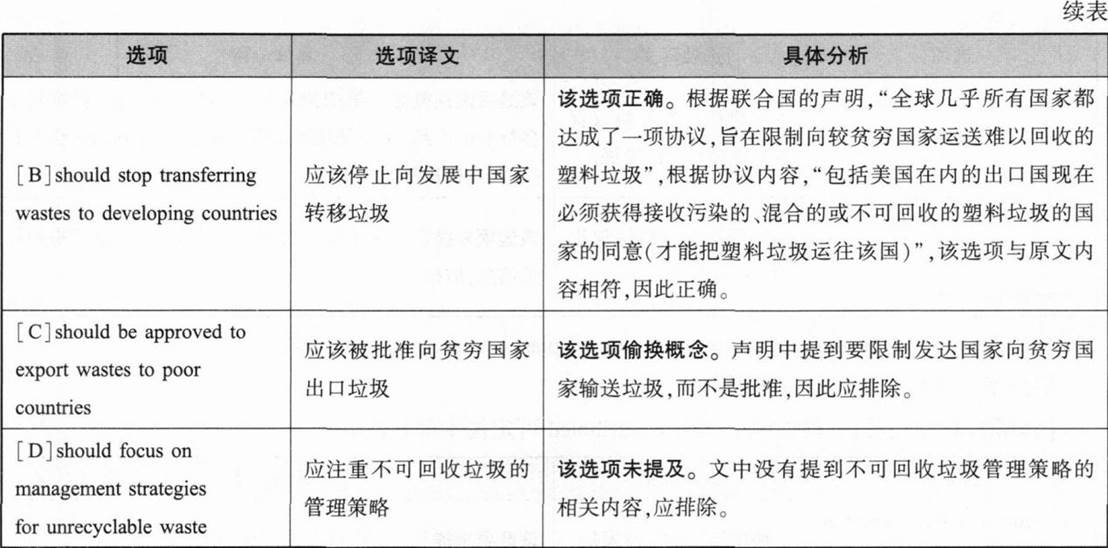
According to the United Nations' announcement in Paragraph 1, developed countries_______.
参考答案
B
答案解析
文章来源:The Guardian,May loth,2019
原文标题:Nearly All Countries Agree to Stem Flow of Plastic Waste Into Poor Nations
According to the United Nations’announcement in Paragraph l,developed countries_______.
根据第一段中联合国的声明,发达国家_______。
细节题。根据题干关键词United Nations’announcement可定位于第一段。

原文标题:Nearly All Countries Agree to Stem Flow of Plastic Waste Into Poor Nations
According to the United Nations’announcement in Paragraph l,developed countries_______.
根据第一段中联合国的声明,发达国家_______。
细节题。根据题干关键词United Nations’announcement可定位于第一段。
你可能感兴趣的试题
A.Supportive.
B.Opposed.
C.Indifferent.
D.Sympathetic.
A.Plastic waste poses great threat to the wild animals.
B.Plastic waste can be converted to useful products.
C.The deal about plastic waste has promoted many industries.
D.The deal about plastic waste has influenced international trade.
A.economic development in developing countries
B.close cooperation among different countries
C.pressure on the U.S.from different countries
D.people's growing awareness of the harm of plastic waste