单选题
题号 #6335787

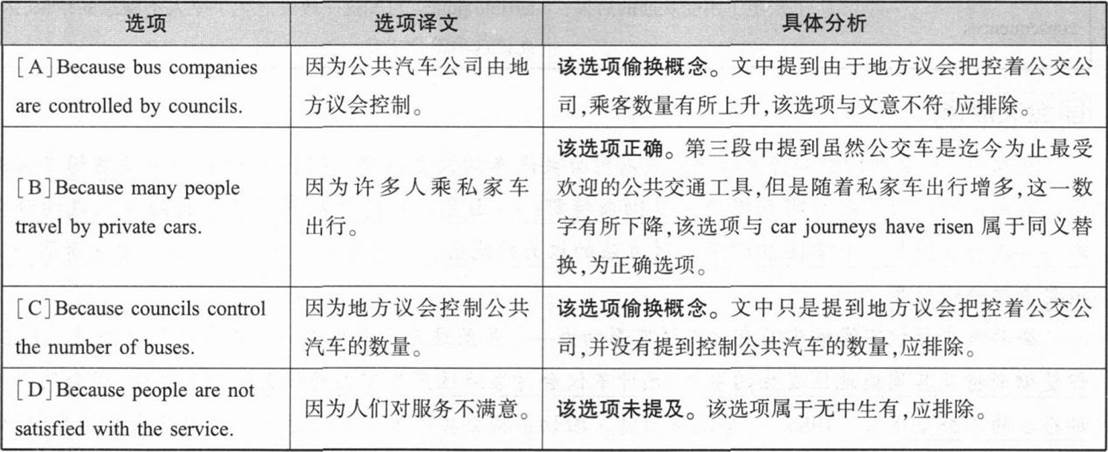
According to Paragraph 3, why does the number of bus riders decline?

进入在线模考

参考答案

B

答案解析

According to Paragraph 3,why does the number of bus riders decline?
  根据第三段,为什么乘公共汽车的人数减少了?
细节题。根据题干提示可定位于第三段。
你可能感兴趣的试题

A.All the people will take buses for free.
B.Public transportation forms a network.
C.More public transportation is provided.
D.Public transport is painted the same color.
A.is a preferred option in Greater London
B.has increased geographical disparity
C.is a desirable carbon neutral policy
D.has produced unpopular consequences
3 根据以下材料,回答题
As Britain warily exits lockdown, the post-pandemic challenges that the country faces are looming large.On Tuesday, a study by the Resolution Foundation thinktank outlined some of them, including reaching netzero carbon emissions by 2050 and managing the transition to automation in parts of the economy.The reportalso highlighted a new social divide, one that emerged in the context of Covid and is likely, in some form, toremain when the pandemic is behind us.In 2019, only 5% of employees worked mainly from home, but thatnumber grew to almost 50% during the first and third lockdowns.Remote working has become particularlyprevalent among the higher-paid and higher-educated, as a substantial part of the knowledge economysuccessfully migrates to affluent suburbs in London and elsewhere.Figures released by the Office for NationalStatistics this week reveal that 70% of all staff in Richmond upon Thames worked from home at some pointduring the pandemic.The equivalent figure in Burnley was less than 14%.
The implications of this shift, and its social composition, need to be thought through.For millions ofmostly better-off citizens able to work from home, a hybrid working week--part-home, part-office--seemslikely in the future.This will have a sizeable impact on the country's economic geography.The Nationwidebuilding society and Santander UK, for example, have already announced the closure of swathes of urbanoffice space.Nationwide has advised 13,000 staff that they are free to work at home from anywhere in thecountry.HSBC intends to cut office space, but require its staff to come in for part of the week.As otherbusinesses follow suit, and the shift to online shopping continues, the decline of high streets and urban centresmay accelerate.Providers of local goods and services, stranded in the physical economy, may struggle andmay be forced to relocate.Places and individuals that could be losers in this process must be properlysupported and provided with meaningful options and assistance.
For businesses, the main advantage of staying wholly or partly on Zoom is obvious: in one recent survey,88% of organisations said that they made real-estate savings in 2020 through remote working; 92% expectedfurther cost reductions in the next two to three years.For employees, the picture is more complicated.The lossof a stressful daily commute has certainly not been mourned.But as a short-term novelty has turned into thenew normal, there has been evidence of a sense of social disconnection, burnout and falling morale.
Matthew Taylor, the author of a 2017 government review on work, warned this month that a high levelof working from home risked creating "highly atomiged workforces", lacking the kind of solidarity andmutual support that should be part of a good working experience.Andy Haldane, the Bank of England'soutgoing chief economist, has suggested that an online working world can become a long-term drain oncreativity and collaboration.For young people starting out in their careers, the physical workplace providescrucial opportunities to bond with colleagues and get the feel of an organisation.
In some form, working from home is set to remain part of millions of people's lives.But there must becareful thinking on how to mitigate its downsides, both for those in the virtual working world and those tryingto make a living outside it.
What does "a new social divide" (Para.]) refer to?
A.The income gap among people with different jobs.
B.The challenges people face in different occupations.
C.The rate of remote working across different income groups.
D.The unemployment rate of suburb and downtown.
找试题 · 找答案 · 找资料 在线模考