根据以下材料,回答题
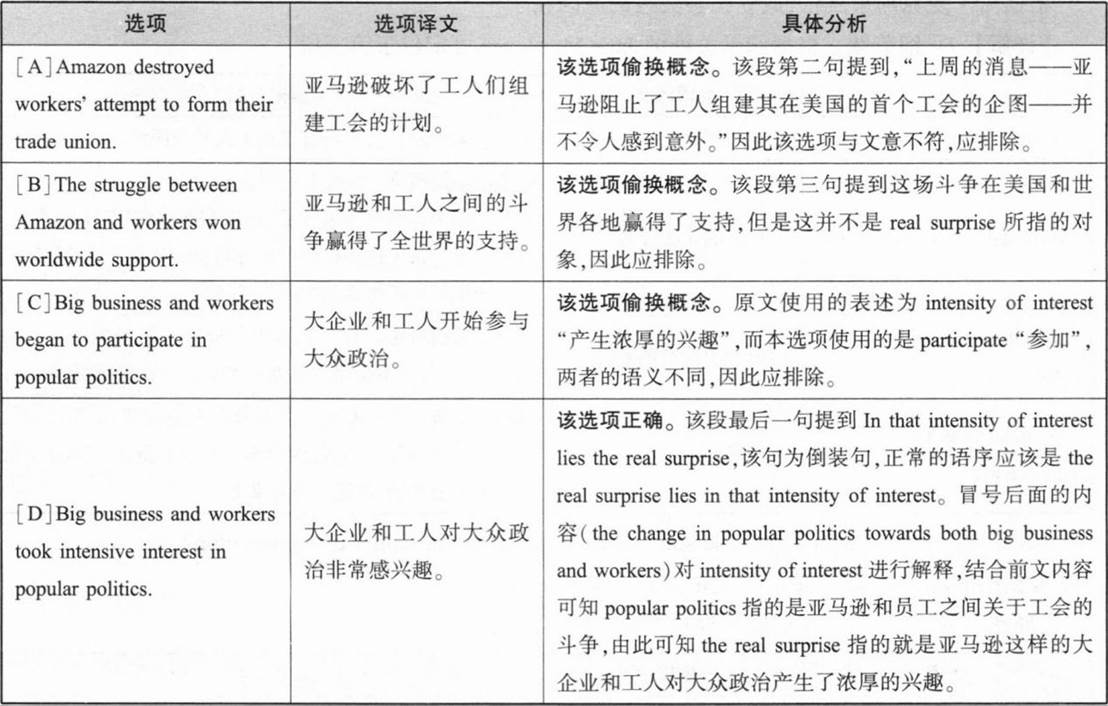
Goliath beats David isn't half as good a story, but it is the usual way of the world.So last week'snews that Amazon has fended off an attempt by workers to form its first ever US trade union isunsurprising, if sad.What intrigues is the volume and variety of support that the struggle won across theUS and the world, from faith leaders to the NFL players association to Republican ever-hopefuls such asMarco Rubio.In that intensity of interest lies the real surprise: the change in popular politics towardsboth big business and workers.
As battles go, it was always ridiculously lopsided.In one comer you had the world's richest man sittingatop corporate America's second-largest employer, in perhaps the most anti-union country in the rich world.Opposing him were workers and activists in Alabama, one of the most conservative of all US states, tryingsomething never attempted before in the land of the flee: to unionise an entire Amazon warehouse, thosehangars full of consumer goods and crushing conditions for workers that together define our way of life.Nowonder Jeff Bezos won last week, with workers at the Bessemer warehouse voting more than two to oneagainst forming a union.That result allows Amazon to continue hiring and firing at will.It also brings to ahalt perhaps the most watched union drive in the US in years.The future of industrial relations inside a giantwarehouse in the Deep South became a subject of debate across Europe, so vast is Amazon's empire.
Just why the defeat was so large is a question that has prompted much soul-searching among Americanprogressives, with some blaming poor strategic choices by the activists and the Retail, Wholesale andDepartment Store Union claiming Amazon pursued "egregious and illegal" anti-union tactics, allegations thatthe company denies.But perhaps the fairest assessment is that from the longstanding labour writer and activistJane McAlevey: "If the rules for unionization in the US came close to being fair, they E pro-union workers 1would have won.But the rules aren't fair.Quite the opposite: they are outrageously unfair."
But there are two hopeful lessons that America and the rest of the world can take from this story ofdisappointment.First, it is now convention to argue that societies need strong unions.Last month, Joe Bidengave that message in a video address.Researchers at the International Monetary Fund have long pointed outthe links between inequality and financial crises, and argued that "restoration of the lower income group'sbargaining power is more effective" than a crash in righting a giant wealth gap.In that battle between thebillionaire Mr Bezos and the Alabama workers, it's clear who those IMF researchers would have rooted for.
Second, the excitement around that Alabama ballot shows how far sentiment in the capitalist heartland ismoving against big business and towards labour.Opinion polls suggest American public approval for tradeunions is the highest it has been in almost 20 years, at 65%.This is not a shift in mood that has been led byMr Biden; rather, the president is being compelled to channel it, often under the tutelage of politicians andadvisers further to the left.This is a very different kind of politics than seen in the era of Barack Obama.Where it goes next will be worth watching.
According to Paragraph 1, what is the real surprise?
参考答案
D
答案解析
文章来源:The Guardian,Apr.14th,2021
原文标题:The Guardian View on Amazon and Unions:an Unfair Fight,but Not Yet Over
According to Paragraph l,what is the real surprise?
根据第一段,真正让人感到意外的是什么?
细节题。根据题干提示可定位于第一段:
原文标题:The Guardian View on Amazon and Unions:an Unfair Fight,but Not Yet Over
According to Paragraph l,what is the real surprise?
根据第一段,真正让人感到意外的是什么?
细节题。根据题干提示可定位于第一段:
你可能感兴趣的试题
A.Workers are not allowed to form trade union in America.
B.Amazon's leaders encourage workers to form trade union.
C.The warehouse workers complained about the bad work conditions.
D.The plan to unionize the entire warehouse workers failed.
A.disunity of the workers
B.illegal tricks of Amazon
C.bad strategy of the activists
D.unfair rules for unionization
A.Trade union becomes increasingly essential in the society.
B.IMF still supports the economically advantageous side.
C.Economic inequality will eventually lead to financial crisis.
D.Narrowing the wealth gap is a top priority of the government.