根据以下材料,回答题
Congress is delving into data privacy at last.The House held a hearing on the subject Tuesday, and theSenate follows Wednesday.Testimony from industry groups and advocates previewed plenty of buzzy topicsthat legislators are likely to probe, from discriminatory pricing to limits on processing certain types of data.But lawmakers are split most starkly over preemption, or the question of whether a federal law shouldsupersede state statutes.That may sound like a technicality, but it is highly consequential.
Those who favor Congress overriding, or preempting, state standards claim that local protection regimescreate a "patchwork" too complicated for companies to comply with.Tech companies want a harmonizedapproach to privacy across the United States, like the European Union has tried to achieve with its GeneralData Protection Regulation.Republicans on the Hill so far seem inclined to agree.Privacy advocates counterthat the push for preemption is a cynical ploy to neuter stricter rules, such as those in the California ConsumerProtection Act, signed into law last summer.Supporters of that legislation believe its protections will trickleacross the country, much as California's heightened auto-emissions standards have led to more eco-friendlycars nationwide.
There's a plausible case for preemption.Grappling with varying data-govemance regimes is differentfrom grappling with varying building codes, because data necessarily travels across borders.For companies,the alternative to navigating this conundrum is to identify the strictest set of rules (say, California's) and applythem everywhere.But there is a philosophical argument to be made against allowing a single state todetermine the experience of consumers across the country.There are practical hurdles, too: Privacy law ismore complicated than auto emissions.Rules from one state could conflict with another's, and determiningwhich is "strictest" is not as easy as it may sound.
Still, an anemic federal privacy regime that undoes robust state efforts without offering a viablealternative would leave everyone worse off.A better idea, if Congress can agree only on weak rules, would beto set a baseline that states can improve on.After all, the argument for such a scheme would go, technologymoves fast, Congress historically does not, and states might prove more nimble.Experimentation at the locallevel sometimes inspires smarter policy on Capitol Hill.
Preemption so far has been treated as an all-or-nothing proposition.It doesn't have to be.Congress couldset overriding federal rules in some areas of privacy regulation and allow states more leeway in others.Legislators could also ensure that preemption clauses in any bill sunset after a certain number of years, soCongress could assess whether federal regulation has succeeded and whether technological advances requirenew protections.There is more opportunity for harmony on the Hill than the conversation so far has allowed.
According to Paragraph 1, on what issue do lawmakers fight the most?
参考答案
D
答案解析
文章来源:The Washington Post,Feb.26th。2019
原文标题:Should Congress Override State Privacy Rules?Not So Fast.
According to Paragraph l.on what issue do lawmakers fight the most?
根据第一段,立法者在什么问题上分歧最大?
细节题。根据题干提示可定位于第一段。
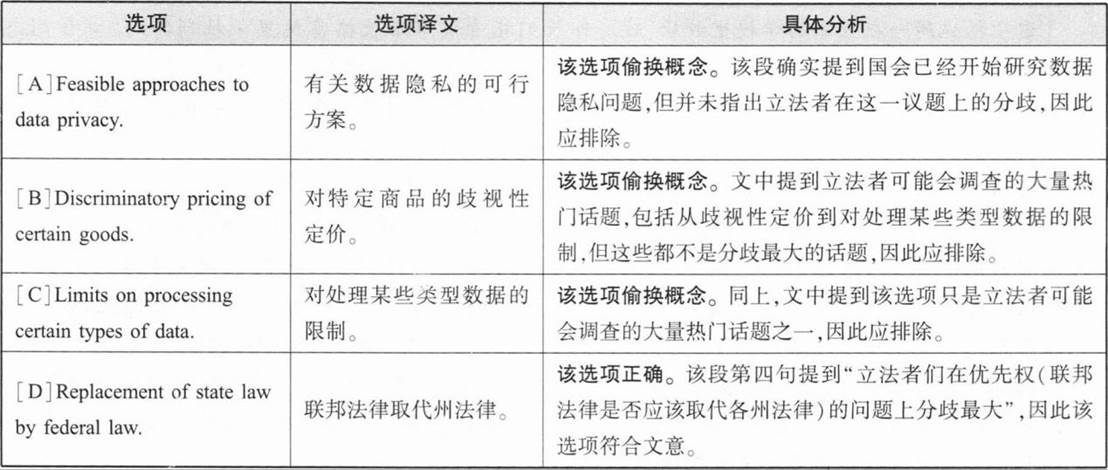
原文标题:Should Congress Override State Privacy Rules?Not So Fast.
According to Paragraph l.on what issue do lawmakers fight the most?
根据第一段,立法者在什么问题上分歧最大?
细节题。根据题干提示可定位于第一段。
你可能感兴趣的试题
A.uniform rules are needed to deal with privacy issues in the US
B.tech companies should find their own way to privacy issues
C.it's too complicated to seek a harmonized approach to privacy
D.the promotion of preemption can weaken strict regulations
2
In Paragraph 3, by mentioning data-governance regimes and building codes, the author aims to_______.
A.illustrate the differences between them
B.emphasize the difficulties of processing data privacy
C.explain the great difficulties of realizing preemption
D.stress the importance and necessity of preemption
A.States settle down more flexible rules.
B.States make their own rules based on the baseline.
C.Congress makes the strictest rules and applys them everywhere.
D.Experimentation at the local level inspires Congress to make smarter rules.